


Andrew Wakefield’s 1998 Lancet paper didn’t show a link between Autism and Measles Vaccine
On November 17, 2026, the United States officially lost its measles elimination status. In one generation, we lost that designation. The United States went from having eliminated measles as an ongoing infection to where it is now here. Like the constant fire in the Peat of Scotland, it is raging beneath the surface.
Public health worked hard to extinguish this threat. Measles isn’t just a rash and a fever. With 3–4 million infections annually before vaccination, with 48,000 hospitalizations, 400–500 deaths and 1,000 cases of encephalitis. In a public health triumph, we had over 95% vaccination. This meant that if the occasional world traveler came to the US with measles, the measles would not be able to take hold in the community.
Why did one of the greatest triumphs in public health get lost in a generation? Much of it can be traced to the Wakefield paper published February 28, 1998 in the journal, The Lancet.
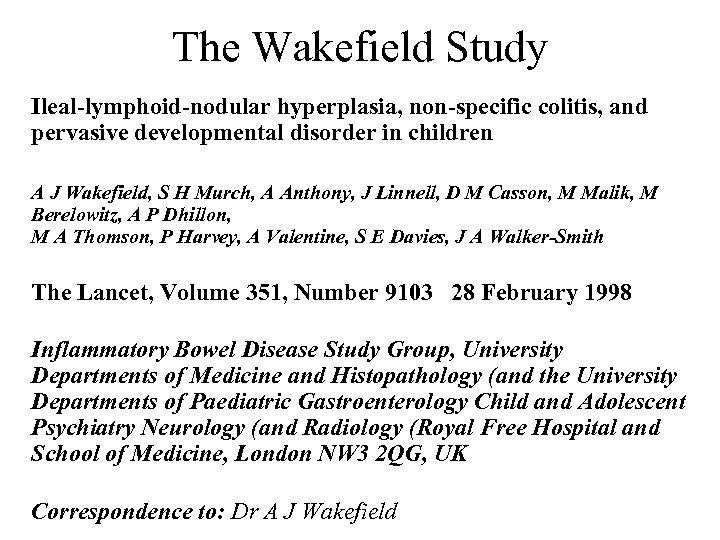
Wakefield’s paper became the basis for the claim that measles vaccination causes autism. Antivaxers post screenshots, quote its conclusions, and tell parents that doctors have ignored evidence linking vaccination to autism. Mention the paper was retracted, the anti-vax group will claim medical censorship.
But if you read the paper, you will find it does not say what most anti-vaccine folks claim. What is even worse is that when the paper was investigated, it was fraudulent.
Here is the original paper. Read it if you like.
Wakefield AJ et al. The Lancet, February 28, 1998. PMID: 9500320.
The DOI is 10.1016/S0140-6736(97)11096-0.
The paper was fully retracted, but remains available. So lets go with the issues in the paper.
It involved twelve children.
Twelve. Not 1000, nor 100, but twelve children. Wakefield’s paper described children with gastrointestinal symptoms and developmental disorders. Eight families reportedly associated the onset of behavioral symptoms with the MMR vaccine.
Small studies can certainly have major impacts in medicine. James Lind’s scurvy trial in 1747 involved a dozen men. Lind divided 12 sailors with scurvy into six pairs. The two sailors given oranges and lemons recovered rapidly from scurvy.
To show that bacteria caused ulcers and not stress, Australian physician Barry Marshall drank a broth containing Helicobacter pylori bacteria. He developed severe gastritis within days and cured himself with antibiotics.
A small study can be impactful if reproduced. Lind’s experiment was. British sailors began to carry lime juice, and the Brit’s Navymen are still called Limies.
After Marshall drank the broth, universities everywhere began to show that the bacteria caused ulcers.
The ability to reproduce results is key to research. Wakefield’s study has never been reproduced. But even more striking, the paper didn’t demonstrate the association between MMR and autism.
The paper does not demonstrate that MMR caused autism.
Parents of eight of the twelve children reported their autistic symptoms began around the time they received the vaccine. One parent associated the onset with measles infection, and another with otitis media.
The average interval between vaccination and onset of behavioral symptoms was 6.3 days, and up to fourteen days. Notice the wording: the association was reported by the parents.
That’s it. If it were a paper establishing the autism from MMR, it would have a control group. But it didn’t, this paper did not establish causation. The paper did not even measure whether vaccinated children developed autism more often than unvaccinated children.
What happened when investigators examined the medical records?
This is where the story becomes considerably more troubling.
Investigative journalist Brian Deer examined the original medical records and compared them with what was reported in the Lancet paper.
His findings, published in the British Medical Journal in 2011, identified several lies in Wakefield’s publication.
The children were not developmentally normal before the vaccine.
Wakefield’s paper described a history of normal development, followed by loss of acquired skills after vaccination. Deer’s examination of the records identified five children with documented developmental concerns before vaccination.
The made up autism diagnoses
Wakefield reported nine children had regressive autism. Deer found three did not have an autism diagnosis anywhere in their medical record. Only one patient met the description of regressive autism.
The recruitment process was cherry picked
Deer’s investigation found that subjects in Wakefield’s paper were carefully cherry picked by anti-vaccine campaigners.
What did the authors eventually say?
In 2004, ten of the thirteen authors published a statement in The Lancet retracting the interpretation that the paper had established a possible causal relationship between MMR vaccination and autism.
They made it clear that no causal link had been established and that the data were insufficient.
Wakefield’s Dishonesty
The 2010 General Medical Council found Andrew Wakefield guilty of professional misconduct, including dishonesty and irresponsible conduct in relation to his research. He was removed from the UK medical register, meaning he could no longer work as a physician in the United Kingdom.
The Lancet subsequently retracted Wakefield’s 1998 paper.
But before the dishonesty was shown, researchers designed studies to see if there was a link between autism and the MMR vaccine. This is what science does, we test. If there was a link, they would find it.
In 2002, a Danish population-based cohort study published in the New England Journal of Medicine examined 537,303 children. Of those, 440,655 had received MMR vaccination. The researchers found no increased risk of autism among vaccinated children.
More and more studies designed to show any link were reported. Finally, researchers published a meta-analysis in 2014 examining the relationship between vaccination and autism. It included five cohort studies involving 1,256,407 children and five case-control studies involving 9,920 children.
The analysis found no relationship between vaccination and autism, especially no association with MMR vaccination.
The lesson
There is something important here for everyone who values science. Read the original research, the primary sources.
Science is a process, we call it the scientific method. We used to teach it in grade school. Based on an observation or notion, we develop hypotheses. We then design experiments to test that hypothesis. It is often not easy, as we collect data. What is harder is when we have to challenge our assumptions. No one likes to be proven wrong is a wonderful thing, because it shows mother nature has a more elegant model for us to discover.
The Wakefield paper was originally treated by physicians and scientists as a small case series that required investigation. But for some members of the public, it was proof of their anti-vaccination views. When the evidence failed to support the hypothesis, the controversy did not disappear. Conspiracy theorists and anti-vaccine people everywhere denied the overwhelming research disproving Wakefield’s paper. Wakefield became a public disgrace in the medical community and became a martyr among the anti-vaccine crowd. The public should have been outraged when investigators demonstrated that important elements of the published account did not match the original medical records, and the GMC found Wakefield guilty of dishonesty.
Read the paper. Examine the methods. Look at the data. Then compare it with the subsequent research.
We spent decades eliminating measles from the United States. We now have to do the work of eliminating it again. We cannot undo 1998. We cannot recover the years spent arguing over a hypothesis that failed scientific scrutiny.
Will measles become a disease our children read about in history books, or will it again become a regular threat to infants, the elderly, and people with compromised immune systems?
For those wanting the original references: References — Wakefield, MMR and Autism
1. Wakefield AJ, Murch SH, Anthony A, et al. (1998). Ileal-lymphoid-nodular hyperplasia, non-specific colitis, and pervasive developmental disorder in children. The Lancet. 351(9103):637–641.
DOI: https://doi.org/10.1016/S0140-6736(97)11096-0
Original paper — PubMed
Retracted
2. Murch SH, Anthony A, Casson DH, et al. (2004). Retraction of an interpretation. The Lancet. 363(9411):750.
DOI: https://doi.org/10.1016/S0140-6736(04)15715-2
PubMed
3. The Lancet Editors (2010). Retraction—Ileal-lymphoid-nodular hyperplasia, non-specific colitis, and pervasive developmental disorder in children. The Lancet. 375(9713):445.
DOI: https://doi.org/10.1016/S0140-6736(10)60175-4
Retraction record
4. Deer B. (2011). How the case against the MMR vaccine was fixed. BMJ. 342:c5347.
DOI: https://doi.org/10.1136/bmj.c5347
Full article
5. Madsen KM, Hviid A, Vestergaard M, et al. (2002). A population-based study of measles, mumps, and rubella vaccination and autism. New England Journal of Medicine. 347:1477–1482.
DOI: https://doi.org/10.1056/NEJMoa021134
PubMed
6. Taylor LE, Swerdfeger AL, Eslick GD. (2014). Vaccines are not associated with autism: An evidence-based meta-analysis of case-control and cohort studies. Vaccine. 32(29):3623–3629.
DOI: https://doi.org/10.1016/j.vaccine.2014.04.085
PubMed
7. Hviid A, Hansen JV, Frisch M, Melbye M. (2019). Measles, mumps, rubella vaccination and autism: A nationwide cohort study. Annals of Internal Medicine. 170(8):513–520.
DOI: https://doi.org/10.7326/M18-2101
PubMed
8. Walker-Smith v General Medical Council (2012). [2012] EWHC 503 (Admin). High Court judgment overturning the GMC panel’s findings against Professor John Walker-Smith.
Judgment
9. Pan American Health Organization (2026, November 17). PAHO urges countries to step up efforts to stop measles outbreaks and move towards elimination in the Americas.
Official announcement
10. Centers for Disease Control and Prevention (2026, November 17). Joint Statement: Loss of U.S. Measles Elimination Status.
CDC announcement