


There are only a few things in medicine guaranteed to unite Republicans, Democrats, vegans, carnivores, and gastroenterologists. Explosive diarrhea is one of them.
Over the past several days, my TikTok comments have become a master class in human curiosity. People wanted to know whether vinegar kills parasites. They wondered if frozen blueberries are safe. Someone insisted salt water would solve the problem. Another asked whether the government should simply wash vegetables better. One pregnant woman worried about her baby. Several people with sulfa allergies wondered if they were doomed.
Welcome to the world of Cyclospora, a microscopic parasite that suddenly became one of the hottest topics in food safety. It has also reminded me of something I learned years ago as a surgeon: when people have diarrhea for three weeks, they stop asking whether they should eat organic and start asking much better questions.
“Doctor, how do I wash my vegetables?”
That was probably the most common question I received this week after posting a short video about a parasite called Cyclospora. Close behind were questions about vinegar, baking soda, salt water, frozen fruit, sulfa allergies, pregnancy, and one particularly optimistic viewer who was convinced a salad spinner was the missing link in infectious disease prevention.
There are only a few things in medicine guaranteed to unite Republicans, Democrats, vegans, carnivores, gastroenterologists, and surgeons. Explosive diarrhea is one of them.
As I write this over a cup of coffee—thankfully brewed with boiling water—state health departments continue to report new cases. The CDC’s national surveillance has documented more than one hundred confirmed infections across multiple states, but those numbers always trail reality because diagnosis, laboratory confirmation, and reporting take time. Michigan alone is experiencing one of its largest outbreaks in years, with more than two hundred reported cases across more than twenty counties in little more than a week, compared with the roughly fifty cases the state typically sees in an entire year.
That’s why I wanted to write this article. The questions you’ve been asking are exactly the right ones. They also reveal how little many ever learn about parasites unless we happen to get one.
First, this is not a worm.
When most people hear the word parasite, they picture something long, squiggly, and horrifying enough to become the subject of a late-night cable television documentary.
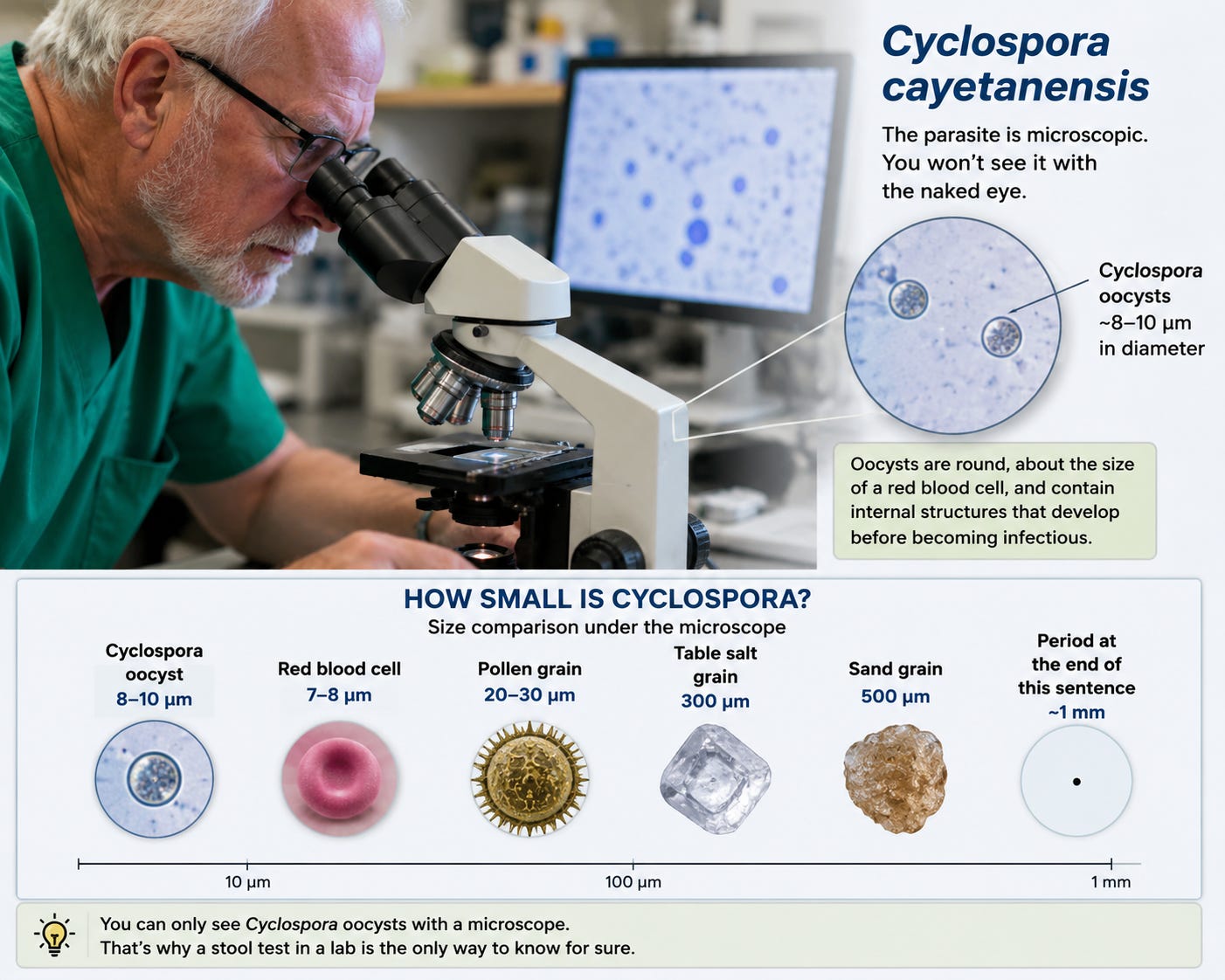
Cyclospora is nothing like that.
It is a microscopic, single-celled protozoan. You could fit thousands of them across the tip of a pin (it isn’t angles dancing on them either - maybe in your colon). You don’t see worms in your stool. Your doctor isn’t looking for eggs. Instead, this tiny organism infects the cells lining your small intestine and quietly begins interfering with one of your body’s most important jobs—absorbing water and nutrients.
That disruption explains almost every symptom people experience.
Watery diarrhea.Cramping. Bloating. Fatigue. Nausea. Loss of appetite. And not the way you want it, but Weight loss.
The remarkable thing is not that people become ill. It’s how long they stay ill. Unlike the twenty-four-hour stomach bugs that circulate through schools and cruise ships, Cyclospora often waits about a week before symptoms begin. Then it may continue for weeks, sometimes improving just enough to fool you into thinking you’ve recovered before returning for another round.
If you’ve ever wondered why physicians ask whether your diarrhea has lasted “more than a few days,” this is one reason. Time matters. The longer symptoms continue, the broader the list of possible causes becomes.
So where does it come from?
Most outbreaks are linked to fresh produce.
Not hamburgers.
Not chicken.
Not sushi.
Fresh herbs, leafy greens, berries, and vegetables are the usual suspects because they are eaten raw. Once food is cooked thoroughly, Cyclospora is no longer a concern. The challenge is that salads rarely spend fifteen minutes in a frying pan.
The contamination usually occurs before the produce reaches your kitchen. That may happen through contaminated irrigation water, contaminated wash water during processing, or other environmental exposure on the farm. By the time the lettuce or cilantro arrives at your grocery store, the opportunity to prevent contamination has largely passed.
That brings us to the question that flooded my comments.
“Should I wash my vegetables?”
Yes.
Absolutely.
I wash mine.
I hope you wash yours.
Just understand what washing can—and cannot—do.
Rinsing fruits and vegetables under cool running water removes dirt, reduces many bacteria, and lowers your exposure to contaminants. It is one of the simplest and most effective food safety habits you can develop.
Unfortunately, Cyclospora doesn’t read household cleaning blogs.
The parasite is enclosed within a tough microscopic structure called an oocyst. Think of it as a tiny survival capsule. Those oocysts can lodge within the folds of lettuce, cling to herbs, or remain attached to berries despite vigorous rinsing. Think of being glitter bombed - you can’t get that glitter out easily.
That is why studies have not shown that soaking produce in vinegar, baking soda, salt water, or commercial produce washes reliably removes or kills Cyclospora. Those methods may make us feel industrious, but they have not demonstrated a meaningful advantage over plain running water for this parasite.
Wash your produce anyway.
Wash it because it removes dirt.
Wash it because it reduces many other contaminants.
Wash it because good food safety is built from many small habits.
Just don’t expect your kitchen sink to undo something that happened hundreds of miles away on a farm.
So how do I wash produce?
Keep it simple. Wash your hands first, first you don’t want to add anything to the mix and secondly, always wash your hands when going into the kitchen and handling food. It is a good idea.
Rinse fruits and vegetables under cool running water while gently rubbing the surface.
Use a clean vegetable brush for firm produce like carrots, potatoes, cucumbers, melons, and apples. Do you put your brush in the dishwasher after each use? Why not - do it.
Remove the outer leaves from lettuce or cabbage. They are usually the most exposed to contaminants and the most wilted.
Wash produce immediately before using it rather than when you unload groceries because excess moisture encourages spoilage.
Notice what isn’t on that list.
Soap.
Bleach.
Vinegar.
Baking soda.
Salt water.
The evidence simply doesn’t show they outperform running water for routine home use. Yes, I know, everyone has their own cocktail for washing produce. But the data isn’t there to show that these help. Besides, while I love getting a chemistry set out and doing experiments, I prefer to use tap water and scrubbing for the produce. Keep it Simple Simpson (KISS).
How do doctors know it’s Cyclospora?
Here’s something that surprises many people.
Your doctor doesn’t usually know just by hearing your symptoms.
The diagnosis is made with a stool sample. Modern laboratories often detect the parasite using PCR, looking for its genetic material. Other laboratories identify the microscopic oocysts using specialized staining techniques.
One important point is worth remembering: Cyclospora isn’t included in every routine stool test. If the story fits—a week after eating fresh produce followed by prolonged watery diarrhea—your clinician may need to specifically consider Cyclospora when ordering laboratory studies.
That is one reason these infections are occasionally missed.
What about treatment?
The preferred antibiotic is trimethoprim-sulfamethoxazole, better known by the brand name Bactrim.
Most people improve rapidly once treatment begins.
The question I was asked most often, however, wasn’t about Bactrim.
It was about allergies.
“I’m allergic to sulfa. Am I out of luck?”
Fortunately, no.
First, the healthiest people eventually recover even without antibiotics, although the illness can linger for weeks and sometimes relapse.
Second, not everyone who carries the label “sulfa allergy” has a true allergy.
Medicine has become remarkably good at placing allergy labels into charts, and surprisingly poor at taking them back out.
Some people experienced nausea twenty years ago and have been “allergic” ever since.
Others developed a rash that may or may not have represented a genuine allergic reaction. And some of those rashes were not to the antibiotic, but to the fillers they used to put into the pills that also had the antibiotic.
Still others truly cannot receive sulfonamide antibiotics safely.
Those are different situations.
If you’ve been told you’re allergic to sulfa antibiotics, don’t assume you’re out of options, but don’t experiment with herbal remedies or leftover antibiotics either. Your healthcare provider can determine whether the allergy history suggests a true contraindication, and recommend the safest approach based on the severity of your illness.
When should you call your doctor?
Most cases of ordinary viral diarrhea improve within a few days.
Cyclospora is different.
If your diarrhea persists beyond several days, you’re becoming dehydrated, you’re unable to drink enough fluids, you’ve lost significant weight, you’re pregnant, or your immune system is weakened, it’s time to seek medical care.
Diarrhea is inconvenient.
Dehydration can be dangerous.
There’s a difference.
And this is one of the few times I say - get electrolytes. No, not the paleo sugar free stuff. Get some real electrolytes like Pedialyte (see my previous post about these).
The bottom line
Cyclospora reminds us that food safety begins long before we walk into the grocery store. Farmers, processors, distributors, public health investigators, and clinicians all play a role in preventing outbreaks and identifying them when they occur.
You still should wash your fruits and vegetables.
You still should enjoy salads.
You should not become afraid of fresh produce.
But you should also understand that no home washing technique can completely sterile food. Sometimes, the most important part of medicine is recognizing the limits of what we can do at home.
Although if you happen to have a food radiation device at home, this would be the time to use it on your spices (Ok, I haven’t seen one of these, but I would get one if they had it).
For paid subscribers below, let’s take a fascinating journey through the life cycle of this remarkable little parasite. Ironically, the organism leaving your body today probably isn’t capable of infecting anyone else—yet. That’s one of the reasons Cyclospora behaves differently from the stomach viruses we’re used to seeing.
