


Every week, I have a podcast called FORK U. I use these articles to expand on the ideas in the podcast. Here is the episode, and if you like it you can subscribe. The post below contains more details.
The First Egg Thief
The first egg thief wasn’t human. Millions of years before humans arrived, a hungry animal discovered that a nest contained something worth eating. It just lay there. You didn’t have to chase it, or worry it would injure you. Just climb into the nest, take the egg, and try not to get eaten by an understandably irritated parent.
Growing up in Alaska, we collected seagull eggs. Trust me, a grocery store is much easier than collecting nests of eggs.
In fact, in Alaska, especially on St Paul Island, there are thousands of birds that seasonally nest in the cliffs. Going on the cliffs, getting your favorite eggs, and leaving some for the continuation of the species is not a year round process. They only nest during one season and may only produce a few eggs. In Native culture, you always leave an egg or two. The species must continue.
But if you are collecting seagull eggs, take as many as you want. There are plenty of seagulls out there. They’re kind of pests.
Seagulls eat anything. The flavor of their eggs is similar to salmon you left in the refrigerator for a few days.
Our great great (many great) grandparents took a seasonal source of nutrition, domesticated the animal producing it, bred that animal to produce hundreds of eggs annually. We made the equivalent of pregnant at every opportunity and built an industry that makes breakfast possible without climbing a cliff.
Of course, the controversies would come later. Are eggs the perfect food, or will they kill us?
The Egg Came First. By Several Hundred Million Years.
Which came first, the chicken or the egg? The egg. Simple evolution.
Consider the dinosaur, they laid eggs. We have great fossils of the eggs, with the tiny creatures locked in forever. Some dinosaurs began to fly. Eventually, we went from T-rex into a chicken. And chickens have wings, they do not fly. But add Buffalo sauce…
The egg is a remarkable adaptation of nature. It allows animals to lay eggs on land, and the covering protects the embryo from the environment. The contains everything needed for development, no umbilical cord needed. And the egg is permeable to air through the shell to keep the embryo alive.
A Chicken Walks Into a Rice Field
The modern chicken descended from the red junglefowl of Southeast Asia.
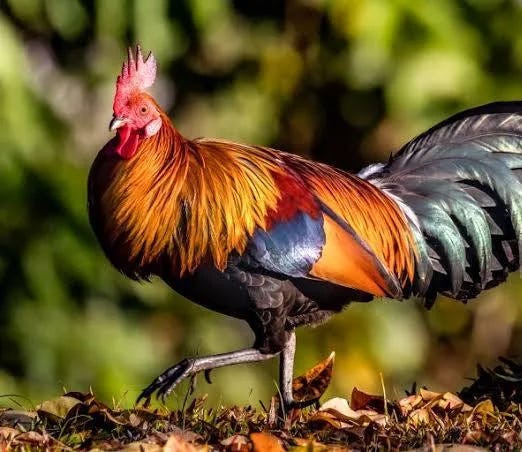
See the photo above. These birds are smaller and more athletic than their domesticated descendants. We think domestication began about 3500 years ago. As humans began cultivating rice, the fields and settlements attracted junglefowl. These fields provided a food source for the birds, but also a service.
Junglefowl not only ate rice that had spilled onto the ground, but also the bugs in the field, and the rodents. Even modern chickens will chase and eat squirrels, rats and mice. No pesticides needed, just make this bird happy, and your field is free of bugs, mice and rats.
As they domesticated the chickens, they became not only a built-in gardener, but even pets. Chickens traveled with humans along trade routes, across continents, onto ships, and into settlements. I wonder if they were emotional support chickens? .
In our last FORK U podcast episode, we talked about how the Polynesians would bring these creatures when settling a new island. Today, if you go to the Hawaiian Island of Kauai, you will see chickens everywhere. These are the descendants from those voyages. Yup, those chickens have occupied Hawaii longer than any European. And somewhere along the way, humans started to select and breed those creatures that produced eggs more often.
The Hollywood Egg
Some of the first “protein supplements” in the US were from eggs. To market egg powder, men want to have the muscles, so get a gym rat with big muscles endorse it. For women, get the Hollywood star to endorse it, and that marketing has not changed since the 1950’s. We have many different protein powders today, but egg protein powder was one of the first.
Raw eggs became part of the mythology of strength, immortalized by Hollywood, and every aspiring athlete who thought swallowing raw eggs was more impressive than chewing it. Yes, a bit too slimy for me.
What those muscle-minded folks didn’t know is that cooked egg protein is more digestible and bio-available than raw egg protein. Remember how the proteins change with heat. It turns out cooked eggs are easier for the small bowel to break down, digest, and absorb than raw eggs. And cooked eggs have far less risk of Salmonella food poisoning.
Eggs around the world
On Amazon, you can get the cookbook from the Roman times. Not a first edition, of course. The recipes are incomplete. Apicus, the author often leaves out measurements of an ingredient or sometimes entire ingredients. But this is our oldest cookbook, and one thing is clear, the Romans loved eggs.
Apicius has a recipe for “Roman toast.” It is essentially a recipe for what we call French toast, except in the original additions it does not include eggs. ”
As Rome conquered nations, they not only brought their recipes, but also incorporated the local recipes. While the French take credit for French toast, Roman influence is important. The French have always been good at claiming culinary territory.
This is an impressive amount of chemistry for an ingredient we usually crack against the edge of a frying pan. Since my son is taking chemistry in high school, I have tried to talk to him about this. He usually rolls his eyes and asks me where eggs are on the periodic table. I tell him they are on the breakfast table. Yes, I am a dad.
For the Chicken, Every Day Is Spring
Junglefowl lay eggs seasonally, and chickens today lay 300 eggs a year. This happened because of selective breeding. In the last 100 years, we have increased the average production of eggs from 100 a year to over 300 a year.
Chickens tend not to lay eggs in the winter, but you can keep a chicken coop warm. But their view of winter is daylight savings time. Egg production slows as the day becomes shorter. Adding artificial light, and the chicken is fooled into thinking it is spring.
Humans have been doing selective breeding for years. Archaeologists reported finding ancient chicken eggshells at sites along the Silk Road in Central Asia. suggesting that chickens are laying more frequently than wild junglefowl, possibly throughout much of the year.
We didn’t need to understand genetics to practice selective breeding. Farmers had been doing it with plants and animals for thousands of years.
Eggs, Cholesterol, and the Great Breakfast Debate
Do eggs increase your risk of heart disease? Eggs contain cholesterol. People with higher blood cholesterol levels have more heart attacks and strokes. When you find someone who has had a heart attack, you will find that the walls of their heart's arteries have deposits of cholesterol. So the logic tells us if we get rid of cholesterol in the diet, we should get rid of the cholesterol in the artery. Sounds like a reasonable association. But then we tested that theory, and it doesn’t work that way.
In the 1950’s some cardiologists tried to remove cholesterol from the diet. After President Eisenhower’s heart attack, he was put on a diet of Melba toast, grapefruit, and low cholesterol foods. He hated it.
Eggs, because they have over 180 mg of cholesterol, were high on the list of foods to eliminate. In the 1950’s we had over three times as many people dying from heart disease as we do today. We had no medicines to decrease blood cholesterol, poor medicines for blood pressure, no stents, no bypass surgery. If you had a heart attack we hoped for the best. So finding a dietary solution was important.
It turns out saturated fat, not dietary cholesterol, raises blood cholesterol more than any other food group. This is where we put in boring chemistry about what the molecules look like, but this is about eggs, so we will skip that.
Your liver makes cholesterol in your blood, but it can make too much. And too much of a good thing, be it sugar, water, salt, or cholesterol, can lead to issues. In the case of blood levels of cholesterol (or LDL-cholesterol), higher levels lead to more atherosclerosis (deposits of cholesterol in the arteries). That leads to strokes and heart attacks.
Eggs have been exonerated. But again, I think eggs are bland.
I have Two Problems With Eggs
Some people love eggs. The unctuous yolk is, for many people, a wonderful addition to a meal. But eggs have little flavor for me.
I have many patients in nursing homes, and I noticed that residents often had a bottle of hot sauce. Tapatio, Tabasco sauce, or my favorite, Louisiana Hot sauce (same used in Popeyes), and I finally asked what they used it for. Their eggs. Institutional eggs, or all eggs, are bland. These folks knew it and they kept a bottle on their tray. Of all the things you bring to your nursing home, a few photos of family, some hair care products, and hot sauce. Try it.
The second problem I have is how the chickens are treated. I am not a vegan, but I believe we have a duty to care for the creatures who feed us. I realize we need a factory farming to feed an overcrowded and hungry planet. But I also believe in rewarding those farms who take better care of their hens.
So you see egg cartons labeled cage free, pasture raised, and etc. Most of those are meaningless, from my perspective.
If you can afford to pay a bit more for eggs, try to find ones labeled Certified Humane Pasture Raised or Animal Welfare Approved. These are independent certifications with standards for how the hens are treated, including their access to outdoor space.
For example, Certified Humane requires at least 108 square feet of pasture per hen. A cage-free chicken may spend its entire life inside a large building, surrounded by thousands of other chickens. Both produce eggs, but I would rather reward the farmer, who gives the hen room to behave like a chicken.
It costs more. I realize not everyone can afford that. But if we can afford to spend a little extra on coffee, perhaps we can spend a little extra on the creature that provides breakfast.
Next week on FORK U we’re going from running to roasting. We bred one chicken to lay almost every day, and another to grow large enough for dinner in just a few weeks.