


You Bought Salt With a Marketing Department
Or how one of the greatest medical discoveries in history became a mango-flavored subscription service.
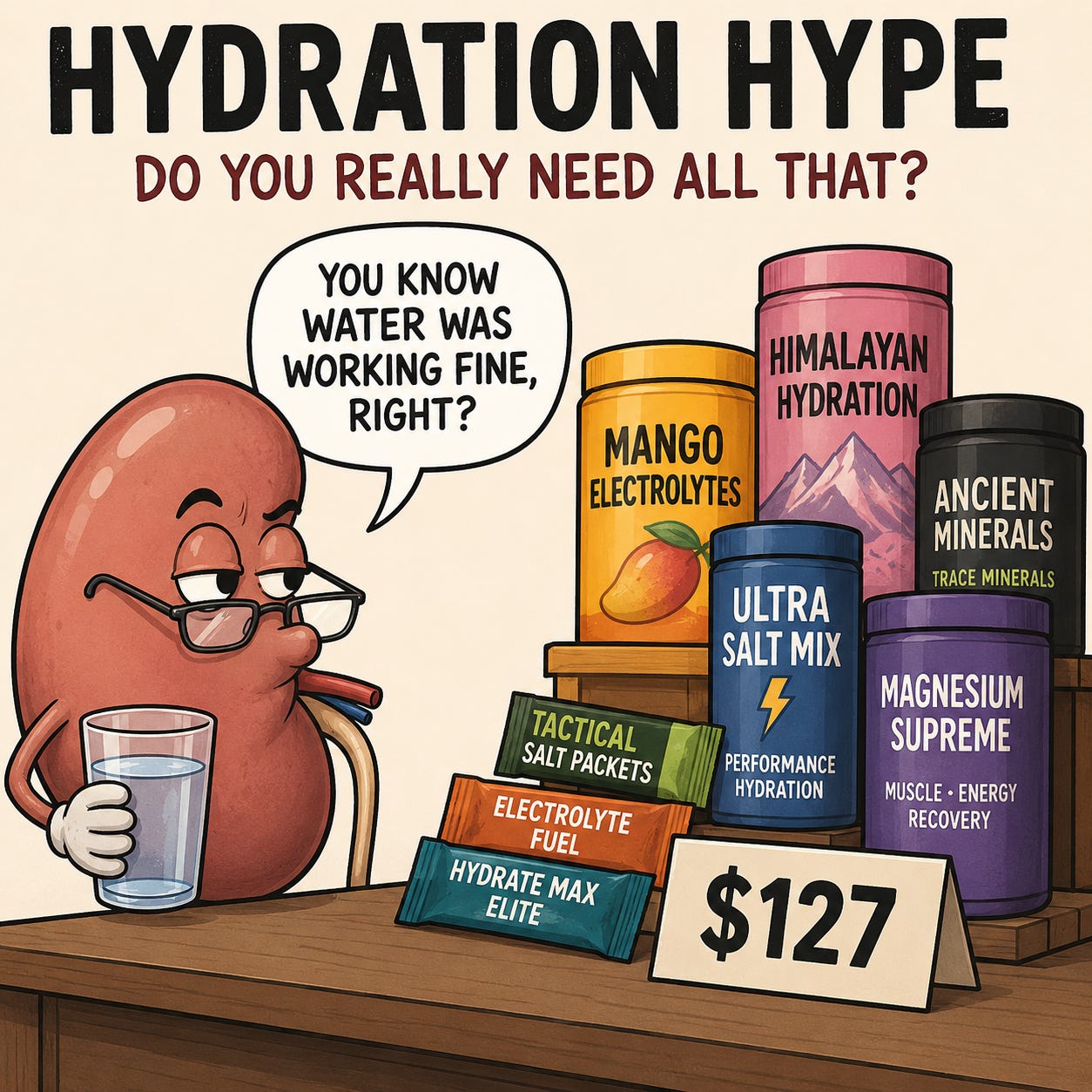
There are few things in medicine more satisfying than a simple solution to a deadly problem.
As a surgeon, I spent years doing complicated things. Operations took hours. Some required teams of people, specialized equipment, and years of training. We tend to admire complexity in medicine, because complexity often reflects expertise.
Yet one of the greatest medical advances of the twentieth century wasn’t a drug, surgery, or machine.
It was this recipe:
A liter of clean water, 6 parts Sugar and one part Salt.
That’s it. And it saved 92 million children world wide from cholera and other diarrheal illnesses.
The remarkable thing about this oral rehydration therapy is that it looks too simple to be important. If someone tried to sell it today, most people would scroll right past it. There are no proprietary ingredients. No celebrity endorsements. No tactical hydration branding. No shirtless salesmen of supplements and scams explaining how it unlocks ancient secrets of human performance.
Yet that simple solution helped change the world.
The Discovery That Saved Millions
Not long ago, diarrheal diseases killed millions of children every year. Cholera, dysentery, and other infections swept through communities, particularly in poorer regions of the world. The tragedy wasn’t merely the infection itself. Children died because they lost water and electrolytes faster than they could replace them.
Scientists eventually discovered something elegant about the intestine. Sodium and glucose are absorbed together. When they move into the body, water follows.
That insight led to oral rehydration therapy.
The recipe was simple enough to be used almost anywhere. The effect was profound. Depending on the estimate used, oral rehydration therapy has been credited with saving tens of millions of children’s lives. Some estimates place the number above 90 million.
Pause and think about that for a moment.
One of the greatest lifesaving interventions in human history can be written on an index card.
Meanwhile, healthy adults spend a dollar a serving for flavored salt.
From Garden Hoses to Gatorade
The story of hydration in sports is equally fascinating.
For much of the twentieth century, athletes were often told not to drink much water. Some coaches believed it made athletes soft. Others worried about stomach cramps. Players in the Big Ten often hydrated from whatever hose was attached to the side of the stadium.
Medical science was not always consulted.
Then came the era of salt tablets.
Coaches were convinced athletes lost dangerous amounts of sodium. Players swallowed salt tablets by the handful. Many became nauseated. Some vomited. The evidence was never especially impressive, but the practice persisted because it sounded scientific.
Then researchers at the University of Florida began studying football players practicing in the brutal Florida heat. They weren’t looking for a miracle supplement. They were trying to solve a practical problem.
The result became Gatorade.
The mythology says Gatorade succeeded because it contained electrolytes. The reality is more interesting. Gatorade worked because it provided water, carbohydrate, and some sodium. The carbohydrate mattered. Glucose helps facilitate water absorption and provides fuel during prolonged exercise.
The success of Gatorade was another victory for physiology. Not marketing. But it was Physiology. And those Florida teams did great, until the other teams discovered what they did. That ended the era of salt tablets in football. They say football is a league that plagerizes.
The Rise of the Electrolyte Industrial Complex
Unfortunately, good science often attracts bad marketing.
Today, hydration has become an industry. Walk into a grocery store, Costco, or Target, and you’ll find hydration powders, hydration packets, hydration sticks, hydration tablets, hydration concentrates, and hydration products with names that sound like military operations.
The message is remarkably consistent. You don’t just need water, you’re dehydrated, low on electrolytes. Your cells are thirsty, and because of that, your performance is suffering.
Your afternoon fatigue is probably caused by a lack of trace minerals harvested from an ancient seabed.
This is usually where the shirtless salesmen of supplements and scams make their entrance.
The modern hydration industry has managed to convince healthy people that normal physiology is a problem that requires a monthly subscription.
My favorite example is Himalayan salt.
First, it doesn’t come from sherpas climbing icy mountain peaks. It comes from a salt mine in Pakistan, about as far away from the Himalayas as LA is from the Rockies. Second, the amounts of magnesium and trace minerals are tiny. If magnesium were your goal, Himalayan salt would be an extraordinarily inefficient way to obtain it. You’d need three and a half cups of salt to get about 80 mg of magnesium.
A sodium ion, however, remains blissfully unaware of its marketing campaign.
Electrolytes are more profitable than bottled water
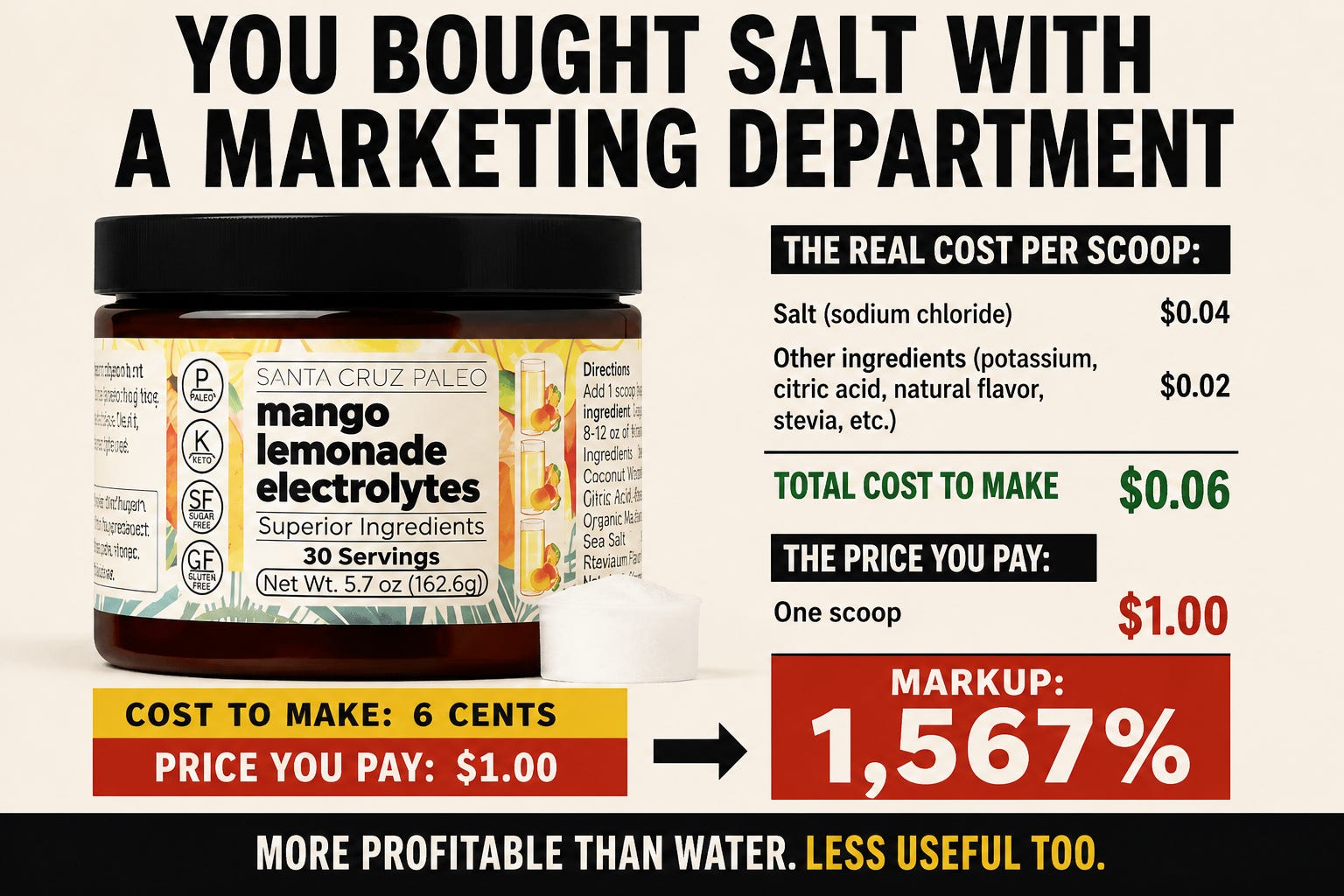
If you are old enough to remember when the first bottled water appeared in the grocery stores, you probably asked - who on earth would buy that. Well, we now found something more profitable than water. It is salt.
One dose of this costs a buck. Yes, for a mere dollar, you can get this electrolyte solution (main ingredient salt, and some berry flavor).
Now if you bought “pre packaged” salt, 1000 mg (the amount sold), it would cost you 4 cents.
This is more profitable than water, easier to package and easier to sell.
What DASH Taught Us About Salt
So I want to tell you about one of the great nutritional studies you’ve never heard about. DASH (Dietary Approach to Stop Hypertension) was a diet designed to guide people with high blood pressure. Physicians, dieticians, and scientists took the best information about food at the time to make up a diet.
The other name for DASH is the American version of the Mediterranean diet.
Then they tested it. But to test it, they didn’t simply hand participants a brochure and wish them luck. They supplied meals. They supplied snacks. All the meals were prepared. And they found that blood pressure was reduced on this diet.
Then in phase two, they used the DASH diet and different concentrations of salt with the diet. As sodium intake fell, blood pressure fell. When sodium reduction was combined with the DASH dietary pattern—rich in fruits, vegetables, legumes, whole grains, and low-fat dairy—the effects became even greater.
One of the most common criticisms physicians hear is that we don’t understand lifestyle. We only prescribe medications. We don’t understand nutrition. The DASH-Sodium Trial is a wonderful reminder that medicine has been studying nutrition seriously for decades.
The results were striking.
For many individuals with hypertension, the blood pressure reduction was comparable to adding an antihypertensive medication.
Think about that. One dietary intervention produced an effect large enough to rival a prescription drug. That isn’t alternative medicine. That isn’t wellness culture. This is a nutritional study showing that eating better and eating less salt results in lower blood pressure, resulting in fewer heat attacks and fewer strokes. Not to mention, lower salt decreases the risks of some cancers.
Who Actually Needs Electrolytes?
This doesn’t mean electrolyte solutions are useless.
Far from it. They are lifesaving if you have severe diarrhea, vomiting, heat illness, prolonged endurance exercise, or certain medical conditions. In the emergency room, electrolyte replacement can be extremely important. Products such as Pedialyte exist for a reason.
Notice what all those clinical situations have in common. They involve actual dehydration, not just the fear of dehydration. And here’s where modern hydration marketing becomes especially strange.
One of the greatest hydration breakthroughs in human history depended on glucose. Yet many hydration products proudly advertise they contain no sugar at all.
Oh, and even as a Zepbound user, I have never used an electrolyte replacement solution.
The Kidney’s Final Opinion
Your kidneys are remarkable devices. For the entirety of human existence, they have taken the food you eat, the water you drink, and kept your body in perfect shape, unless you are sick.
So all our ancestors chase after deer, gathering legumes, or running from tigers - they didn’t have electrolyte drinks. They had water. When you were a kid running around, you had water from a hose.
Now, while some people will say you sweat a lot of salt, we don’t need to guess. We’ve measured sweat. We’ve measured sodium losses. We’ve measured hydration strategies. We’ve studied athletes, laborers, military recruits, marathon runners, and patients with genuine dehydration.
And here is the simple truth: For most healthy people eating a normal diet and engaging in normal exercise, water remains remarkably effective.
The next time someone tries to sell you mango-flavored Himalayan electrolyte powder, remember that one of the greatest medical discoveries in history fit on an index card. Water, salt and sugar saved 92 million children in the world so far.
But today we have shirtless salesmen of supplements and scams selling you a science sounding product (electrolyte solution) for a markup that makes them millions, makes your water taste marginal, and may actually do more harm than good.
If you don’t need the extra salt, you will raise your blood pressure, put strain on your heart, and increase the risk of stroke, heart attacks and even cancer.
Listen to the Podcast
I just put up a podcast about this - about 8 minutes long.
Paid Subscriber Bonus: What I Actually Do
Whenever I write about nutrition, somebody eventually asks what I actually eat, what I actually drink, and whether I have some secret hydration strategy that I’m not sharing with everyone else.
