


The X Files - Food noise Is Just Hunger
Some of you follow me on Twitter (now called X) and there I am often faced with people who don’t understand how GLP-1 works, and think that food noise is nothing more than a hunger/satiety problem.
They sneer and say - if it isn’t the food, then what is obesity? Often these folks are people selling a low-carb diet along with a workout program. They think all a person needs is discipline - usually to eat nothing but steak and work out in the gym hours a day. I am sorry, but I do have a life, and it isn’t flexing my muscles and eating steak. But more important, food noise that drives obesity is not due to a lack of working out, or from eating “carbs.”
So today we will dive into food noise, because it is an important driver of obesity, and something I didn’t know I had until 12 hours after my first Zepbound shot nearly 18 months ago.
It’s Not Hunger. I Know Because I’ve Heard Both.
I once sat at a medical conference across from another weight loss surgeon. Thin. Unremarkable lunch. The kind of hotel dessert that looks better than it tastes.
He took one bite of the cake, paused, made a face—not dramatic, just…dismissive—and put the fork down.
Done.
I remember watching that like it was a magic trick.
So I tried it. Took a bite myself.
Now, in the old days, I would have finished that cake in six bites. Not because I was hungry. Not because it was good. Just because it was there—and because something in my brain said, keep going.
But this time I paid attention. It wasn’t good. It wasn’t worth it. And for once, I stopped.
Not willpower. Observation.
That distinction matters more than people think.
The Lie: “Food Noise Is Just Hunger”
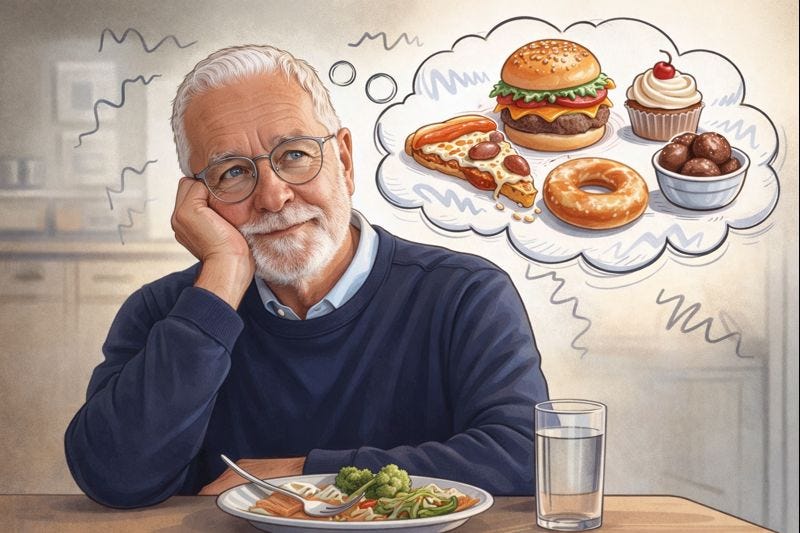
People who have never experienced food noise say this with confidence.
They shouldn’t.
Because hunger is quiet, logical, and surprisingly polite. You feel it, you eat, it goes away.
Food noise doesn’t behave like that.
Food noise is:
thinking about food when you’re not hungry
continuing to eat after you’re satisfied
wanting something specific, not just calories
In medical terms, we call it hedonic hunger—a drive that comes from reward pathways, not energy need.
But that clinical language misses the lived experience.
Food noise is not a signal from your stomach.
It’s a conversation in your brain that doesn’t know when to end.
The Change Wasn’t Discipline
There’s this idea that the difference between people is discipline.
It isn’t.
Here’s another example.
Today, if I order a glass of wine and don’t like it, I stop. One sip, maybe two. That’s it.
Before? I would have finished the glass. Maybe had another. Not because it was good—because it was there.
No internal discussion. No pause.
Just completion.
Now I’ll sit on a plane and skip the wine altogether and have tea instead. Not as a moral victory. Just because it’s the better choice in the moment.
Something changed—but it wasn’t a lecture I gave myself.
It was the volume of the signal.
This Isn’t Coming From Your Stomach
One of the biggest mistakes people make is assuming food noise starts in the gut. It doesn’t. It starts in the brain—and not the part that measures hunger.
It comes from the reward centers.
When you see food, smell it, or even just think about it, a different set of regions gets involved. The ventral tegmental area flags something as important. The nucleus accumbens generates that quiet push to get it. The orbitofrontal cortex weighs whether it’s worth it. None of those counting calories. None of them ask if you’ve eaten enough.
They’re asking a different question: is this worth repeating?
That’s a very different conversation than hunger.
Why Full Doesn’t Mean Finished
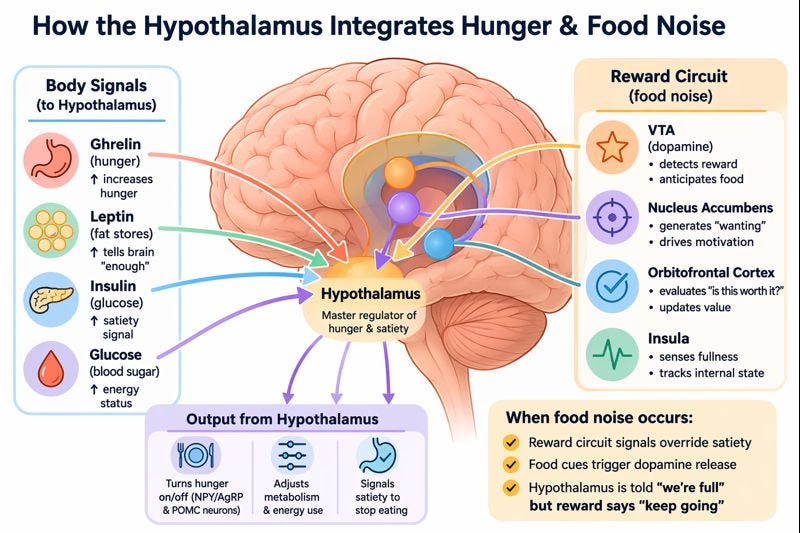
This is where people get tripped up. They assume that once you’re full, the signal should shut off. That would be true if everything ran through the same system—but it doesn’t.
The hypothalamus handles hunger and satiety. It’s the part that says, “you’ve had enough.” But the reward system sits alongside it, connected to it, and at times capable of overruling it .
So you can finish a meal, feel physically satisfied, and still find your brain circling back to food. Not because your body needs more, but because something in the reward system is still active. It hasn’t gotten the memo that the meal is over—or more accurately, it doesn’t care.
That’s the difference. Hunger stops. Food noise lingers.
The Brain Learns What to Want
What makes this more complicated is that the reward system is trainable. It learns quickly, and it doesn’t forget much.
Highly palatable foods—especially ultra-processed ones—are very good at teaching it. They deliver a strong, fast reward: sugar hits quickly, fat carries flavor, salt enhances everything. The brain notices. Then it remembers.
After enough repetition, you don’t even need the food itself. The cue is enough. You walk past a bakery, see a commercial, or just remember a taste, and the system activates. It’s not responding to hunger. It’s responding to expectation.
That’s why someone can say, “I’m not even that hungry, but I want something.” They’re not confused. They’re describing two different signals.
This Is Why the Advice Falls Flat
If you think food noise is hunger, the advice seems obvious: eat less, wait it out, use discipline. But that advice assumes the signal will behave.
It often doesn’t.
Because this isn’t a simple input-output loop. It’s a learned, reinforced, cue-driven system that can keep firing even when the biological need has been met.
Once you see it that way, the experience makes more sense. You’re not failing to control hunger. You’re dealing with a system that was designed to notice reward and repeat it—and in the modern food environment, it has plenty of opportunities to practice.
Eating Slower Isn’t a Trick—It’s a Symptom
This morning at breakfast, I ordered two poached eggs with avocado and pico de gallo. The waitress asked if I wanted a biscuit.
“Sure,” I said.
The biscuit never came.
And here’s the part that would have been impossible before: I didn’t care.
I finished the meal. I was full. I paid and left.
No reminder. No irritation. No sense that something was missing.
Before, I would have noticed. Asked. Waited. Wanted it.
Not because I needed it.
Because the system that says “complete the meal” used to run the show.
Now it doesn’t.
Why This Happens
We like simple explanations, but this one isn’t simple.
There are two systems involved in eating:
one that regulates hunger (the hypothalamus)
one that drives reward (dopamine pathways)
They are not the same.
And importantly, the reward system can override the hunger system .
That’s how you end up:
full, but still thinking about food
satisfied, but still reaching for more
That’s food noise.
Ultra-Processed Food Turns Up the Volume
Here’s where modern life complicates things.
Ultra-processed foods are engineered to hit reward pathways hard:
sugar, salt, fat combinations
texture that dissolves quickly
flavors that linger
They don’t just feed you. They stimulate you.
And for some people—not all, but enough—the brain learns this quickly.
It starts to anticipate.
Then it starts to seek.
Then it starts to repeat.
That’s when food stops being about hunger and becomes about response.
Alcohol: The Quiet Amplifier
Alcohol makes this worse in a way people underestimate.
It lowers the part of your brain that says, “that’s enough.”
At the same time, it makes food more rewarding.
So now you have:
less inhibition
more reward
That’s not a fair fight.
Which is why the same person who can skip dessert at lunch suddenly finds themselves ordering it after a glass or two of wine.
We’ve Seen This Before
Long before we had a name for any of this, we saw it play out in history.
Henry VIII
A man who went from controlled and athletic to impulsive and excessive after a head injury that likely affected central appetite regulation.
Different era. Same principle.
When the brain changes, behavior follows.
What People Get Wrong
People who don’t experience food noise think this is all semantics.
They think:
“You’re just hungry.”
“You just need discipline.”
But those explanations don’t survive contact with reality.
Because if it were hunger, it would stop when you ate.
And if it were discipline, it would be consistent.
Neither is true.
The Difference
The difference is this:
Hunger asks.
Food noise insists.
And once you’ve experienced both, you never confuse them again.
Paid Section Preview
In the paid section, we’ll go deeper into what’s actually happening in the brain:
the reward centers involved
why “wanting” and “liking” separate
and why some treatments quiet food noise instead of just fighting hunger
Because once you understand that, you stop blaming behavior—and start understanding biology.
A Tour Through the Circuits (Not the Sermons)
If the free section is the experience, this is the wiring.
Because once you understand where food noise lives, the conversation changes from “why can’t I control this?” to “what system is talking right now?”
