


We Learned There Is Another Case
Today we learned that another passenger aboard the cruise ship tested positive for the hantavirus.
That matters. It confirms continued transmission within a confined environment. However, it does not mean we are watching the opening scene of the next global catastrophe. Cruise ships are uniquely efficient places for infectious diseases to spread, because people live in tight quarters, share dining spaces, touch the same surfaces, and spend prolonged periods indoors together.
Historically, ships have always been vulnerable to outbreaks. Influenza, norovirus, cholera, and countless other infections have spread efficiently in these environments long before modern travel existed. Think the original black plague
This is information worth paying attention to. It is not information that justifies panic.
What “Close Contact” Actually Means
One of the most important lessons today is that “close contact” has a very specific definition. Many people hear that phrase and assume it means everyone on the ship was significantly exposed. That is not how epidemiology works.
In practical terms, close contact generally means one of four things:
You shared a cabin with the infected person.
You were a steward or caretaker regularly entering that cabin.
You were medical personnel caring for the patient.
You spent more than 15 minutes within six feet of the infected individual during a 24-hour period.
That last definition surprises people, because it sounds less dramatic than many imagine. Yet infectious disease transmission is not mystical. Exposure depends on duration, proximity, ventilation, viral load, and biology.
Viruses are not ghosts floating through steel walls hunting random victims.
Public health investigators try to quantify risk, not amplify fear.
Yes, There Is a Mutation — No, Nobody Knows What It Means Yet
We now have the genomic sequence of the virus, and researchers have identified a mutation.
Predictably, the internet immediately split into extremes. One side insists the mutation proves the virus is evolving into a pandemic-level threat. The other side dismisses mutations entirely.
Both reactions misunderstand how viruses work.
RNA viruses mutate constantly. Every day, millions upon millions of viral replications produce tiny evolutionary experiments. Most mutations do nothing. Some weaken the virus. A few may improve transmission or adaptation.
The problem is that anyone claiming certainty today is practicing fortune telling, not science.
We often do not know the significance of a mutation for years. Sometimes we never fully understand its impact. Genomic sequencing gives us clues, not prophecy.
Science is observation followed by evidence — not instant certainty delivered through social media confidence.
The Real Lesson: We Are Not Prepared
The most important lesson from today has little to do with this specific cruise ship outbreak.
We are not prepared for the next pandemic.
To be clear, I do not think this hantavirus outbreak is the next great global pandemic. However, history strongly suggests there will be another pandemic, probably sooner rather than later.
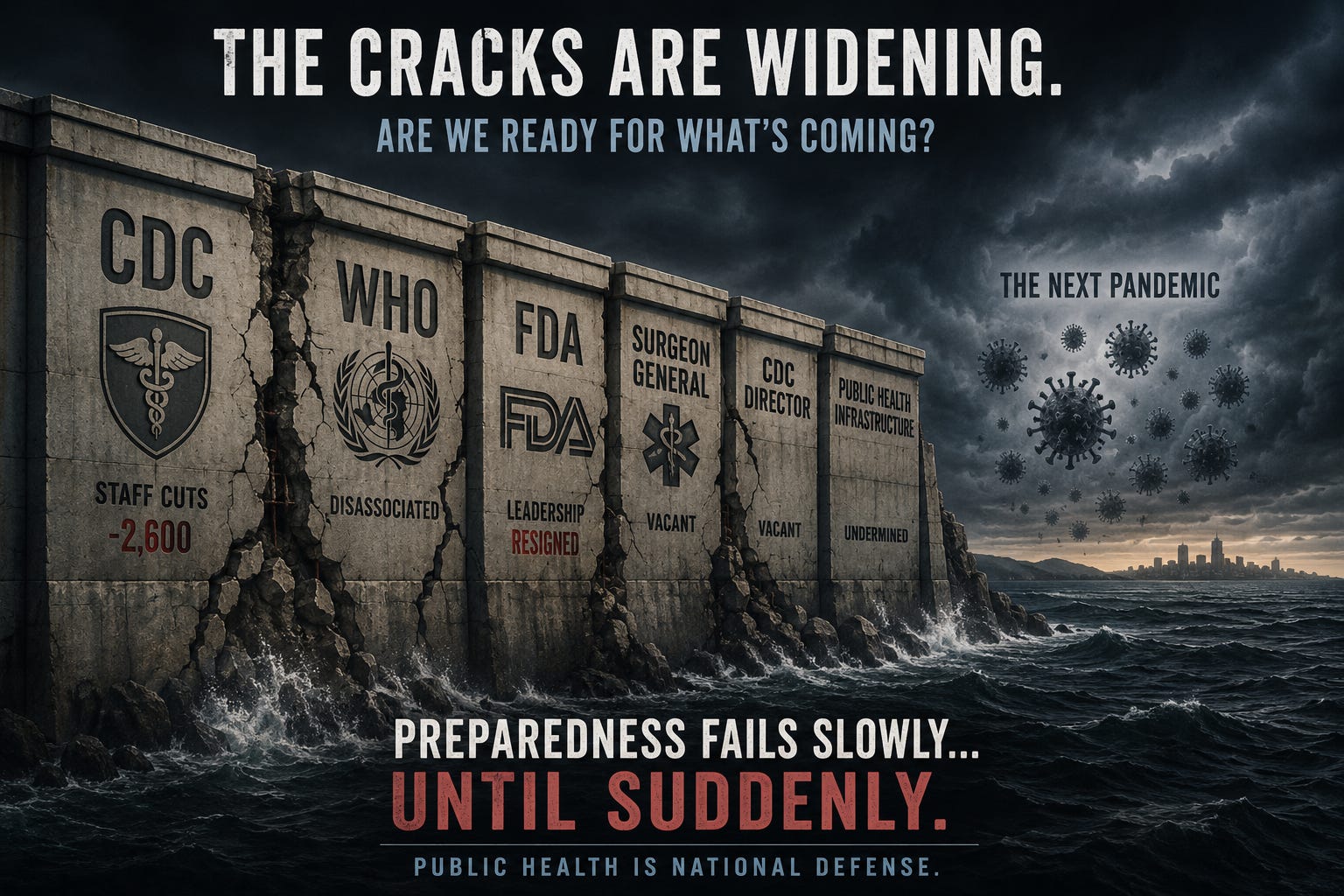
What concerns me is how casually we now treat institutions like the CDC and the WHO, as though they are optional bureaucracies instead of components of national defense.
Historically, infectious diseases have killed more civilians and soldiers than bombs or bullets. Entire armies have collapsed because of infection. Empires have been weakened by plague long before modern warfare existed.
Viruses do not care about borders, politics, or ideology.
That means preparedness is not merely a health issue. It is infrastructure. It is surveillance. It is logistics. It is defense.
And yet here we are.
The current administration fired roughly 2,600 members of the CDC workforce. We have distanced ourselves from the WHO at precisely the moment global cooperation matters most. We currently have no confirmed Surgeon General, no permanent head of the CDC, and the FDA leadership has become increasingly unstable following another major resignation.
Even more concerning is that many figures elevated or promoted in recent years are not people most physicians or researchers would look toward as internationally respected leaders in infectious disease, epidemiology, vaccinology, or public health science. Too often, the loudest voices are ideological performers — agenda-driven anti-vaccine personalities who speak confidently about nutrition while romanticizing beef tallow on french fries, as though nostalgia itself was a substitute for evidence.
Public health cannot function as a lifestyle brand.
Preparedness requires serious scientists, functioning institutions, international cooperation, stable funding, and leadership grounded in evidence, rather than grievance politics or internet applause.
We spend enormous resources preparing for military threats we hope never happen. Pandemic preparedness deserves the same seriousness, because the next pathogen will not pause, while governments debate whether science itself should be trusted.
We Spend Trillions Preparing for War — While Dismantling Pandemic Defense
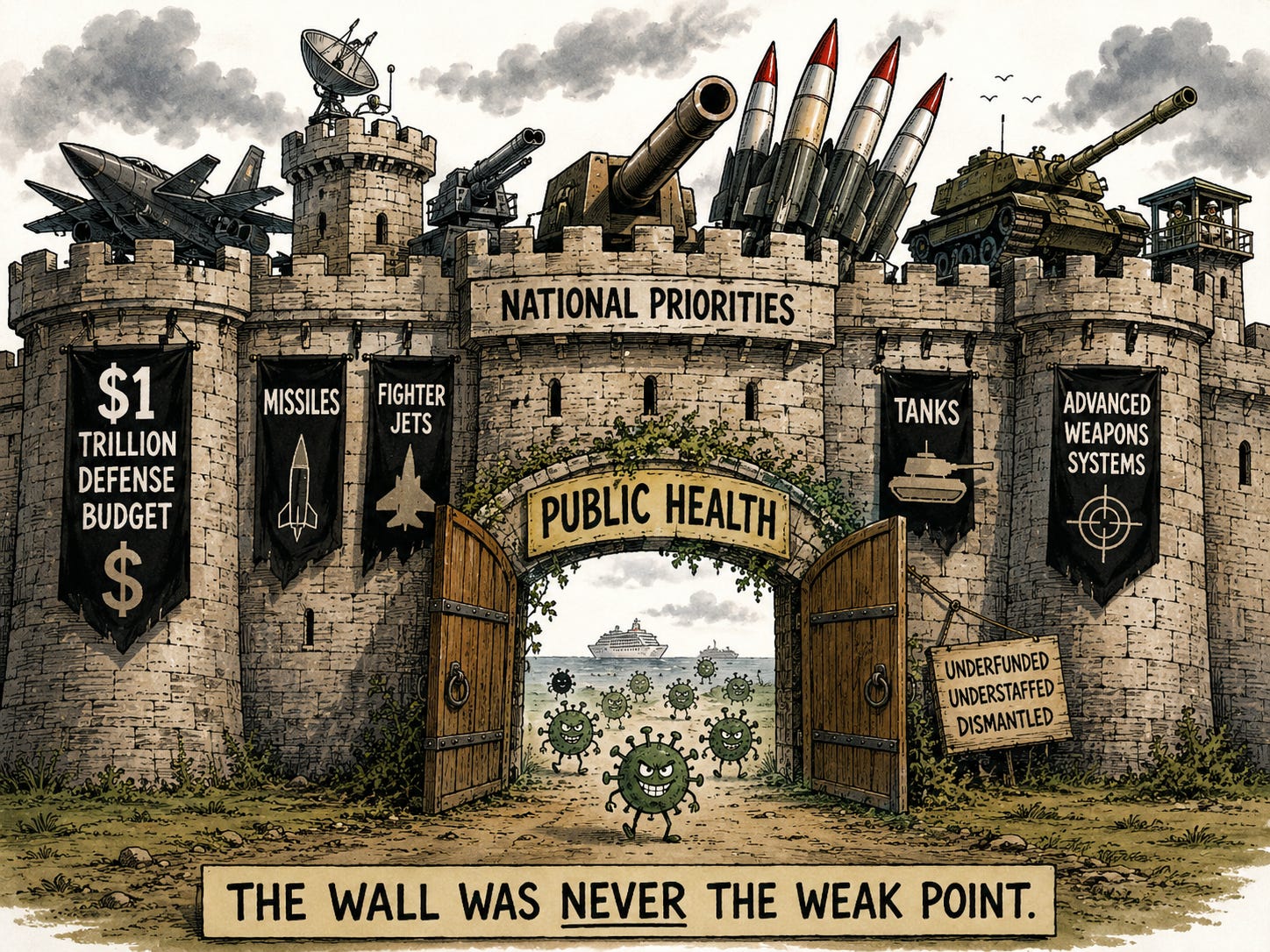
Perhaps the most astonishing part of this moment is not the virus itself. It is the contradiction in our priorities.
This administration has celebrated moving military spending toward roughly one trillion dollars annually — and now even proposed budgets approaching $1.5 trillion in total defense-related spending.
At the very same time, we have reduced CDC staffing by thousands, destabilized leadership at major health agencies, weakened ties with the WHO, and continued cutting or constraining scientific infrastructure.
For perspective, the entire annual NIH budget is roughly $48–49 billion. The CDC budget is approximately $13 billion. American contributions supporting the WHO are only a fraction of that. Combined, all of those institutions together cost dramatically less than even a modest increase in military spending.
In other words, for a tiny fraction of what we spend preparing for missiles and bombs, we could maintain the very systems designed to detect, track, sequence, contain, and fight the pathogens that historically have killed more human beings than warfare itself.
That is the lesson history keeps trying to teach us.
Civilizations rarely believe they are vulnerable until they are. Armies throughout history have survived bullets only to collapse from dysentery, influenza, cholera, typhus, plague, and smallpox. Infection has repeatedly humbled nations that considered themselves untouchable.
Yet today, public health expertise is treated as elitism, scientific institutions are treated as political enemies, and international cooperation is mocked as weakness.
Preparedness is not weakness.
It is civilization.
Those who have not learned history are doomed to repeat it.
The Signal Matters
The lesson from today is not panic.
It is also not complacency.
Outbreaks are signals. The intelligent response to a signal is preparation.
