


Life, love, and libido. Spend enough time on social media, and you’ll find people claiming that GLP-1 medications ruin all three. According to some critics, these drugs don’t simply quiet food noise—they flatten emotions, destroy romance, eliminate sex drive, and even make people fall out of love. It is a remarkable claim, and fortunately, one we can actually investigate.
As someone taking tirzepatide myself, I can only speak for one patient—me. I haven’t noticed any loss of libido, any decline in romantic interest, or any diminished interest in romance. If anything, feeling healthier, moving more easily, and becoming more comfortable in my own body has probably nudged things in the opposite direction. Before my inbox suddenly becomes much more active, let me add one disclaimer: this is not an invitation to slide into my direct messages.
Still, I couldn’t completely dismiss the question.
One thing became obvious as I began looking into this question. Nearly every confident assertion that GLP-1 medications destroy romance, libido, or the joy of living came from the same corner of the internet—the people who oppose these medications almost on principle. They repeat the claim so often that it begins to sound like an established fact. It isn’t. The published scientific evidence simply does not support the notion that GLP-1 medications routinely rob people of their sex drive, their capacity for love, or their enjoyment of life. Quite the opposite. Many patients describe feeling healthier, more energetic, more confident, and more engaged with the world around them. So before we accept the mythology, let’s examine the biology. The real story is far more interesting than the rumor.
A Dose Dependent Loss of Interest in Food
One of my friends is a board-certified obesity medicine physician who cares for hundreds of patients using GLP-1 medications every year. During one of our conversations, he mentioned that a handful of patients taking the highest doses of Zepbound had described something that sounded like anhedonia—a reduction in the pleasure they experienced from food. He had even seen patients improve after reducing the dose.
That caught my attention, because another friend had recently told me a remarkably similar story.
He and his wife are the kind of people who make me just a little jealous. They travel the world, stay in beautiful hotels and castles, and plan trips around memorable restaurants. If I didn’t enjoy my work so much, I’d probably want their life. Food has always been part of their adventures together.
Then he told me something unexpected.
At a higher dose of Zepbound, he simply wasn’t interested in food anymore. He wasn’t nauseated. He wasn’t avoiding meals. He just didn’t care much whether he ate. Wine still interested him. Traveling still interested him. His wife certainly still interested him. The joy of discovering the next great restaurant, however, had largely disappeared.
When he reduced his dose, his interest in food returned. The food noise remained quiet, but the pleasure of eating came back.
His interest in his wife never changed.
In fact, if you ask him, she’d probably tell you she’s smiling even more these days.
That conversation sent me to the medical literature. If GLP-1 medications can reduce the reward we experience from food—and in some people perhaps reduce it a little too much—could they also affect romance, intimacy, or emotional attachment? Or are we confusing a specific change in food reward with something much broader?
Can GLP-1 Medications Cause Anhedonia?
The first thing we should do is define the word, because anhedonia isn’t simply “not enjoying dessert.”
Psychiatrists use the term to describe a diminished ability to experience pleasure. People with true anhedonia often lose interest in food, but also in hobbies, music, relationships, work, exercise, and the activities that once brought them joy. It is one of the hallmark symptoms of major depression.
That distinction matters because my friend’s experience was much narrower. He still loved traveling. He still enjoyed a good glass of wine. His marriage hadn’t changed. His curiosity about the world remained intact. What disappeared was something very specific: the excitement of finding the next great meal. Oh, and his sex life was better than before.
That observation fits well with what we know about GLP-1 medications.
These drugs were designed to reduce the rewarding properties of food. They quiet food noise, reduce cravings, slow gastric emptying, and alter activity in brain regions involved in reward and motivation. In many ways, that is precisely why they work so well.
The scientific question is whether those effects spill over into other parts of life. If they dampen the pleasure of eating, could they also dampen the pleasure of romance, sex, music, travel, or simply being alive?
Researchers have asked exactly that question.
One reason scientists took it seriously is history. Older readers may remember rimonabant, a weight-loss medication introduced in Europe nearly twenty years ago. It also acted on brain reward pathways and was initially greeted with tremendous enthusiasm. Unfortunately, it produced depression, anxiety, and suicidal thoughts in enough patients that it was withdrawn from the market. Nobody wanted history to repeat itself.
Fortunately, that isn’t what has happened with GLP-1 medications.
A 2026 review in JAMA Psychiatry acknowledged the theoretical concern and concluded it deserved careful study. Then came something even better than theory: a randomized clinical trial that directly measured motivation. Instead of finding evidence that semaglutide reduced people’s willingness to pursue rewarding experiences, investigators found exactly the opposite. Participants became more willing to work for worthwhile rewards, suggesting that the medication reduced the perceived cost of effort, rather than flattening pleasure itself.
That is a very different picture from true anhedonia.
Food Reward Is Not the Same as Falling in Love
The concern isn’t as far-fetched as it first sounds.
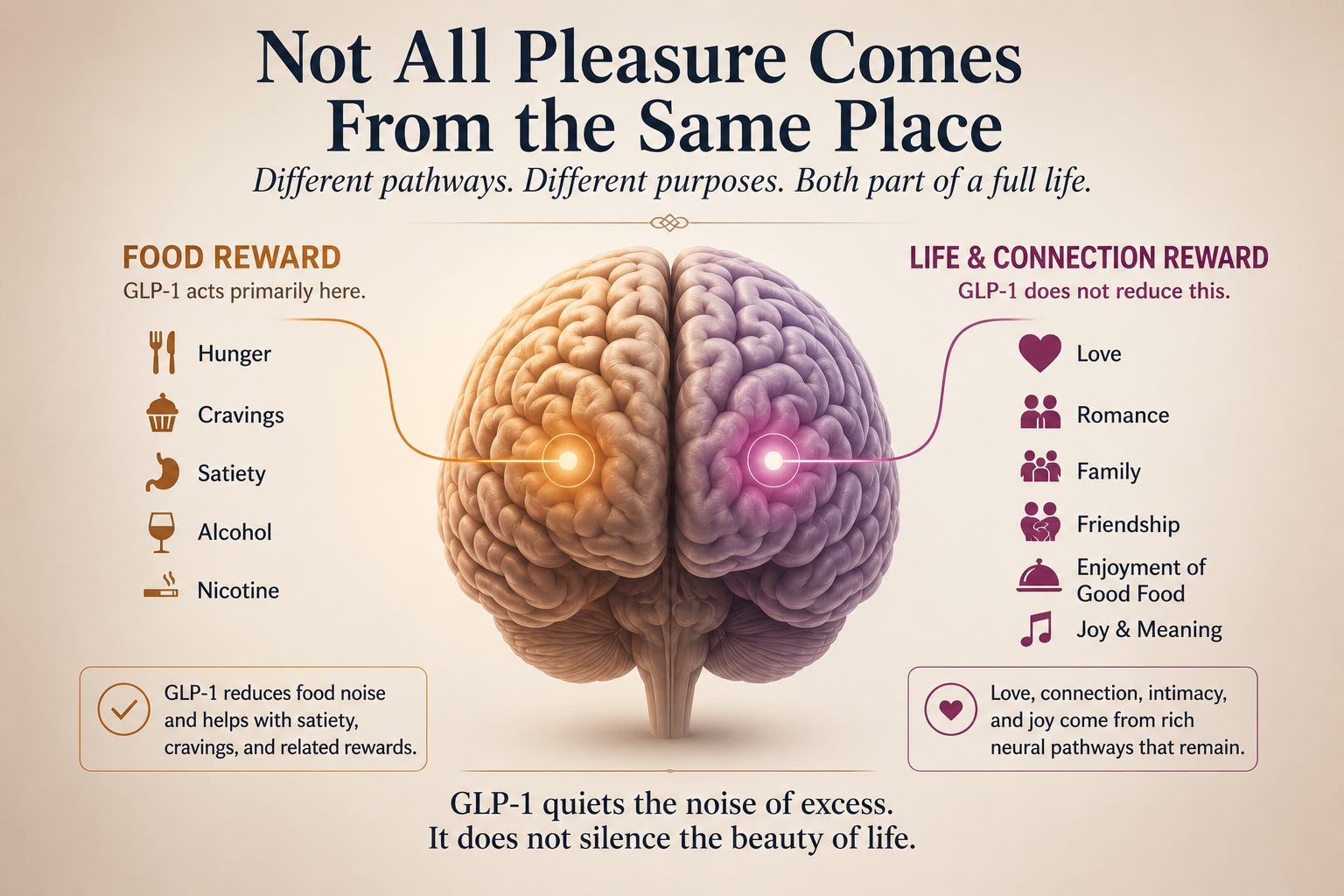
GLP-1 medications absolutely change activity in some of the brain’s reward circuits. They reduce cravings for food, and researchers are now studying them for alcohol use disorder, nicotine addiction, and other compulsive behaviors. These drugs clearly influence motivation and reward.
The question is whether all rewards are created equal.
The answer appears to be no.
The same brain that decides whether a slice of chocolate cake is worth eating is not using exactly the same circuitry that allows you to fall in love with your spouse, delight in your grandchildren, or spend an evening laughing with old friends. Those experiences overlap in the brain, but they are not identical.
Romantic attachment depends heavily on oxytocin, vasopressin, memory, shared experiences, and complex social networks that have evolved over millions of years. Food reward relies much more heavily on metabolic signaling and dopamine pathways that help us seek calories when they are needed. The systems communicate with one another, but they are not interchangeable.
If they were, dinner and marriage would be the same thing.
Fortunately for all of us, they are not. Oh do I have some stories about that. Moving on…
That distinction is important, because the strongest clinical evidence we have doesn’t show widespread emotional blunting. In fact, the only randomized trial designed to measure motivation found that people taking semaglutide became more willing to work for worthwhile rewards, not less. Large meta-analyses have also found no evidence that higher doses increase the risk of depression or other psychiatric disorders compared with lower doses.
None of that means individual patients cannot experience something different. Medicine is filled with uncommon side effects that never become common enough to appear in large trials. It does mean that, based on everything we know today, the evidence does not support the claim that GLP-1 medications routinely make people stop loving their partners or lose interest in intimacy.
The science points in a different direction.
