

GLP-1 and Muscle: The Next Chapter

There comes a point on almost every GLP-1 journey when the question changes. At first it's all about the scale. The food noise is quieter. The weight begins to come off. Clothes fit differently. Friends start noticing. Then, almost without realizing it, the question changes from "How much weight have I lost?" to "Now what do I do with this second chance?"
Then one day you wake up and think:
“I have more energy.”
“Maybe it’s time to exercise a little more.”
Or perhaps you’ve been doom-scrolling through social media and have been told that GLP-1 medications cause muscle loss. Suddenly, you’re wondering whether all the weight you’re losing is muscle rather than fat.
Let’s take a step back.
One of my favorite sayings is, “You can’t manage what you don’t measure.”
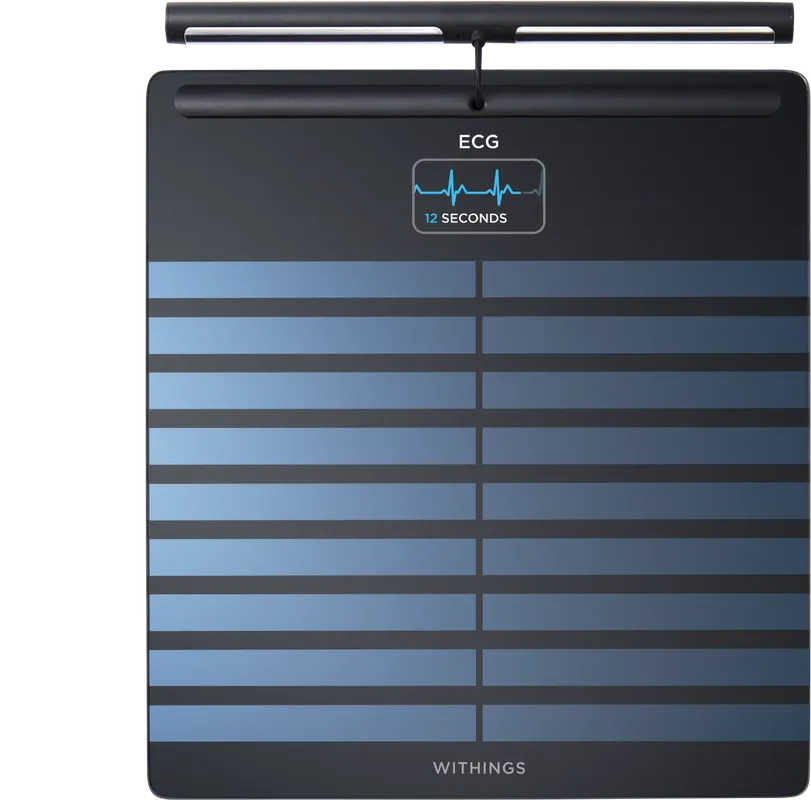
That’s why I use a Withings scale. In fact they just came out with version 2 and I love that scale. If you use the same device under the same conditions, it becomes a useful way to follow body trends, rather than obsess over single measurements.
The Withings scale estimates body weight, body fat percentage, lean body mass, muscle mass, and visceral fat. I don’t pay much attention to any one day’s number. I pay attention to where the trend is going.
Before I show you my own data, let me make something clear. This isn't evidence. It's an anecdote. I'm an N of 1. The studies come first. My experience simply illustrates them.
But after nearly two years on tirzepatide, I have watched my muscle mass increase. My fat mass has steadily declined, while my estimated muscle mass has been maintained—and even increased slightly. I don’t obsess about protein, and I don’t go to the gym.
Over the past year, I gradually increased my yoga classes until I attended three classes each week. Two of those classes are vigorous. They challenge my balance, strength, and keep my heart rate comfortably in Zone 2 for much of the session. Saturdays are different. That class is restorative—a chance to stretch, recover, and prepare for another week.
Yoga may not look like traditional weight training, but anyone who has held a long plank, balanced in Warrior III, or moved through repeated standing sequences knows that body weight can be a remarkably effective resistance tool.
Has yoga been the only reason? I can't say. But it has certainly become an important part of the story.
More importantly, it made me realize that the conversation around GLP-1 medications and muscle is often far too simplistic.
So let’s look at what the studies actually show.
What Is “Lean Muscle Mass,” Anyway?
Before we start worrying about losing muscle, let’s make sure we’re talking about the same thing.
One of the most common misunderstandings I see is that people think every pound of “lean mass” lost on a body composition scale represents muscle disappearing. It doesn’t.
When your scale reports “lean mass,” it isn’t measuring muscle fibers alone. Lean mass includes muscle, but also glycogen and water, both of which make up a large portion of what is inside healthy muscle.
Think of glycogen as your muscles’ rechargeable battery. It is the storage form of glucose, ready to provide quick energy when you exercise. Your muscles don’t store glycogen by itself. Every gram of glycogen is stored along with water. Depending on the study, each gram of glycogen is associated with roughly three grams of water, although the exact number varies.
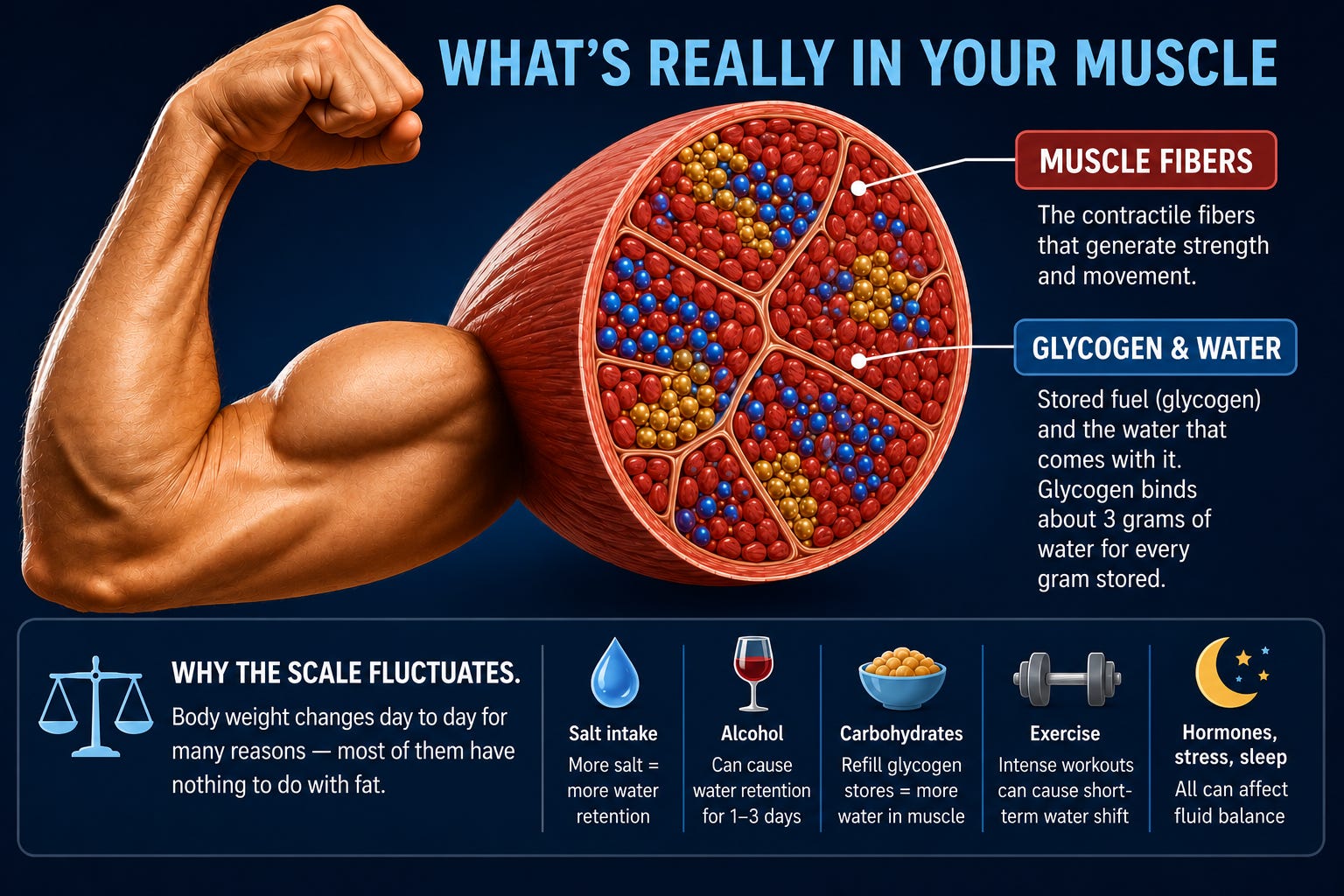
The important point is simple. Lose glycogen and you lose water. Lose water, and the scale says your lean mass has fallen. That does not mean your body has started consuming muscle fibers.
This is one reason people often lose several pounds quickly when they begin a low-carbohydrate diet. They haven’t suddenly burned several pounds of fat in a few days. Much of that early weight loss comes from using stored glycogen and the water that accompanies it. It’s real weight loss, but it isn’t the same as losing body fat.
The opposite happens too. Enjoy a carbohydrate-rich weekend, refill your glycogen stores, and your muscles pull water back in. The scale goes up, but you haven’t suddenly gained several pounds of fat overnight.
Body builders use this trick. When they want their muscles to pop, and which body builder doesn’t, they eat a high carbohydrate diet and add creatine to increase the glycogen and water in the muscle. Great body builders, before stepping on stage often manipulate carbohydrate intake, glycogen, water, and even creatine to make their muscles look fuller. It isn't new muscle. It's physiology.
Every effective weight-loss intervention behaves this way. Lifestyle programs do it. Bariatric surgery does it. GLP-1 medications do it. Low-carbohydrate diets do it. Any time the body begins using stored glycogen, some accompanying water leaves.
Over thirty years of performing bariatric surgery, I heard countless patients worry they were “eating their muscles.” In reality, what we usually observed early after surgery was exactly what physiology predicts: glycogen depletion, water loss, and then gradual fat loss. True muscle tissue is far more valuable to the body than social media would have you believe. Your body does not casually dismantle muscle fibers the moment you start losing weight.
That is also why I prefer to look at trends rather than individual weigh-ins. If I eat a particularly salty dinner, I’ll often weigh a pound more the next morning. I didn’t gain a pound of fat overnight. I retained water. If I enjoy a glass of wine with dinner, I often notice I retain water for a few days afterward. That’s just my physiology.
Oddly enough, between that and the fact that GLP-1 therapy has made alcohol far less interesting to me, my alcohol consumption has dropped dramatically. But that’s a story for another article.
The lesson is this: don’t let one number on a scale define your progress. Understanding what that number represents—and what it doesn’t—is one of the best ways to make this journey less frustrating.
Muscle Is Your Retirement Account
A few days ago I wrote that muscle is your retirement account. In fact, I think it’s a better investment than your 401(k). Money can hire someone to push your wheelchair. It can't buy back the muscle that would have kept you out of it.
So if you’re fortunate enough to live into your nineties, the question won’t be how much money you accumulated. It will be whether you can get out of a chair without someone pulling you up. It will be whether you can carry your groceries, climb a flight of stairs, travel with your family, or simply maintain your independence.
My father lived to almost 99 years old. One of the things I admired most about him was that he kept moving. He walked every day for years, and although age eventually catches all of us, that lifetime of movement paid dividends that no financial investment ever could.
Resistance training is part of that investment. Whether it’s lifting weights, yoga, Pilates, resistance bands, body-weight exercises, or simply finding ways to challenge your muscles, you are making deposits into a bank account that your future self will draw from.
So what does that have to do with GLP-1 medications?
Everything.
One of the myths surrounding these medications is that they somehow “eat your muscles.” That’s simply not what the evidence shows. Like every successful weight-loss intervention, GLP-1 therapy results in some loss of lean mass, particularly early in treatment, as glycogen and the water stored with it are depleted. But the more important question isn’t whether lean mass changes.
The real question is this:
What can we do to preserve—and even build—muscle while losing fat?
Should you exercise? Absolutely. Should you lift heavy things? If you enjoy it, why wouldn’t you? Resistance training is one of the best investments you can make in your future. It builds strength, improves balance, preserves independence, and pays dividends long after you’ve forgotten what you lifted on a Tuesday afternoon. If you are fortunate enough to live into your nineties, your future self will thank you every time you stand up from a chair without needing someone else’s hand.
My advice, however, is not simply to find a gym. It is to find the right gym culture. There is a tremendous difference between someone who teaches people how to become stronger and someone who teaches people to feel ashamed because they needed help getting there. Those are two very different philosophies, and they produce very different results.
When I came out publicly and said I was taking a GLP-1 medication, two people in the fitness world immediately reached out to encourage me. Jeremy the Hulk, who lives here in Southern California, even said, “Come by and let’s work out.” Ziegler Monster, whose wife is a veterinarian and every bit as science-minded as he is, was equally supportive. Neither one viewed medication as a shortcut. Neither one questioned my commitment. They simply saw another person trying to become healthier and wanted to help. They understood something many people still don't: medication doesn't replace discipline. It makes discipline possible for people whose biology has been fighting them for years.
Those are exactly the kinds of trainers I recommend to people. They know how to build muscle. They understand resistance training. They appreciate a Mediterranean approach to eating instead of pretending there is only one way to be healthy. Most importantly, they understand that biology and behavior are teammates, not competitors.
That, to me, is what the future of fitness should look like. If someone comes to you after losing fifty pounds on a GLP-1 and says, “I want to get stronger,” the correct response is not, “You should have done it my way.” The correct response is, “Fantastic. Let’s build some muscle.”
GLP-1 medications don’t replace exercise any more than eyeglasses replace reading. They remove one barrier. What comes next is still up to us. We still have to move. We still have to challenge our muscles. We still have to nourish ourselves well. The difference is that many of us are finally doing those things without constantly fighting a brain that is telling us to eat.
That is why I believe the best fitness professionals are not the ones who spend their time arguing about medication. They are the ones who understand how to help people take advantage of the opportunity that medication provides. They welcome people into the gym instead of testing whether they deserve to be there. In my experience, those are the coaches who help change lives.
Let me leave you with one final thought.
You don’t have to become a weightlifter. If you enjoy lifting weights, wonderful. If your passion is Pilates, yoga, Lagree, calisthenics, dancing, swimming, pickleball, cycling, or running, that’s wonderful too. The best exercise has always been the one you’ll still be doing ten years from now.
If there is one prescription I would write for almost everyone, regardless of what else you do, it would be this: spend at least twenty minutes outside every day and go for a walk.
Walk around your neighborhood. Walk through a park. Walk with your spouse, a friend, or your dog. Walk without your phone once in a while and pay attention to the world around you. You’ll improve your cardiovascular fitness, strengthen your muscles and bones, help maintain your weight, improve your mood, and probably make your dog the happiest member of the family.
We spend far too much of our lives indoors. My friend Dr. John La Puma wrote an excellent book called Indoor Epidemic, and I recommend it highly. His message is simple and important: our health suffers when we disconnect from the outdoors.
GLP-1 medications can quiet the food noise and help you lose weight. Exercise can make you stronger. Good food can nourish you. But don’t forget one of the simplest medicines we have ever known: put on a comfortable pair of shoes, step outside, and take a walk. Leave your phone in your pocket once in a while. Listen to the birds. Let your dog decide where to sniff. There is something restorative about walking that has nothing to do with burning calories.
Sometimes the best prescription doesn’t come in a bottle.
Sometimes it comes with a leash.