


What the $50,000 Longevity Clinic Won’t Tell You
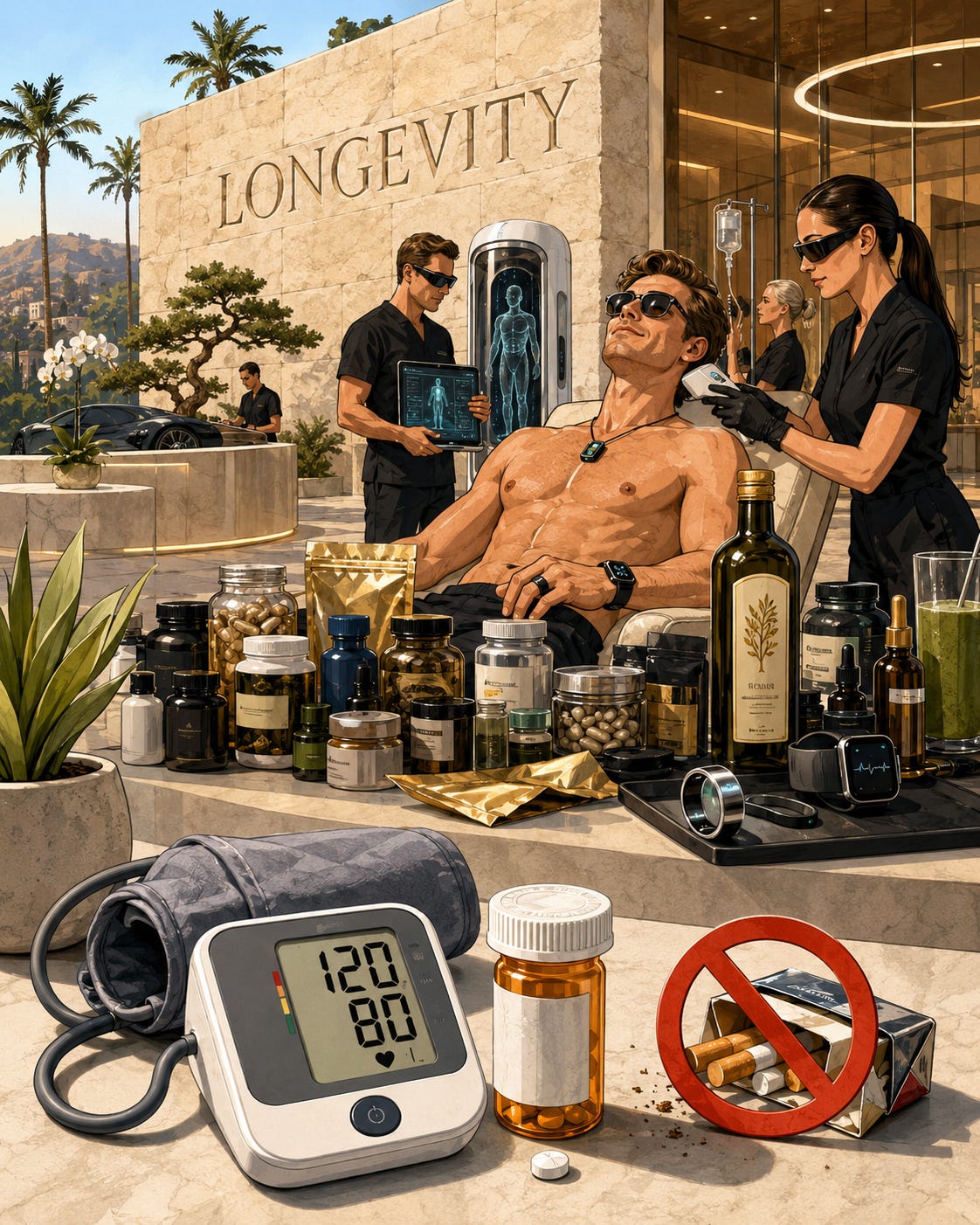
A friend of mine showed me the designs for the stone walls of the Atria Health Institute, part of their nearly 30,000 square foot office. The Atria Center opened their Beverly Hills branch, and was founded by entrepreneur Alan Tisch. This was not a stone for the wall, the entire wall was one solid piece of stone, cut carefully by a computer to be part of the office for people paying tens of thousands of dollars a year to get tested, prodded and prescribed the latest luxury packaging of concierge-preventive-longevity medicine.
This business is booming, I thought, as a boomer. In an economy plunging for most people, the wealthy flock to try to touch the immortal. All I could think of is that we have these insufferable individuals around for longer. Atria’s clients are paying tens of thousands of dollars for services available from a good primary care physician, or what that physician can refer you for.
If someone is offering to make you live past 100 and they are 40, you should probably dismiss them. Instead of trying to live to 150, focus on what we actually know: how to function well for as long as possible.
Or, as the old line goes, “I would have taken better care of myself if I knew I was going to live this long.”
Taking Longevity Advice from People younger than I am
The world is filled with longevity experts, like Bryan Johnson. Trying to find ways to sell you his protocol. He was born 20 years after I was. Sometimes he gets the blood products from his son to find some Draculan way to boost his longevity.
He will sell you his Blueprint Longevity Protein and other supplements. Johnson takes some 50 to 100 a day, and can be yours for $449 per month (the Big Stack Box). Of course, there are other (less expensive) options. He even sells olive oil - his brand of course.
I’m 69, and I’m doing just fine
Oddly, I’m doing fine at 69 years old. For the past few years, I have seen what happens when people of my age don’t take simple steps to take care of themselves. You don’t need to spend $20,000 to $70,000 a year to implement these steps and improve your life and health span. Human lifespan has increased, but what I am more interested in is extending my period of healthy functioning.
People in the luxury business of longevity target upper middle class individuals. They convince them to buy the “regenerative farm olive oil” that doesn’t use pesticides, costing many times more than standard olive oil. They make their money targeting high-income people with solutions inaccessible to most Americans. Making these solutions seem “exclusive.” The solutions are not exclusive. Even with the “inexpensive” $20,000-a-year package, most of what matters for your health span is available through a good primary care physician and the specialists they refer you to.
A Good Primary Care Physician
When I renewed my Crestor, my doctor from the UCLA system spent ten minutes, of which nine filled out information on the computer. The rest was a quick look at me, stating, “How are you doing?” and then “Probably time for a colonoscopy.”
In contrast, my primary care doctor in Alaska, now retired, closed his laptop after looking at my labs and said, “So, Terry, what is going on in your life?”
This is the reason many people who can afford it flock to places like Atria. Time with a doctor, time to be seen, heard and probed with the latest gadget to feel as if they are getting the best. You don’t need to spend that money to get quality care and a quality primary care physician.
Think of healthcare in two systems: one is the preventive, primary care side that takes care of your medications, screens you for diseases (breast cancer, colon cancer, heart disease, etc). And directs you to be as self sufficient as possible for your health.
The other is the hospital system. This is for when things fall apart. You need surgery, whether to remove a gallbladder, repair your aorta or replace your knee. Your job is to stay out of that system, but if you must interact with it you want to find the best in the business.
I chose UCLA for the second reason. Perhaps my years in surgery led me to worry about the worst that might happen, and which hospital system do I want to take care of that issue. UCLA is a good answer, while their primary care doctor is marginal.
In contrast, my producer (20 years my junior) has her care from the Kaiser network, where she loves her primary care doctor, if not occasionally constrained by a system that demands she stay within it. Her job is to stay out of the hospital system and have a good PCP (primary care physician) to do that.
I travel a lot, so while I appreciate the Kaiser system, I want flexibility wherever I go. Kaiser, if you need their tertiary care, has excellent physicians and facilities.
The primary care physician can assist you with daily living. For most of your care, this is who you need to interact with, and finding one who will know you, take their time with you, and keep you out of a system or prevent problems from turning into emergencies is what you are looking for. If they are associated with a system you like, that is great. That is not a requirement, however.
When my friend needed a knee replacement, I knew who to recommend. The surgeon had great outcomes, but his personality is one you would never invite into a social circle because he is boring. Most important, he is an excellent technician, with a great support staff. You want a primary care doctor who knows their system, or you want to go to a system so uniformly excellent that it is unlikely to have a bad choice.
Stress Comes From People
I spent a stressful career as a surgeon, and I loved the operations, the trauma call, and the technical aspect of surgery. What bothered me were those things I could not control: always involving people, because as my late brother told me, no matter what you do, the stress comes not from your job, but from the people you work with. Surgeons are, for the most part, assholes. Hospital administrators took our playbook and perfected it. Surgeons are aggressive; administrators are passive-aggressive. We tell you exactly what we think. They nod thoughtfully, tell you they hear your concerns, and quietly wonder whether your suggestion will affect their seven-figure bonus. I say this, telling you that one of my best friends is a surgeon. Unfortunately, I fall into the surgeon’s personality.
My brother was a pipe fitter. His greatest stress was people, and he imparted on me that wisdom that no matter what job you have, your stress will come from people. Those who don’t pull their weight, those who are officious, those who think being an “inspector” gives them a license to harass with impunity.
I live in a community where my friends retired early to avoid the stress of the job, and yet the stress they have is from some of the people they have to deal with. Be that the HOA “Karen” or the “Chads”, the city government officials who need to put in a stop sign where there have been five accidents in the last year, the neighbor with the dog who barks too loud, or the overcompensating friend who talks over everyone and knows everything.
Yes, you can love your job, and be around people that are stressful. My job was stressful, but it was never the blood I saw that bothered me. It was the blood I heard.
There is no supplement that will make those people change. There is no meditation that will give you “serenity now.” Change jobs, careers, locations, and all that is fine - expect the people around you will have their own Chads and Karens.
Take Care of Yourself - Don’t Smoke, or if you do, stop.
For all my brother’s wisdom, he smoked, since he was 14 years old. The happiest of kids, the most popular guy who everyone loved. At his funeral, people who knew him as a kid paid their respects. He was a good man who everyone loved.
But his life was cut short - not because he didn’t take the BJ supplements, but because his lungs, having survived Hodgkins and being irradiated when he was younger, found some cells that became malignant, and by the time they were discovered, had metastasized throughout his body.
I stopped working in hospitals several years ago, and now do wound care at nursing homes, helping those with wounds, ulcers, sores get them better. I see people who are my age or younger, that didn’t do well. They smoked.
When I meet someone older than I am, who is in good health, I ask if they smoke, but I know they don’t. Some had quit, most never started. I don’t see active smokers in their 80’s and 90’s - and I am sure there are some, but they are rare.
One of my favorite patients died last week. I’d known him for several years. He had suffered a devastating stroke years ago, and couldn’t speak but a few, but could understand, and was one of those people who always smiled, always remembered you, and made you feel better. He continued to smoke. Several times a year, I would ask if he would quit, and he would laugh and shake his head. He indicated that his lot in life now, unable to use half his body, unable to express himself well, was just relegated to people like me coming by and talking to him, and he was waiting to die. He got his wish, sadly he was confined to his bed the last few weeks, and I am sure the one thing he wished he could do was go outside and have a cigarette. Tortured by your habit.
Mind your blood pressure
This is an easy one. You won’t feel your blood pressure, so you have to measure it. If your blood pressure is high, get it under control. You think your blood pressure is fine and you only have “white coat syndrome.” You don’t you have high blood pressure.
Practical Advice From Someone Who Isn’t in Their 40s
How to Find a Good Doctor, Avoid Chad and Karen, Stop Smoking, and Check Your Damn Blood Pressure
