


This Week in Medical News
Throughout the week, I read medical journals so you don’t have to. Some weeks there is a common thread that immediately jumps out.
And sometimes the stories seem unrelated until you begin to pull on them. This week, headlines ranged from measles to peptides to contaminated lettuce. I kept coming back to the same conclusion: medicine has become increasingly political.
Viruses do not care who you voted for, bacteria don’t read social media, and plaque in your coronary arteries has no political opinion.
Rand Paul and Anthony Fauci
The biggest medical/political story was Anthony Fauci appearing before Senator Rand Paul’s committee. It was sad to see an 85 year old giant in the field take the fifth. Rand Paul telegraphed he wanted Fauci to say something that contradicted what he said in 2021, then refer Fauci for perjury.
The conspiracy types want to believe COVID-19 was made in a lab, then leaked, leading to world wide chaos, all because of Fauci. Oddly, they also state the virus is nothing more than a cold, so I am not sure what their issue is.
I worry about what happens when a future public health physician sees this circus. Easier to stay in university or private practice. We need good people in public service. But who could blame them if they worry they may spend their retirement defending every email, every meeting, every recommendation, and every imperfect decision made in the middle of a rapidly evolving crisis? We absolutely need accountability. We also need good people willing to accept impossible jobs.
Measles Makes a Comeback
While cameras focused on Washington: The United States recorded 2,371 measles cases, making 2026 the worst year for measles since 1991, and we still have four plus months left in the year. I have repeatedly received the same question over the past several weeks: “How many of these cases came from people who entered the United States illegally?”
The answer is none.
That surprises some people, because it does not fit their narrative , or from their echo chamber online. The CDC investigates measles aggressively. Travel history is documented. Contact tracing is performed. Imported cases are identified separately from domestic transmission.
This year, there have been imported cases from citizens who travel internationally. But once they brought measles into susceptible communities, the spread occurred among people with inadequate immunity.
We can talk immigration policy - I won’t. But the issue is that public confidence in vaccines has declined.
Vegetable Confidence
The Cyclospora outbreak causes many Americans to avoid vegetables. I admit, I ordered a burger without lettuce.
A major outbreak of cyclospora was linked to shredded iceberg lettuce. The lettuce came from a farm in Central Mexico, whose lettuce was distributed mostly to the Midwest. And now forty percent of Americans are eating less produce because of the outbreak.
That response illustrates that fear spreads faster than cyclospora. The answer to contaminated lettuce is not to abandon salads forever.
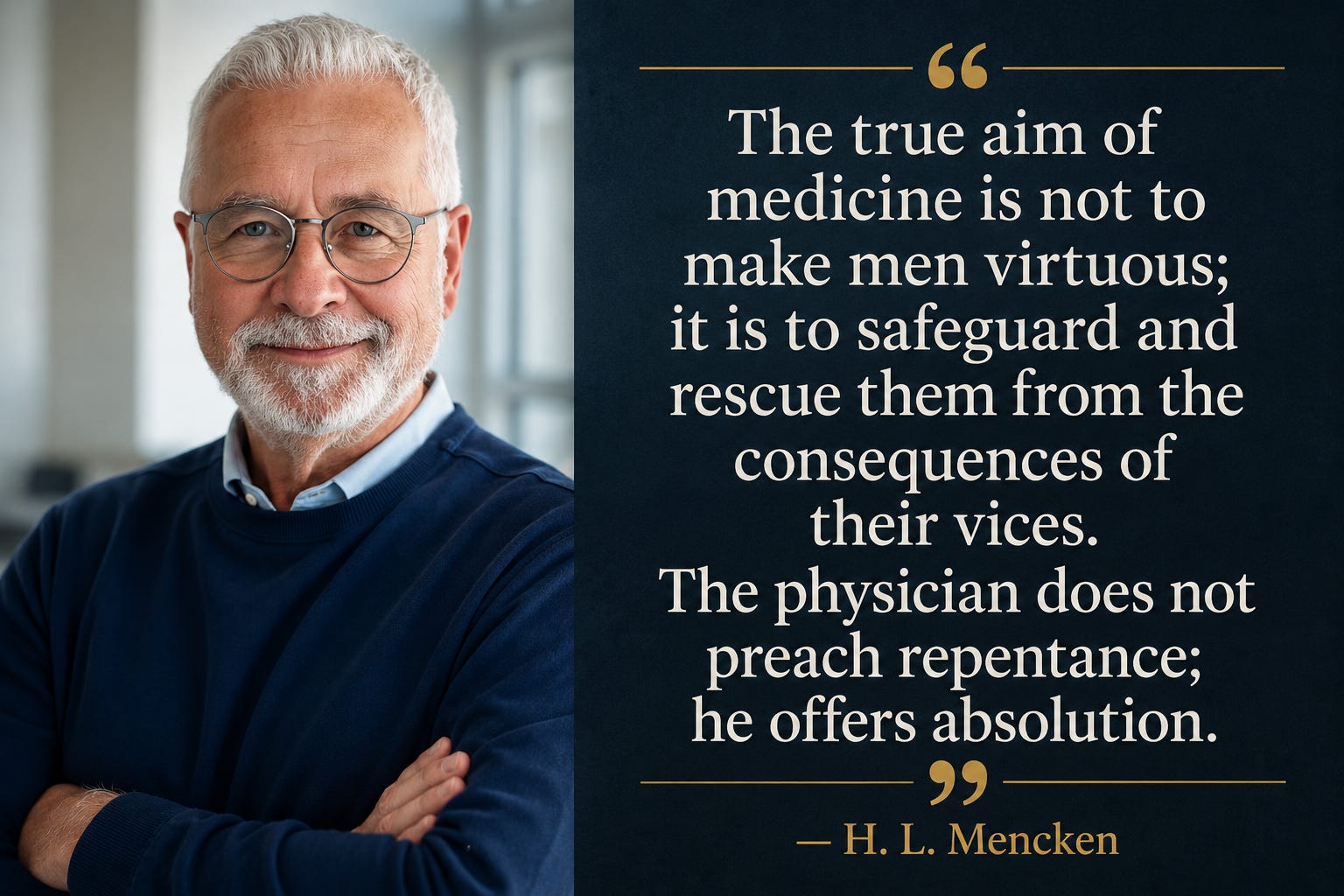
Before we move on to the next headline, I think H. L. Mencken captured something medicine occasionally forgets. Our job is not to decide who deserves illness. It is to understand disease, evaluate evidence, and help people recover.
Peptides and Gym Bros
Another story that generated much excitement involved peptides. Depending on which influencer you follow, you may have heard the FDA “approved” a collection of popular peptides this week. That is not what happened.
An FDA advisory committee recommended that several peptides be eligible for compounding under very specific circumstances. FDA scientists expressed concerns about the lack of human safety data for several of those peptides, and unanswered questions about manufacturing.
An advisory committee recommendation is not the same thing as FDA approval. Nor is a compounded product the same thing as an approved medication. By the time the story reaches social media, “an advisory committee recommended a pathway for compounding” somehow becomes “the FDA proved these peptides work.”
Not every story this week involved controversy. Below are some of my favorites.
Blood Test for Colon Cancer
The FDA approved a blood test for colorectal cancer. This is blood, not stool, not blood in stool, but a sample of blood.
That is good news, because any screening test that persuades people to participate improves our ability to detect cancers early.
The test detected most existing cancers, but it was not effective at identifying precancerous polyps. Colonoscopy remains the gold standard, because it does more than detect disease. It prevents disease by removing those polyps during the examination. Blood tests are not a replacement for colonoscopy.
GLP-1 Data after Treatment
We also saw encouraging data on GLP-1 medications. A study following patients taking semaglutide found participants continued to eat fewer calories, despite increasing hunger.
Hunger, food noise, satiety, and calorie intake are related, but they are not identical. Many patients tell me that while they occasionally feel hungry, they are satisfied with much smaller portions and not compelled to keep eating. This is also what I’ve experienced.
GLP-1 Reduce Fragility in Elderly - the opposite of what some have stated
Another study suggested that GLP-1 medications may reduce fragility fractures in older adults with type 2 diabetes. The group studied had 21% lower risk of fractures over three years in adults aged 50 to 90 with type 2 diabetes. This protective effect is independent of weight loss or blood sugar control.
The fractures occurred in the spine, or vertebral fractures (32% reduction) and hip/femur fractures (30% reduction). I might remind you that there is a significant anti-GLP-1 community who provoked fear in people by stating that GLP-1 will lead to muscle loss in elderly adults. We still recommend bone density scans for GLP-1 users. But know this, with any weight loss, there will be bone remodeling and bone loss. Resistance exercises are still recommended.
A smaller study alternatively reported an 11% increase in fracture risk. This small study was too small to reach statistical significance. Stay tuned.
Calcium Scoring on Routine CT scans
Ever get a chest CAT scan? Researchers found that some chest CAT scans, ordered for coughs or lung checks, had calcium in the arteries going to the heart. There was enough calcium that physicians could identify cardiovascular risk. This means we can save some patients having to order an additional scan. The Researchers showed that risky coronary plaque increases as traditional cardiovascular risk factors accumulate (no surprises here).
Doctors can now use these existing scans to forecast future heart disease risk, just as effectively as a calcium heart scan. Saving patients from extra medical bills and unnecessary radiation exposure. Insurance does not cover most cardiac calcium scans.
If you are over 50, you should ask your doctor to review any recent chest CT scan reports for mentions of “incidental calcium” or “calcification.” That finding can help guide decisions about starting preventative heart medications, like statins or other medications. Although, I would prefer you take the medicine before you get a calcified plaque.
National Blood Supply Crisis - please donate blood
The American Red Cross declared a national blood supply crisis, with less than a one-day supply of O-positive blood available. As a surgeon, I have stood in operating rooms where donated blood meant the difference between life and death. Blood cannot be manufactured. It cannot be synthesized in a laboratory. It still depends on one person rolling up a sleeve to help another person they will never meet. If you are healthy and eligible to donate, this would be an excellent week to do so.
Four Things I’m Telling My Patients This Week
One advantage of spending the week reading journals is that I usually come away with a few practical lessons. Medical news can be fascinating, but my readers rarely ask me to summarize a journal article. They ask a much simpler question: “Doctor, what should I do?”
This week I have four answers.
