


The Unfiltered MD
Medicine This Week: Good News, Bad News, and What Actually Matters
Medicine is rarely all good news or all bad news. This week is a perfect example.
We have encouraging news: more Americans than ever are receiving treatment for obesity. The U.S. death rate has reached its lowest point on record, and influenza vaccination continues to save children’s lives.
We also have concerning news: Cyclospora continues to spread across multiple states, measles is approaching yet another record year, and we’re reminded again how quickly speculation can outpace facts when a public figure suddenly dies.
Let’s separate what we know from what we don’t.
Lindsey Graham: What We Know—And What We Don’t
The death of Senator Lindsey Graham has led to the inevitable speculation online. As of this writing, no official cause of death has been released.
We know he reportedly experienced chest pain before collapsing into cardiac arrest.
It’s important to understand that cardiac arrest is not a diagnosis. It simply means the heart has stopped beating effectively. The real question is: what caused it?
While we don’t know the answer in Senator Graham’s case, we know the most common life-threatening causes of sudden chest pain followed by cardiac arrest.
Many conditions can cause chest pain—acid reflux, muscle strain, gallbladder disease, pneumonia, and even anxiety. But when someone develops sudden chest pain and then collapses into cardiac arrest, the most common cause is an acute problem with the heart’s blood supply.
The leading possibility is an acute heart attack, or myocardial infarction. This occurs when a cholesterol plaque inside one of the coronary arteries becomes unstable and ruptures. Many people imagine a heart attack happens because an artery slowly narrows until it is almost completely blocked. Surprisingly, that’s often not the case. A relatively small plaque can suddenly tear. The body sees that tear as an injury and quickly forms a blood clot over it. Within minutes, that clot can completely block the artery.
The heart muscle beyond the blockage is suddenly deprived of oxygen and begins to die. If the blocked artery supplies a large enough portion of the heart, the muscle becomes electrically unstable, causing a fatal rhythm, such as ventricular fibrillation, and sudden cardiac arrest. Smaller heart attacks often damage less muscle and can often be treated successfully if blood flow is restored quickly.
You may have heard the term “widow maker.” This usually refers to a blockage high in the left anterior descending (LAD) coronary artery. That vessel supplies blood to a large portion of the heart muscle, so when it suddenly becomes blocked, a tremendous amount of muscle is at risk. Without immediate treatment, these heart attacks can be rapidly fatal.
Another important possibility is pulmonary embolism. After prolonged sitting—such as during long-distance air travel—a blood clot can form in the deep veins of the legs or pelvis. If that clot breaks loose, it travels through the bloodstream and lodges in the arteries of the lungs. A large pulmonary embolism can cause sudden chest pain, severe shortness of breath, collapse, and cardiac arrest within minutes. Since he just returned from a long flight, this is always a possibility. This is why we want you to walk a lot on planes and keep up your hydration.
A third life-threatening cause is an aortic dissection. In this condition, the inner lining of the aorta, the body’s largest artery, tears. Blood enters the wall of the vessel and creates a false channel between its layers. If that tear extends to the coronary arteries that supply the heart, it can suddenly cut off blood flow to the heart muscle, causing severe chest pain, heart attack, and death. It is one of the true emergencies in cardiovascular medicine.
There are other causes of sudden cardiac arrest, including serious heart rhythm disorders, myocarditis, and inherited heart conditions. These three represent some of the most common life-threatening causes of chest pain followed by collapse.
The same lesson applies to Senator Mitch McConnell. We still do not know exactly what caused his medical emergency. The encouraging news is that he survived the initial event, received CPR, and remains hospitalized. Surviving long enough to reach the hospital generally carries a much better prognosis than dying before medical care can be provided. However, until physicians identify the underlying cause, it would be irresponsible to speculate.
That’s really the lesson here.
Medicine isn’t about making the fastest diagnosis on social media. It’s about making the right diagnosis. Sometimes the most accurate answer is also the least satisfying:
We don’t know yet.
If there is one takeaway from these events, it is this: never ignore sudden chest pain, especially if it is accompanied by shortness of breath, sweating, nausea, fainting, or collapse. Call 911 immediately. Minutes matter, and early CPR and rapid defibrillation remain the best chance of surviving sudden cardiac arrest. Don’t assume it is heartburn, because it could be your heart burning.
Cyclospora Continues to Spread
Last week I wrote about the growing Cyclospora outbreak. Unfortunately, it has continued to grow.
By the time you’re reading this, the number of reported cases will likely be approaching 3,000 across more than 30 states, with Michigan remaining the epicenter. Investigators continue to search for the source, but no specific food has been identified despite an extensive investigation.
I’ve seen rumors online—and even a report briefly appeared before disappearing—suggesting investigators had narrowed the search to certain vegetables. Until the FDA or CDC officially identifies the source, I’d be cautious about repeating those claims. Early leads in food-borne outbreak investigations often turn out to be dead ends.
So what am I doing?
I’m not avoiding fruits and vegetables. Evidence supporting diets rich in produce hasn’t changed because of one outbreak.
I am making a few temporary changes to my own routine.
For now, I’m avoiding bagged salads and pre-cut leafy greens. I’m choosing vegetables that I can peel or cook, and this week I’ve been cooking most of my vegetables rather than eating them raw. Even if I order a burger, I’m skipping the lettuce and tomato until we know more.
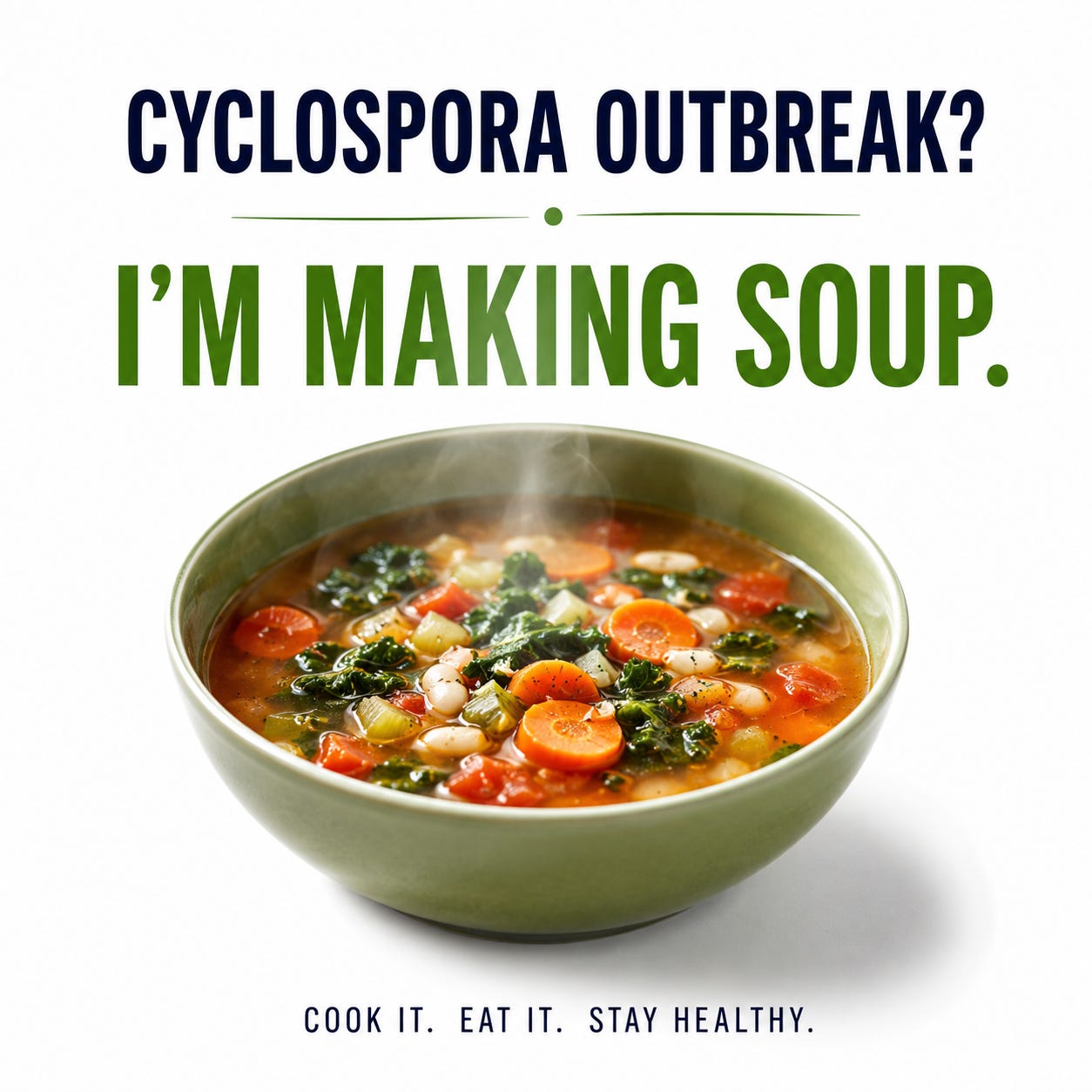
The silver lining? It’s a great week to make vegetable soups, roast vegetables, or throw together a ratatouille. Cooking vegetables won’t erase all risk from every food-borne illness, but it does reduce the risk of many pathogens. It is an easy way to keep eating the foods we know are good for us.
Now, about washing produce.
You’ll hear all kinds of advice online about soaking vegetables in vinegar, baking soda, special produce washes, or other concoctions. None of those has been shown to reliably eliminate Cyclospora from contaminated produce. Plain, cold running water is still the recommendation. Washing may not remove every Cyclospora oocyst, but it helps remove dirt, bacteria, pesticide residues, and many other unwanted contaminants. So keep washing your fruits and vegetables—just don’t expect vinegar to perform miracles.
If you own a home plutonium-powered irradiation unit, that would probably solve the problem. I don’t know anyone who has one. Irradiation of produce can be done, and would solve this problem, but hey…
And yes, if you’ve been looking for an excuse to launch Brussels sprouts across the yard with a slingshot...well...I’m not officially recommending that either.
One final reminder: this is not a worm. Parasite cleanses won’t prevent or treat it. Ivermectin will not treat it either. If you’ve had several days of persistent watery diarrhea—especially after eating fresh produce—ask your physician whether Cyclospora testing should be included with your stool studies. Standard ova-and-parasite examinations may not detect it unless the laboratory specifically looks for it. Fortunately, when diagnosed, the infection usually responds well to the antibiotic trimethoprim-sulfamethoxazole (TMP-SMX, Bactrim or Septra), which significantly shortens the illness.
GLP-1 Medications Reach Mainstream America
One of the most remarkable stories this week came from Gallup.
Fifteen percent of American adults report having used a GLP-1 medication for weight loss at some point.
Eleven percent say they are currently taking one. I am one of those people.
Pause for a moment and think about that.
Just a few years ago, many people had never heard the words semaglutide or tirzepatide. Today, more than one in ten American adults reports using one of these medications.
Even more interesting, Gallup found that the nation’s obesity rate has fallen from a peak of 39.9% in 2022 to 36.4% this year.
The survey cannot prove that GLP-1 medications caused that decline. Many factors influence obesity rates. But this is the first bump in the curve we have seen, despite the popularity of low carb diets and carnivorism.
But for years obesity specialists argued that when effective treatments became available, we should expect to see changes at the population level.
For the first time in decades, we’re beginning to see those numbers move in the right direction.
The conversation has also changed.
A few years ago, people asked whether these medications worked.
Today, the better question is: How do we use them well? Or how can we afford them.
That means preserving muscle through resistance exercise, eating adequate protein, getting enough fiber, staying physically active, and recognizing that these medications are tools—not magic.
Your Smartwatch Knows More Than Your Doctor
Nearly every physician surveyed by the American Medical Association would gladly review information collected by wearable devices.
Fewer than six percent have actually integrated that information into routine practice. Why?
Because our healthcare system wasn’t built for continuous streams of data. Most physicians use an electronic medical record system, and some are not equipped to integrate the data. Some are, check with your primary care physician.
Your watch may collect heart rhythm information every few minutes, monitor sleep, detect falls, measure activity, estimate oxygen saturation, and increasingly use artificial intelligence to identify trends.
Meanwhile, your physician often has fifteen minutes to review medications, examine you, answer questions, document the visit, complete insurance requirements, and formulate a treatment plan.
The technology is ready. The healthcare system isn’t.
I remain a fan of wearable technology. Detecting atrial fibrillation, identifying abnormal heart rhythms, recognizing falls, and allowing someone to call for help from almost anywhere are meaningful advances in preventive medicine.
One big one - I am a fan of home blood pressure monitoring. Learn to do this at home, and bring your unit to your doctor to calibrate it against yours. Bringing your information to the doctor is helpful.
Now we simply need healthcare to catch up.
Measles Continues Its Comeback
Unfortunately, measles continues to spread across the United States.
The country is rapidly approaching last year’s record number of reported cases, and we’re only halfway through the year.
Measles was declared eliminated in the United States in 2000.
That didn’t mean it disappeared worldwide. It meant imported cases rarely produced sustained transmission.
That protection depends on maintaining high vaccination rates.
When communities become under-vaccinated, measles finds opportunities.
This isn’t a theoretical discussion anymore.
It’s happening.
Some Good News for a Change
Medicine isn’t only about problems.
Sometimes we should celebrate progress.
The U.S. Death Rate Reached Its Lowest Level Ever Recorded
That headline deserved far more attention than it received.
Despite an aging population, despite chronic disease, despite the challenges facing healthcare, Americans experienced the lowest recorded death rate in our nation’s history.
Medicine often gets criticized—and sometimes deservedly so—but it’s worth recognizing when decades of better prevention, better treatments, and better emergency care produce measurable improvements.
Influenza Vaccination Continues to Save Lives
A new study found that influenza vaccination reduced children’s risk of dying from influenza by approximately 80%.
Think about that. Not preventing sniffles. Preventing death.
Vaccines don’t have to be perfect to make an extraordinary difference.
One Outbreak Ends
The World Health Organization officially declared the recent hantavirus outbreak aboard a cruise ship over.
After months of investigation, contact tracing, and quarantine, the outbreak has ended.
It’s a reminder that public health successes rarely become headlines.
Food Matters—Especially Early in Life
Researchers continue to examine the relationship between diet and brain development.
A new study found that higher consumption of ultra-processed foods during early childhood was associated with measurable differences in brain regions involved in reward and emotion by age six.
Association is not causation. The study cannot prove that ultra-processed foods caused those differences.
But it adds to a growing body of evidence suggesting that the foods children eat during the earliest years of life influence far more than weight.
Another international study reached a different but equally important conclusion: children simply aren’t eating enough fruits and vegetables.
Ironically, American toddlers perform relatively well.
Teenagers? Not so much.
Healthy eating isn’t built in high school. It’s built long before then. This week, roast the vegetables and use an immersion blender to put them into the marinara sauce with the whole wheat pasta. They won’t know it is good for them.
Quick Notes
Alcohol after bariatric surgery
Researchers continue to confirm what bariatric surgeons have observed for years: alcohol is absorbed more rapidly after gastric bypass and sleeve gastrectomy. One drink after surgery may have a much greater effect than patients expect. If you’ve had bariatric surgery, drink cautiously—and never assume your previous tolerance still applies.
This Week’s Note to Paid Subscribers
Normally this is where I close the door and invite paid subscribers into the library.
We’d spend another 2,000 words dissecting one paper, looking at the statistics, discussing the limitations, and separating what the research actually showed from what the headlines claimed.
This week feels different.
Every one of these stories affects patients, families, and the conversations we have every day.
So this week’s newsletter is free for everyone.
To those who support this work with a paid subscription, thank you.
Your support lets me spend hours reading original studies instead of repeating press releases. It gives me the freedom to write without chasing clicks, and allows me to make weeks like this available to everyone.
Next week, we’ll return to our usual format with a members-only deep dive into one topic that deserves more than a headline.
Until then, wash your vegetables, don’t ignore chest pain, wear your smartwatch if you have one, get vaccinated when appropriate, and remember:
The goal isn’t to win arguments. The goal is to get the science right.