


Explosive Diarrhea, Norwegian Soccer, and Why Good Medicine Is Usually Boring
Weekly I sit down with a cup of coffee, look over the week’s medical news, and ask myself the same question: What would I tell my patients if they were sitting across from me? This week the answer came quickly. We’d spend a few minutes talking about a microscopic parasite called Cyclospora cayetanensis, then we’d probably wander into coffee, dementia prevention, obesity, and somehow Norwegian soccer. Medicine has a way of doing that.
Speaking of Norway, I have something to confess. After watching Norway knock Brazil out of the World Cup, I ordered a Norwegian soccer jersey. They haven’t paid me. They haven’t promised me salmon. They certainly haven’t offered me lutefisk. I simply decided that if Erling Haaland is going to keep scoring goals like that, I should probably support the homeland. Don’t worry if you’re not cheering for Norway. I’ve accepted that not everyone gets to be Norwegian.
Now, back to the parasite.
When I wrote about Cyclospora a few days ago, the CDC was reporting just over one hundred confirmed cases across the country. Since then, Michigan has reported more than 700 cases (30 hospitalizations) in what officials are calling a large and growing outbreak, New York continues to identify additional cases, and investigators are still trying to determine which food links them together. That’s how outbreak investigations work. We usually know what is making people sick before we know which food is responsible.
One of the reasons this outbreak is so difficult to solve is that Cyclospora is in no hurry. Most food poisoning announces itself within hours. Cyclospora waits. Symptoms usually begin seven to ten days after you eat contaminated food. By the time you’re making repeated trips to the bathroom, the salad that caused the problem is the one you don’t even remember eating. It may have been the lettuce on a hamburger, a little cilantro sprinkled over tacos, or the side salad that came with dinner because you were trying to make one healthy decision that day. Epidemiologists are asking people to remember meals from last week, and most of us can barely remember breakfast.
A parasite isn’t a parasite, unless it is
Another misconception that filled my inbox this week is the word parasite. People immediately picture worms. Cyclospora isn’t a worm. A parasite isn’t defined by what it looks like; it’s defined by how it lives. A parasite survives at the expense of another organism. Think of it as biology’s version of the cousin who still lives in the basement, eats somebody else’s food, never pays rent, and somehow always has time to comment on my Substack. Cyclospora is actually a microscopic protozoan, much more like the paramecium you looked at under a microscope in high school biology than a tapeworm.
It’s tiny—only about eight to ten microns across. Remember the old philosophical question about how many angels could dance on the head of a pin? I have a different question: how many Cyclospora could fit there? Quite a few. You won’t see them on your lettuce, you won’t smell them, and no amount of staring at your Caesar salad is going to reveal them.
How to Wash your Produce - and why
That naturally led to another flood of questions: vinegar? Baking soda? Vegetable washes? Ultrasonic cleaners? Ozone machines? Running water is still the recommendation. I wash every fruit and vegetable under running water. I use a vegetable brush on carrots, potatoes, parsnips, cucumbers, and melons, then I throw the brush into the dishwasher. If I’m peeling vegetables, I wash them first, wash the peeler afterward, and then give the peeled vegetable one more rinse. Will that remove every Cyclospora organism? Probably not. Trying to get every one of these tiny protozoa off a head of lettuce is like trying to get glitter out of shag carpet—or cleaning up after somebody throws a glitter bomb while you’re wearing Velcro. It isn’t going to happen perfectly. That’s not why we wash produce. We wash it because we’re removing dirt, bacteria, pesticide residues, and a whole collection of other things we’d rather not eat. Reducing risk has always been the goal.
I also continue to recommend salad spinners. I seem to buy one every time I move because they disappear somewhere between kitchens, but they’re worth replacing. Dry lettuce tastes better, and if we’re trying to encourage people to eat more vegetables, making salads more enjoyable isn’t exactly a bad strategy.
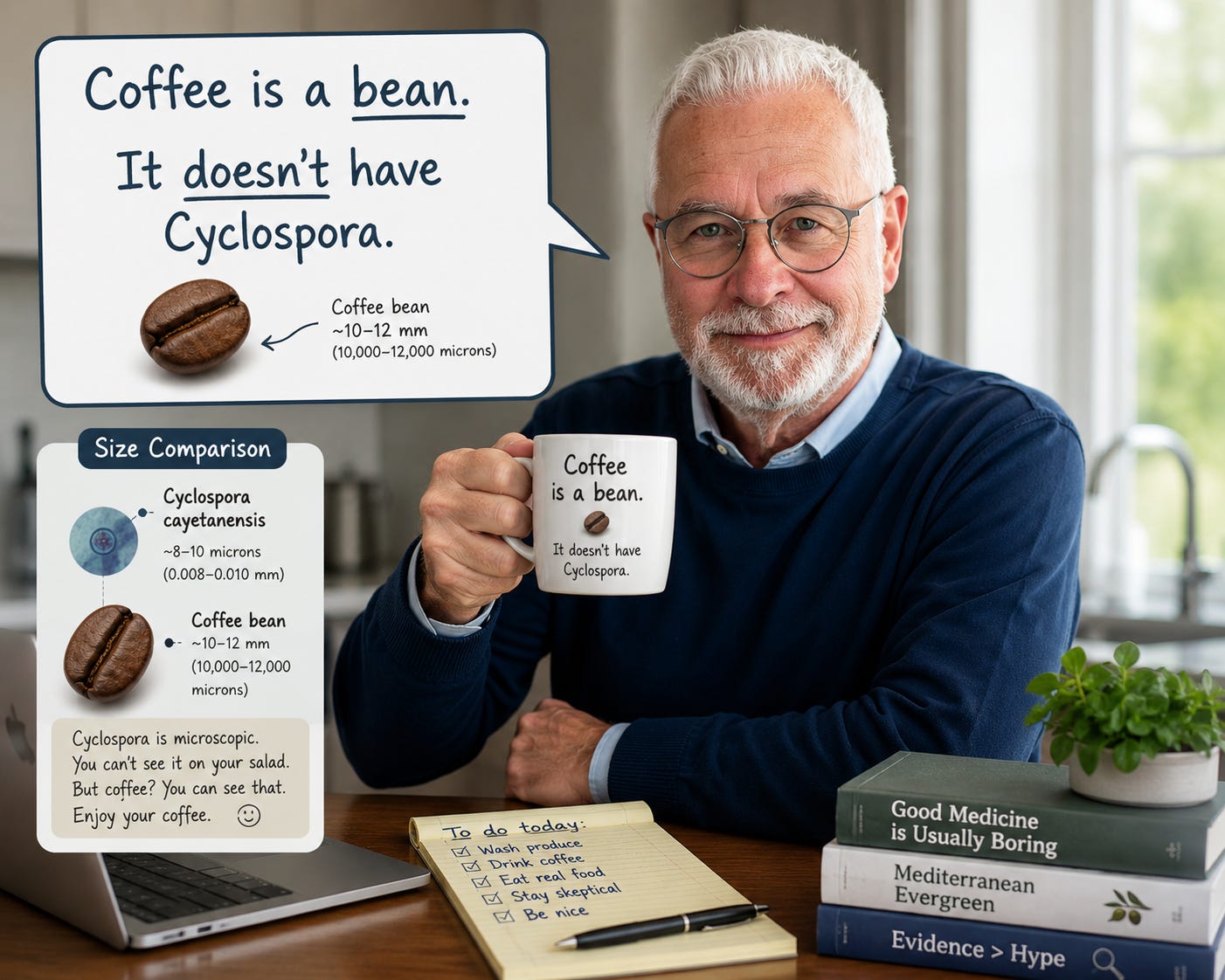
A Parasite Cleanse
One final myth deserves to die. Please don’t buy a “parasite cleanse.” It won’t treat Cyclospora. It won’t reliably treat intestinal worms. It will, however, improve the financial health of the person selling it. If you truly have Cyclospora, the treatment is trimethoprim-sulfamethoxazole—Bactrim. If you’re allergic to sulfa antibiotics, your physician has other options, but first you need the diagnosis. Remember, not every case of explosive diarrhea is Cyclospora. Norovirus, Salmonella, Campylobacter, certain strains of E. coli, inflammatory bowel disease, and even medications can all produce similar symptoms. Not every stool test automatically looks for Cyclospora, so if you’ve had persistent watery diarrhea during this outbreak, it’s worth mentioning that possibility to your physician.
Heia Norge!


Now that I’ve thoroughly ruined your appetite, let’s improve your morning. Another study this week found that coffee drinkers continue to enjoy lower risks of serious liver disease and liver-related death. Since Norwegians are among the world’s greatest coffee drinkers and have now reached the World Cup quarterfinals, I’m choosing to believe these facts are somehow connected. They probably aren’t, but it’s a pleasant thought while wearing my new Norwegian jersey.
Coffee Is Still Winning
After spending the better part of this newsletter talking about explosive diarrhea, I think we’ve earned a cup of coffee.
Fortunately, science agrees.
Another study this week found that people who drink coffee have lower risks of cirrhosis, liver cancer, and dying from liver disease. We keep looking for reasons to tell people to stop drinking coffee, and instead coffee keeps quietly accumulating evidence in its favor. No, that doesn’t mean six caramel frappuccinos count as preventive medicine, but your morning cup? I’m not worried about it.
Of course, I was delighted to read that paper because my Norwegian side immediately claimed victory. Norway is consistently one of the world’s biggest coffee-drinking countries, and after watching them advance in the World Cup I celebrated by ordering a Norwegian soccer jersey. They didn’t send it to me. They didn’t pay me. They certainly didn’t promise me free salmon. I simply decided that if I’m going to cheer for Norway, I ought to look the part. Don’t worry if you’re rooting for another team. I’ve accepted that not everyone gets to be Norwegian.
Our family farm is still there, in Otnes. The farm and the family have carried that name since the 1300s. There are sheep everywhere, and my grandfather left there in 1919, settled in Portland, and met my grandmother through the Norwegian community. They had a soccer club, just like so many immigrant communities did in those days. Italians played Italians, Swedes played Swedes, Norwegians played everybody, and somewhere along the line my grandparents met. Without soccer, I might not be writing this newsletter.
People assume that means I grew up on lutefisk.
Absolutely not.
Lutefisk was banned from our house.
It was banned from my grandparents’ house.
Lefse, however, was another story. My grandmother would spread butter over that warm lefse, sprinkle it generously with cinnamon and sugar, roll it up, hand it to me, and for a few minutes the world was a pretty wonderful place. That is Norwegian cuisine worth preserving. Lutefisk? That belongs in the history books under the chapter titled, “People Will Eat Almost Anything If Winter Lasts Long Enough.”
The Mediterranean Diet Refuses To Become Unfashionable
If you’ve been reading this newsletter for any length of time, you probably knew what the next study was going to show before I even opened the journal.
Researchers followed older adults for years and found that those eating a less inflammatory diet were significantly less likely to develop dementia, even among people who already had blood markers suggesting Alzheimer’s disease was quietly beginning its work. Every few months another study arrives with a different group of patients, a different country, or a different way of measuring diet, and somehow the conclusion keeps sounding familiar.
It isn’t exotic berries harvested during a full moon. It isn’t a supplement whose label promises to “unlock your brain.” It isn’t a powder sold by someone standing shirtless next to a rented Lamborghini. Once again, the winning diet looks remarkably like the Mediterranean diet: vegetables, beans, fruit, whole grains, olive oil, fish, nuts, and meals shared with people you enjoy. The longer I practice medicine, the more convinced I become that the healthiest diets are also the least interested in becoming social media influencers.
Here’s Some Quietly Good News About Obesity
One paper this week caught my attention because I could already imagine how it would be misinterpreted on social media.
Researchers found that older adults living with obesity today often have blood pressure and cholesterol levels much closer to those of people with normal body weight than they did thirty years ago. I have no doubt someone will turn that into, “See? Obesity was never the problem.”
That’s like saying seatbelts don’t prevent injuries because trauma surgeons have gotten better at repairing broken bones.
The real story is actually encouraging. Physicians are treating blood pressure earlier. We’re using statins more appropriately. Diabetes care has improved dramatically. GLP-1 medications are helping many people lose weight while improving blood sugar, blood pressure, fatty liver disease, and sleep apnea. In other words, we haven’t made obesity harmless—we’ve become much better at reducing the damage it causes. That is exactly what good medicine is supposed to do.
Vaccines Continue To Surprise Me
One of the pleasures of medicine is watching a treatment prove useful for something nobody expected.
The shingles vaccine was developed to prevent shingles, one of the more miserable infections we see in older adults. Yet study after study now suggests that people receiving the vaccine appears to have a lower risk of developing dementia later in life. We don’t completely understand why, and that’s perfectly acceptable. Science often discovers that something works before it fully understands every mechanism behind it.
The important point is that prevention has a funny way of paying dividends we never anticipated. Sometimes preventing one disease gives another disease fewer opportunities to do its damage.
A Word About Peptides
The FDA also spent part of the week asking a question I’ve been asking for some time.
Where is the evidence?
There are peptides with solid science behind them, just as there are medications that have transformed entire fields of medicine. There are also peptides whose greatest accomplishment has been separating hopeful people from their money. Social media has done a remarkable job convincing the public that if something ends with the word “peptide,” it must represent the next breakthrough in longevity. Biology is rarely that generous.
Whenever I read claims that a peptide builds muscle, melts fat, improves memory, restores youth, and makes your dog love you more, I reach for the original paper rather than my credit card. If the evidence isn’t there, no amount of enthusiastic marketing can manufacture it.
One Last Story Before We Go
Reading medical journals every week has taught me something I wish were more exciting.
The things that make the biggest difference are usually the things nobody wants to hear because they aren’t glamorous.
Wash your vegetables.
Drink your coffee if you enjoy it.
Eat more beans than protein bars.
Take a walk.
Lift something heavy once in a while.
Get vaccinated.
Take your blood pressure medication if you need it.
Most of medicine’s greatest successes don’t come wrapped in revolutionary packaging. They arrive quietly, accumulate evidence over decades, and eventually become so ordinary that we forget how remarkable they are.
That may not make for the most exciting TikTok video, but it has a wonderful habit of helping people live long enough to annoy their grandchildren, cheer for questionable soccer teams, and argue with me about lutefisk.
Finally, thank you to everyone who supports this newsletter. Your subscriptions give me the time to read the journals, chase down the original studies, and translate them into English, before the headlines can translate them into nonsense. I appreciate your trust, your questions, and your willingness to spend part of your day with me. Until next week, stay curious, stay skeptical, and if Norway somehow wins the World Cup, please don’t tell JJ I bought the jersey before they reached the final.
Lutefisk was a staple of Christmas Eve dinner at my Swedish grandparent’s home, and I learned to like it! The last time I had it was at a Sons of Norway dinner pre-covid. Now that you’ve reminded me, I’ll have to investigate future Sons of Norway dinners. Thanks! 😹
Interesting article. I always enjoy your commentary, medical and otherwise. And I relate to your Norwegian affinity: my maternal grandparents came from Norway, right after WW I - grandmother was from Bergen, grandfather was from Stavanger. Wonderful country!