


Hantavirus, Cruise Ships, and the Dangerous Fantasy That Public Health Doesn’t Matter
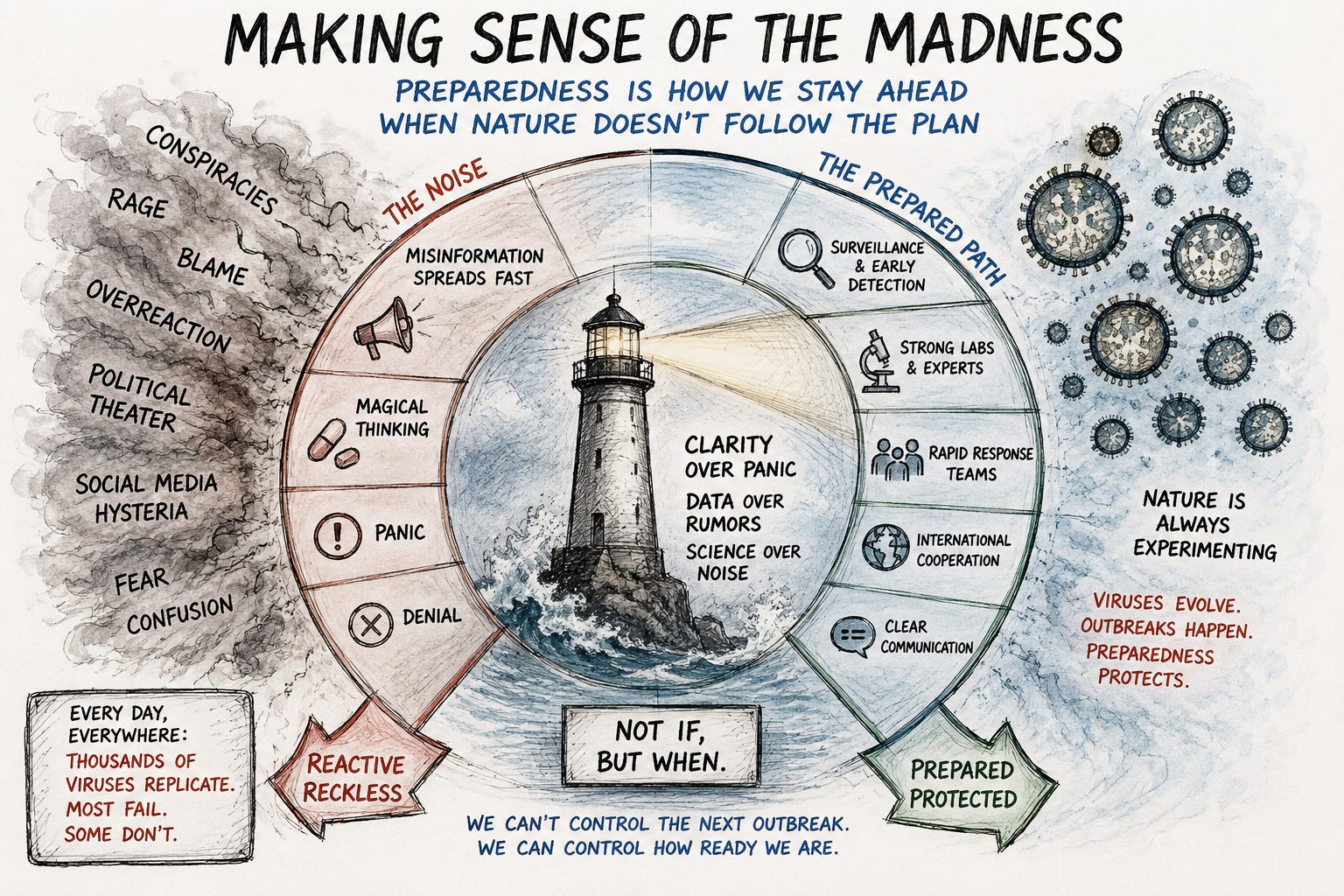
There is something deeply revealing about the way America reacts to outbreaks.
When nothing happens, people assume the system was unnecessary. When something does happen, they suddenly ask why nobody was prepared.
That contradiction sits at the center of the current Hantavirus cruise ship story. Not because the hantavirus is about to become the next COVID, and not because cruise ships are floating plague factories destined to collapse civilization, but because the response exposes a dangerous shift in how Americans think about public health, preparedness, and national defense itself.
The outbreak aboard the M/V Hondius is not, at least from the current evidence, an extinction-level event. Hantavirus is not casually spread, like influenza or measles. Human-to-human transmission is rare and limited. The immediate risk to the public remains low.
Yet the public reaction — and more importantly, the governmental tone surrounding it — tells us something important.
We have spent years dismantling trust in the institutions designed to keep dangerous pathogens from becoming catastrophes.
Meanwhile, we simultaneously cut budgets, weaken international cooperation, retreat from the World Health Organization, hollow out the CDC, and then act surprised when the public senses uncertainty during an outbreak.
That is like firing half the crew of a fire department, and then wondering why the response feels disorganized when smoke starts pouring from a building.
The Problem With “Nothing Happened”
Public health suffers from a paradox.
When it works, people think it was unnecessary.
Nobody sees the epidemic that never occurred. Nobody notices the pathogen stopped at the border. Nobody celebrates the surveillance team that detected an outbreak early enough to contain it quietly. Nobody applauds the laboratory scientist, who spent eighteen hours sequencing viral samples in a fluorescent-lit room, while the rest of the country slept peacefully.
Design invisible success in infectious disease prevention.
Failure, however, is spectacular.
And because success is invisible, politicians are tempted to slash the systems that prevent disaster in the first place.
Preparedness begins to look wasteful. Surveillance appears excessive. International coordination feels bureaucratic. Stockpiles seem unnecessary. Rapid response teams look expensive.
Until suddenly they are not.
The Ebola Panic America Forgot
Many Americans have already forgotten how terrified the country became during the Ebola outbreaks in West Africa.
At the time, cable news was saturated with apocalyptic graphics. Social media was filled with predictions that Ebola would sweep across the United States. People feared airplanes, hospitals, airports, and even casual contact.
Yet Ebola never established itself on American shores.
That did not happen by luck.
It happened because the CDC, the WHO, and international public health teams aggressively contained the outbreak at its source. Surveillance systems were activated. Contact tracing intensified. Laboratories coordinated across continents. Response teams deployed into difficult and dangerous conditions. International cooperation accelerated. American expertise, American funding, and American logistics helped stop the virus before it spread globally.
In other words, the system worked.
Ironically, that success convinced many people the threat had been exaggerated.
But the reason Ebola did not become an American catastrophe is precisely because the world mobilized before it reached that point.
Preparedness often creates the illusion that preparedness was unnecessary.
That is one of the cruelest political realities in public health.
Here is what many didn’t know
Almost every major hospital had a plan for Ebola. We planned rooms for the patients, we planned intake areas for the ER. We anticipated Ebola was going to come to the United States, and we were getting ready for it.
I was involved in those meetings. Figuring out which rooms would hold the patients, how we would upscale for more patients. Which rooms had reverse airflow. How we would talk to the public without panic.
And thankfully, all that planning was never needed. But we were ready, and the public didn’t know it. We thought it was going to come, but it didnt.
It didn’t because the CDC and WHO (mostly funded by us) went to the Congo and set up hospitals, contained the infection and tracked for all.
Disease Does Not Respect Ideology
Viruses do not care whether someone is conservative or liberal. Rodents carrying hantavirus do not check passports. Mosquitoes are not impressed by culture wars. Cruise ships do not float inside ideological bubbles.
Pathogens exploit weakness.
That weakness may come from poor sanitation, delayed detection, fragmented communication, weakened laboratories, underfunded surveillance, or governments that convince themselves expertise is elitism.
Unfortunately, America has spent the better part of the last decade turning scientific institutions into political punching bags.
The CDC became a symbol in partisan warfare, rather than a cornerstone of national preparedness. The WHO became caricatured as some vague international conspiracy, rather than what it actually is: an imperfect but essential global coordination system.
Are these organizations flawless? Of course not.
No human institution is.
Hospitals make mistakes. Military leaders make mistakes. Intelligence agencies make mistakes. Scientists make mistakes. Surgeons certainly do.
But nobody responds to failures in the Navy by suggesting we should eliminate aircraft carriers entirely.
Nobody reacts to a flawed intelligence report by abolishing the CIA and hoping for the best.
Yet somehow public health became the one area where people concluded imperfection meant the entire structure should be dismantled.
That is not reform.
That is self-sabotage.
Infectious Disease Is National Defense
America has no problem spending nearly a trillion dollars annually on traditional defense systems.
We build aircraft carriers capable of projecting power across oceans. We fund missile defense systems designed to stop theoretical attacks decades into the future. We maintain nuclear deterrence against enemies who may never strike.
And perhaps we should.
But it is astonishing how rarely Americans discuss infectious disease preparedness using the same framework.
Nature itself continuously produces biological threats. Sometimes, humans make them worse. Sometimes intentionally. Sometimes accidentally. Either way, microbes remain among the deadliest forces humanity has ever encountered.
Historically, infectious diseases have killed more people than wars.
Far more.
The Black Death reshaped civilizations. Smallpox devastated continents. Influenza altered geopolitics. HIV transformed medicine. COVID disrupted the global economy, education, politics, and life expectancy all at once.
Yet despite this history, many people still treat epidemiology as optional bureaucracy, rather than strategic defense infrastructure.
That mindset is profoundly dangerous.
Pandemic preparedness is not separate from national security.
It is national security.
Stockpiling protective equipment is national defense. Funding laboratories is national defense. Supporting vaccine research is national defense. Maintaining global surveillance systems is national defense. Training epidemiologists is national defense. Coordinating internationally before outbreaks spread is national defense.
An outbreak stopped overseas protects Americans as surely as an aircraft carrier does.
Perhaps more so.
The Cruise Ship as a Warning Signal
The hantavirus cruise ship story matters less because of what hantavirus currently is and more because of what the event reveals.
It reveals how fragile public confidence has become.
It reveals how quickly uncertainty spreads when institutions are weakened.
It reveals how many Americans now view expertise itself with suspicion.
Most importantly, it reveals how vulnerable societies become when preparedness is treated as political excess, not strategic necessity.
The head of the CDC responded with reassurances, coordination language, and promises of monitoring. Some of that is appropriate. Public panic helps nobody.
However, the tone also reflected something else: a public health system increasingly forced into reactive messaging rather than confident leadership, because the political foundation underneath it has been eroded for years.
Preparedness is not built overnight.
You cannot improvise epidemiology in the middle of an outbreak any more than you can improvise an aircraft carrier during a naval war.
Response systems require funding before emergencies happen. They require expertise before crises emerge. They require trust before panic begins.
Once those systems weaken, rebuilding them becomes painfully slow.
The Illusion of Strength
There is a peculiar irony in modern America.
We glorify strength, while undermining one of the most important forms of national resilience ever created.
The strongest nations are not merely those with the largest military. They are the ones capable of surviving disruption, containing crises, maintaining social stability, and protecting their populations against threats both visible and invisible.
A virus does not need tanks.
It does not need ideology.
It only needs opportunity.
And microbes are extraordinarily patient.
The Lesson We Keep Forgetting
The lesson of Ebola should have stayed with us.
The lesson of COVID should have transformed us.
The lesson of this hantavirus incident should at least remind us.
Preparedness always feels expensive before disaster.
After disaster, it suddenly feels priceless.
Public health infrastructure is not charity. It is not academic theater. It is not globalist symbolism.
It is civilization’s immune system.
And dismantling your immune system because you resent being reminded disease exists is not strength.
It is the biological equivalent of firing your smoke alarm because you dislike the noise.
