


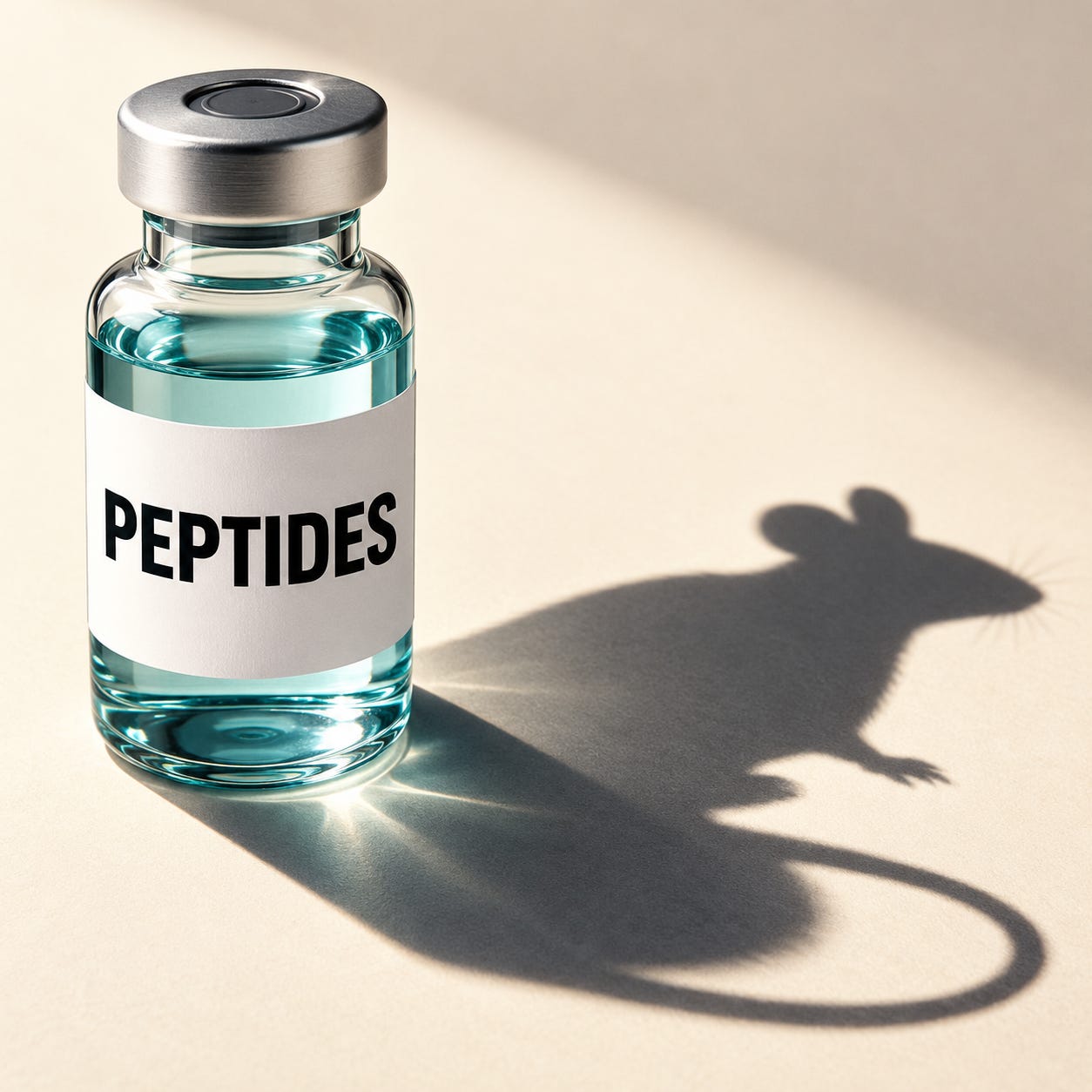
Here are the six peptides in the news - along with their effects, evidence, and our concerns for use.
BPC-157 the healing protein - is it?
BPC-157 is a synthetic peptide containing 15 amino acids. Some think it to be a protective protein found in stomach juice. BPC stands for “body protection compound,” which sounds more Madison Avenue than clinical.
Promoted as a peptide to accelerate the body’s recovery and to heal tendons, ligaments, muscles and bones; relieving joint pain. Some have sold it after bone and joint surgery, claiming “accelerating recovery after surgery”. Finally there is the ubiquitous, it will “repair the gut.” Whenever I hear gut healing, I cringe, because leaky gut is a place where con men love to live.
In gyms, it is combined with TB-500, and marketed as the Wolverine stack.
What is the evidence?
In rats/mice and cultured cells reported improved tissue repair, blood-vessel formation, inflammation, and signaling pathways involved in healing. In experimental tendon injuries, not in humans, some studies report improvements in tissue organization and mechanical strength. That is not the same as a person with a torn tendon improving either healing time or recovery for research. It does point to something that would merit further research.
There are three small human studies. One involves 12 people who were given BPC-157 injections into the knee for knee pain. This was not a study that compared this to placebo, it was not a blinded study, meaning everyone knew they were getting it. Reporting relief of pain after an injection was not compared to no injection. So determining if this was the “normal” course of events is impossible. This pain relief cannot be associated with repair of the injury. Nor were other factors, like if they took medication for knee pain as a background. A poor quality study, and one that no one would rely upon to state that this is worthy of being marketed for knee pain.
Another study involved 12 women with bladder pain who had bladder injections. Ten of the twelve reported complete relief, and two reported 90 percent relief. Again, a non-randomized study and not against a placebo. Poor quality overall.
What concerns us?
What is the dose? Is it effective or are we looking at noise? How long do we treat for? What is the benefit risk profile? What is the long-term safety? We don’t have a study looking at long-term effects. Assuming BPC-157 works, we don’t know how much to give, how much is effective, and how much is toxic.
More concerning is that BPC-157 has “pro-angiogenic effects” —meaning the peptide encourages blood-vessel formation. That could be useful in healing tissue, but it can also be a worry for cancer. Tumors exploit the ability to get new blood vessels into them. Some chemotherapeutic agents block the ability of “angiogenesis” and shrink tumors. This peptide appears to do the opposite. What happens if you have a cancer, and don’t know it, and take this drug? Could the drug itself induce cancer? We don’t know. But it is a concern.
TB-500
We already have a problem with the definition of this peptide. Thymosin beta-4 (TB4) is a naturally occurring 43-amino-acid peptide, and TB-500 is sometimes sold as that 43 amino acid peptide. To be precise, TB-500 is a modified 7 amino acid peptide used in horse racing. So what are we studying here or what is in the vial being sold?
Marketed to accelerate repair of tendons, ligaments and muscles, all with less inflammation, improved flexibility and faster recovery from injury or surgery. Some promise to repair a heart after a heart attack, and of course what bald person doesn’t want hair growth? The longevity doctors love this for what they call “general rejuvenation.”
What is the evidence?
No human studies on TB-500 exist. In a rat wound study, it was no better than placebo for healing wounds.
For TB4 there are some studies showing improved healing of venous stasis ulcers and pressure ulcers. Some rat tendons looked better under a microscope, no clinical evidence it helped the poor rats.
There is no evidence it helps heart attacks in recovery or minimize the size of the dead heart muscle after a heart attack.
What is the concern?
The same as BPC-157. First, no human studies, so we don’t have any established dose that is effective, and no studies showing “efficacy.” Nor are there studies showing toxicity.
We are also concerned again about angiogenesis and cancer.
Mixed with BPC-157, it is sometimes called the Wolverine Stack. I don’t think it refers to the University of Michigan as much as the Marvel character, with about as much evidence that Wolverine exists, as this combination helps recovery after injury or surgery.
Epitalon, sometimes called epithalon
Epitalon (epithalon) is a sequence of four amino acid peptide, so fairly small. The claim is that this peptide helps a person live longer and sleep better. To give away the punchline, there is no evidence it does either.
One of the theories of aging is that our caps on the ends of chromosomes become smaller as we age, which is true. The claim is that this peptide activates the process to keep telomers long and thus reverse aging. Other advertised benefits include restoring melatonin production, improving sleep and circadian rhythms, and supporting immune function.
What is the evidence?
In a Petri dish, in cells studied, it lengthened telomers. They did not allow the cells to live longer. Ten percent of mice lived longer, but no evidence this was significant - meaning it didn’t reliably increase lifespan in mice or rats. None of those studies have been replicated. So if you want mice to live longer, maybe give them this, but don’t count on it.
The sleep claim with changes in melatonin or circadian markers did not show improved sleep. Exogenous melatonin, given at bedtime, increases sleep by an average of 14 minutes. Taking this drug increased melatonin, but not improving sleep.
What is the concern?
Many cancers use telomerase to maintain their capacity for repeated division. Meaning, cancer cells are immortal, and we don’t want to encourage them. We clearly need studies to ensure that this does not increase cancers in people.
We also have no efficacy data, does this actually work? We have no safety data, and we have no dosing data and no toxicity data.
KPV: The “Gut-Healing” Peptide
I cringe when I hear “gut healing” or “leaky gut” as those are the marketing terms of the common cons in every social media platform.
Experiments in cultured cells and animals reported anti-inflammatory effects. In mouse models of colitis, KPV reportedly reduced intestinal inflammation. These findings make KPV a candidate for further research. That does not mean it treats Crohn’s disease, heals an ulcer, or controls eczema.
What is the evidence?
It did have some promising effects on weight regain in mouse and rat models of inflammatory bowel disease. That means it warrants further research, because often mice and rats’ guts do not behave like ours. I mean, look at what they eat.
What is the concern?
Sounding like a broken record here: what about people studies? Until then, we have no evidence KPF does anything to help the human gut. No idea what dose is safe, what dose is toxic, or what long-term toxic effects are.
MOTS-c: The “Exercise in a Vial” Pitch
We know that exercise makes our mitochondria function better, and mitochondria are the powerhouse of the cell. As we age, our mitochondria age also. Now imagine this, instead of exercise, you could inject. OK, as much as I hate needles, I might prefer an injection to the gym.
MOTS-c is a 16-amino-acid peptide found in mitochondria. Almost an irresistible prospect for the longevity industry. Longevity experts need just a mechanism, and a product. No surprise that sellers promote MOTS-c for improved insulin sensitivity, fat loss, greater endurance, more energy and healthier aging. Some add bone protection to the list. Like I said, all the effects of exercise, just in an injection. Forget those who hate the gym, imagine if this worked what it would do for frail elderly?
The evidence
Well, if you are a cell in a Petri dish, we have good news for. you. If you are fully functioning humans, we have no idea. It prevented diet-induced obesity and both age-related and diet-induced insulin resistance. And It improved running capacity in young, middle-aged and old mice. So if you have mice, they can run faster than your cat.
It has many interesting mechanisms. But mechanisms are not evidence, and there are legitimate science groups working on this. But the evidence is simply not there for human beings.
The concerns
Same safety concerns for its purity. Same concerns we don’t have any data showing it is effective. There is always a toxicity level and we don’t have that.
Semax—the brain booster
Sellers promote it as a “nootropic”. That is the same claim made from many mushrooms and mushroom coffee. Nootropic means a substance intended to improve cognitive performance. Nothing like a promise of better memory, sharper attention, improved learning and protection of the brain. Some extend the pitch to stroke recovery, anxiety, depression, migraines and chronic pain. It is commonly marketed as a nasal spray, although injectable products also appear in the marketplace.
The evidence
Semax has human data, but all of it comes from Russian clinical studies of stroke and cerebrovascular disease. These are not randomized trials. It is approved in Russia for stroke, cerebrovascular insufficiency, and optic nerve atrophy. Russian trials report better neurological recovery, rehabilitation and cognition when Semax is added to standard care.
Compared with the earlier peptides, Semax has been used in Russia. They do not have the same standards of evidence we would use. And there is no evidence for any “nootropic" effect.
What is the concern?
If Semax affects the brain, there is no evidence of its benefits or toxicity over time. Semax is a legitimate subject for neurological research.
We need human trials with rigorous standards.
BPC-157
Mendias, CL; Awan, TM. Safety and Efficacy of Approved and Unapproved Peptide Therapies for Musculoskeletal Injuries and Athletic Performance. Sports Med. 2026.
Mayfield, CK; Bolia, IK; Feingold, CL. Injectable Peptide Therapy: A Primer for Orthopaedic and Sports Medicine Physicians. Am J Sports Med. 2026.
McGuire, FP; Martinez, R; Lenz, A; Skinner, L; Cushman, DM. Regeneration or Risk? A Narrative Review of BPC-157 for Musculoskeletal Healing. Curr Rev Musculoskelet Med. 2025;18(12):611–619. doi:10.1007/s12178-025-09990-7
Józwiak, M; Bauer, M; Kamysz, W; Kleczkowska, P. Multifunctionality and Possible Medical Application of the BPC 157 Peptide-Literature and Patent Review. Pharmaceuticals (Basel). 2025.
Luansritisakul, C; Chiang, MC; Burns, SL; Fonseca, ACG. Peptides in Regenerative Medicine: A Comprehensive Review of Clinical Applications in Tissue Repair and Chronic Pain Management. Curr Pain Headache Rep. 2026.
Yıldırım, AK; Demirtaş, H; Özer, A; Arslan, M. Protective effects of BPC 157 in rats with experimentally induced lower extremity ischemia-reperfusion injury. Sci Rep. 2026.
Seiwerth, S; Milavic, M; Vukojevic, J. Stable Gastric Pentadecapeptide BPC 157 and Wound Healing. Front Pharmacol. 2021.
Sikiric, P; Drmic, D; Sever, M. Fistulas Healing. Stable Gastric Pentadecapeptide BPC 157 Therapy. Curr Pharm Des. 2020.
Thymosin beta-4 / TB-500
Tham, A; Hodgkins, CW; Kennedy, JG. Investigational Peptides in Orthopaedic Practice: Evidence, Safety, and Patient Counseling for BPC-157, Thymosin Beta-4, and TB-500. J Am Acad Orthop Surg. 2026.
Tewari, K; Liu, TP; Im, C. Peptide Supplements and Their Therapeutic Applications in Sports Medicine. Am J Sports Med. 2026.
Guarnera, G; DeRosa, A; Camerini, R. The Effect of Thymosin Treatment of Venous Ulcers. Ann N Y Acad Sci. 2010.
Treadwell, T; Kleinman, HK; Crockford, D. The Regenerative Peptide Thymosin Β4 Accelerates the Rate of Dermal Healing in Preclinical Animal Models and in Patients. Ann N Y Acad Sci. 2012.
Kleinman, HK; Sosne, G. Thymosin Β4 Promotes Dermal Healing. Vitam Horm. 2016.
Epitalon / epithalamin and related biology
Jain, A; Gallacher, DM; Issa, MA. Epitalon and Epithalamin: A Narrative Review of Mechanistic, Preclinical, and Clinical Evidence. Int J Mol Sci. 2026;27(19):8922. doi:10.3390/ijms27198922
Araj, SK; Brzezik, J; Mądra-Gackowska, K; Szeleszczuk, Ł. Overview of Epitalon-Highly Bioactive Pineal Tetrapeptide With Promising Properties. Int J Mol Sci. 2025;26(6):2691. doi:10.3390/ijms26062691
Khavinson, VKh. Peptides and Ageing. Neuro Endocrinol Lett. 2002;23(Suppl 3):11–144.
Mavrych, V; Shypilova, I; Bolgova, O. Therapeutic Peptides in Gerontology: Mechanisms and Applications for Healthy Aging. Front Aging. 2026;7:1790247. doi:10.3389/fragi.2026.1790247
Al-Dulaimi, S; Thomas, R; Matta, S; Roberts, T. Epitalon Increases Telomere Length in Human Cell Lines Through Telomerase Upregulation or ALT Activity. Biogerontology. 2025.
Khavinson, V; Diomede, F; Mironova, E. AEDG Peptide (Epitalon) Stimulates Gene Expression and Protein Synthesis During Neurogenesis: Possible Epigenetic Mechanism. Molecules. 2020;25(3):E609. doi:10.3390/molecules25030609
Yue, X; Liu, SL; Guo, JN. Epitalon Protects Against Post-Ovulatory Aging-Related Damage of Mouse Oocytes in Vitro. Aging (Albany NY). 2022;14(7):3191–3202. doi:10.18632/aging.204007
Kossoy, G; Anisimov, VN; Ben-Hur, H; Kossoy, N; Zusman, I. Effect of the Synthetic Pineal Peptide Epitalon on Spontaneous Carcinogenesis in Female C3H/He Mice. In Vivo. 2006;20(2):253–257.
Kang, MK; Park, NH. Extension of Cell Life Span Using Exogenous Telomerase. Methods Mol Biol. 2007.
MacKenzie, KL; Franco, S; May, C; Sadelain, M; Moore, MA. Mass Cultured Human Fibroblasts Overexpressing hTERT Encounter a Growth Crisis Following an Extended Period of Proliferation. Exp Cell Res. 2000.
Jones-Weinert, C; Mainz, L; Karlseder, J. Telomere function and regulation from mouse models to human aging and disease. Nat Rev Mol Cell Biol. 2025.
Hahn, WC; Meyerson, M. Telomerase Activation, Cellular Immortalization and Cancer. Ann Med. 2001.
Anisimov, VN; Khavinson, VKh; Popovich, IG. Effect of Epitalon on Biomarkers of Aging, Life Span and Spontaneous Tumor Incidence in Female Swiss-Derived SHR Mice. Biogerontology. 2003.
Anisimov, VN; Mylnikov, SV; Khavinson, VK. Pineal Peptide Preparation Epithalamin Increases the Lifespan of Fruit Flies, Mice and Rats. Mech Ageing Dev. 1998.
Khavinson, VK; Izmaylov, DM; Obukhova, LK; Malinin, VV. Effect of Epitalon on the Lifespan Increase in Drosophila Melanogaster. Mech Ageing Dev. 2000;120(1-3):141–149. doi:10.1016/s0047-6374(00)00217-7
Anisimov, VN; Mylnikov, SV; Oparina, TI; Khavinson, VK. Effect of Melatonin and Pineal Peptide Preparation Epithalamin on Life Span and Free Radical Oxidation in Drosophila Melanogaster. Mech Ageing Dev. 1997.
Khavinson, V; Goncharova, N; Lapin, B. Synthetic Tetrapeptide Epitalon Restores Disturbed Neuroendocrine Regulation in Senescent Monkeys. Neuro Endocrinol Lett. 2001;22(4):251–254.
Gamble, KL; Berry, R; Frank, SJ; Young, ME. Circadian clock control of endocrine factors. Nat Rev Endocrinol. 2014.
Claustrat, B; Brun, J; Chazot, G. The Basic Physiology and Pathophysiology of Melatonin. Sleep Med Rev. 2005.
Pevet, P; Klosen, P; Felder-Schmittbuhl, MP. The Hormone Melatonin: Animal Studies. Best Pract Res Clin Endocrinol Metab. 2017.
KPV and related melanocortin biology
Brzoska, T; Luger, TA; Maaser, C; Abels, C; Böhm, M. Alpha-Melanocyte-Stimulating Hormone and Related Tripeptides: Biochemistry, Antiinflammatory and Protective Effects in Vitro and in Vivo, and Future Perspectives for the Treatment of Immune-Mediated Inflammatory Diseases. Endocr Rev. 2008.
Brzoska, T; Böhm, M; Lügering, A; Loser, K; Luger, TA. Terminal Signal: Anti-Inflammatory Effects of α-Melanocyte-Stimulating Hormone Related Peptides Beyond the Pharmacophore. Adv Exp Med Biol. 2011.
Luger, TA; Brzoska, T. Alpha-MSH Related Peptides: A New Class of Anti-Inflammatory and Immunomodulating Drugs. Ann Rheum Dis. 2007.
Getting, SJ; Schiöth, HB; Perretti, M. Dissection of the Anti-Inflammatory Effect of the Core and C-Terminal (KPV) Alpha-Melanocyte-Stimulating Hormone Peptides. J Pharmacol Exp Ther. 2003.
Elliott, RJ; Szabo, M; Wagner, MJ. Alpha-Melanocyte-Stimulating Hormone, MSH 11-13 KPV and Adrenocorticotropic Hormone Signalling in Human Keratinocyte Cells. J Invest Dermatol. 2004.
15th Meeting of the European Society for Pigment Cell Research (ESPCR – 2009), September 20–23, 2009, Münster, Germany. Pigment Cell Melanoma Res. 2009. doi:10.1111/j.1755-148x.2009.00612.x
Dalmasso, G; Charrier-Hisamuddin, L; Nguyen, HT. PepT1-mediated Tripeptide KPV Uptake Reduces Intestinal Inflammation. Gastroenterology. 2008.
Kannengiesser, K; Maaser, C; Heidemann, J. Melanocortin-Derived Tripeptide KPV Has Anti-Inflammatory Potential in Murine Models of Inflammatory Bowel Disease. Inflamm Bowel Dis. 2008.
Luger, TA; Scholzen, TE; Brzoska, T; Böhm, M. New Insights Into the Functions of Alpha-MSH and Related Peptides in the Immune System. Ann N Y Acad Sci. 2003.
Singh, M; Mukhopadhyay, K. Alpha-Melanocyte Stimulating Hormone: An Emerging Anti-Inflammatory Antimicrobial Peptide. Biomed Res Int. 2014.
Gkogkolou, P; Sarna, M; Sarna, T. Protection of Glucotoxicity by a Tripeptide Derivative of α-Melanocyte-Stimulating Hormone in Human Epidermal Keratinocytes. Br J Dermatol. 2019.
U.S. Food and Drug Administration. Orange Book: Approved Drug Products with Therapeutic Equivalence Evaluations. U.S. Department of Health and Human Services.
Soeberdt, M; Kilic, A; Abels, C. Current and emerging treatments targeting the neuroendocrine system for disorders of the skin and its appendages. Exp Dermatol. 2020.
MOTS-c and mitochondrial peptides
Lee, C; Zeng, J; Drew, BG. The Mitochondrial-Derived Peptide MOTS-c Promotes Metabolic Homeostasis and Reduces Obesity and Insulin Resistance. Cell Metab. 2015;21(3):443–454. doi:10.1016/j.cmet.2015.02.009
Reynolds, JC; Lai, RW; Woodhead, JST. MOTS-c is an exercise-induced mitochondrial-encoded regulator of age-dependent physical decline and muscle homeostasis. Nat Commun. 2021.
Gunawan, AL; Liparulo, I; Stahl, A. Mammalian mitohormesis: from mitochondrial stressors to organismal benefits. EMBO J. 2025.
Miller, B; Kim, SJ; Kumagai, H; Yen, K; Cohen, P. Mitochondria-derived peptides in aging and healthspan. J Clin Invest. 2022.
Shero, JA; Lindholm, ME; Sandri, M; Stanford, KI. Skeletal Muscle as a Mediator of Interorgan Crosstalk During Exercise: Implications for Aging and Obesity. Circ Res. 2025.
Kutuk, IS; Akin, S; Demirel, H. Reduced serum and skeletal muscle MOTS-c levels in women with polycystic ovary syndrome are associated with mitochondrial dysfunction. Sci Rep. 2026.
Bhullar, KS; Shang, N; Kerek, E; Wu, K; Wu, J. Mitofusion is required for MOTS-c induced GLUT4 translocation. Sci Rep. 2021.
Wan, W; Zhang, L; Lin, Y. Mitochondria-Derived Peptide MOTS-c: Effects and Mechanisms Related to Stress, Metabolism and Aging. J Transl Med. 2023.
Zheng, Y; Wei, Z; Wang, T. MOTS-c: A Promising Mitochondrial-Derived Peptide for Therapeutic Exploitation. Front Endocrinol (Lausanne). 2023.
Merry, TL; Chan, A; Woodhead, JST. Mitochondrial-Derived Peptides in Energy Metabolism. Am J Physiol Endocrinol Metab. 2020.
Semax
Vyunova, TV; Andreeva, LA; Shevchenko, KV. Synthetic corticotropins and the GABA-receptor system: Direct and delayed effects. Chem Biol Drug Des. 2023.
Vyunova, TV; Andreeva, LA; Shevchenko, KV; Myasoedov, NF. Synacton and individual activity of synthetic and natural corticotropins. J Mol Recognit. 2017.
Dolotov, OV; Karpenko, EA; Seredenina, TS. Semax, an Analogue of Adrenocorticotropin (4-10), Binds Specifically and Increases Levels of Brain-Derived Neurotrophic Factor Protein in Rat Basal Forebrain. J Neurochem. 2006.
Dolotov, OV; Karpenko, EA; Inozemtseva, LS. Semax, an Analog of ACTH(4-10) With Cognitive Effects, Regulates BDNF and trkB Expression in the Rat Hippocampus. Brain Res. 2006.
Filippenkov, IB; Stavchansky, VV; Denisova, AE. Novel Insights Into the Protective Properties of ACTH(4-7)PGP (Semax) Peptide at the Transcriptome Level Following Cerebral Ischaemia-Reperfusion in Rats. Genes (Basel). 2020.
Medvedeva, EV; Dmitrieva, VG; Povarova, OV. The Peptide Semax Affects the Expression of Genes Related to the Immune and Vascular Systems in Rat Brain Focal Ischemia: Genome-Wide Transcriptional Analysis. BMC Genomics. 2014.
Medvedeva, EV; Dmitrieva, VG; Limborska, SA; Myasoedov, NF; Dergunova, LV. Semax, an Analog of ACTH, Regulates Expression of Immune Response Genes During Ischemic Brain Injury in Rats. Mol Genet Genomics. 2017.
Inozemtseva, LS; Yatsenko, KA; Glazova, NY. Antidepressant-Like and Antistress Effects of the ACTH(4-10) Synthetic Analogs Semax and Melanotan II on Male Rats in a Model of Chronic Unpredictable Stress. Eur J Pharmacol. 2024.
Tabbì, G; Magrì, A; Giuffrida, A. Semax, an ACTH4-10 Peptide Analog With High Affinity for Copper(II) Ion and Protective Ability Against Metal Induced Cell Toxicity. J Inorg Biochem. 2015.
Sciacca, MFM; Naletova, I; Giuffrida, ML; Attanasio, F. Semax, a Synthetic Regulatory Peptide, Affects Copper-Induced Abeta Aggregation and Amyloid Formation in Artificial Membrane Models. ACS Chem Neurosci. 2022.
Liu, R; Chen, Y; Huang, H. Semax Peptide Targets the μ Opioid Receptor Gene Oprm1 to Promote Deubiquitination and Functional Recovery After Spinal Cord Injury in Female Mice. Br J Pharmacol. 2025.