


Let’s start where this needs to start:
Red meat does not prevent Alzheimer’s disease. It does not “normalize” genetic risk. And it certainly doesn’t cure dementia.
What we have is a single observational study—interesting, limited, and now badly overinterpreted—being turned into dietary dogma. Parts of the low-carb and carnivore community have taken a subgroup signal and promoted it as if it were a prescription.
It isn’t.
And if we’re going to talk about diet and dementia honestly, we also have to talk about what does have real evidence behind it.
Of course, Gary Taubs and the entire low-carb group are grabbing this study as some proof - it isn’t. In fact it almost shows the opposite of what they state.
What the Swedish Study Actually Showed
The study followed about 2,100 older adults and looked at meat intake and cognitive outcomes.
In people carrying the APOE4 allele, those eating more meat had less observed excess risk of dementia compared to those eating less.
That’s the finding.
Not prevention.
Not reversal.
Not treatment.
An association.
How It Became “Meat Slashes Alzheimer’s Risk”
This is how nutrition misinformation evolves:
A subgroup association appears
“No excess risk” becomes “risk normalized”
“Associated with” becomes “slashed risk”
A headline becomes a belief system
By the end, we’ve gone from a signal to a slogan.
What Everyone Missed
This wasn’t a high-meat diet
Even the highest meat consumers in the study were eating:
about 1–2 pounds per week
That’s moderate intake—not a carnivore diet. In fact the average American eats 3.6 pounds of meat per week. This is, by American standards, small. But oddly, it does fit into one of the Mediterranean groups - which allows 4 ounces of meat per day.
This was observational
No randomization. No intervention.
Which means:
healthier people cluster together
diet tracks with lifestyle
causation is not established
Even the authors acknowledge this. Does that mean eating more red meat is healthy - absolutely not.
Subgroup findings are fragile
The effect appears:
in one genetic group
in one cohort
under specific conditions
That’s hypothesis-generating—not practice-changing. We also call this p hacking - find something significant by going through every group and every permutation until we grab onto some statistic that hits a p value and publish it.
This is how they published chocolate is good for you. A deliberate attempt to prove that chocolate was more than dessert - and yet even though they admitted they did this, it lives on in American lore. This will live on in the Twitter wars of the meat eaters, and Gary Taubs.
Now Let’s Talk About What Actually Works
This is the part that gets ignored in the excitement.
Because while one small study is being amplified, we already have decades of data on dietary patterns and brain health.
The diets that consistently show benefit:
Mediterranean Diet
Lower rates of cognitive decline
Reduced risk of Alzheimer’s disease
Benefits seen across large populations
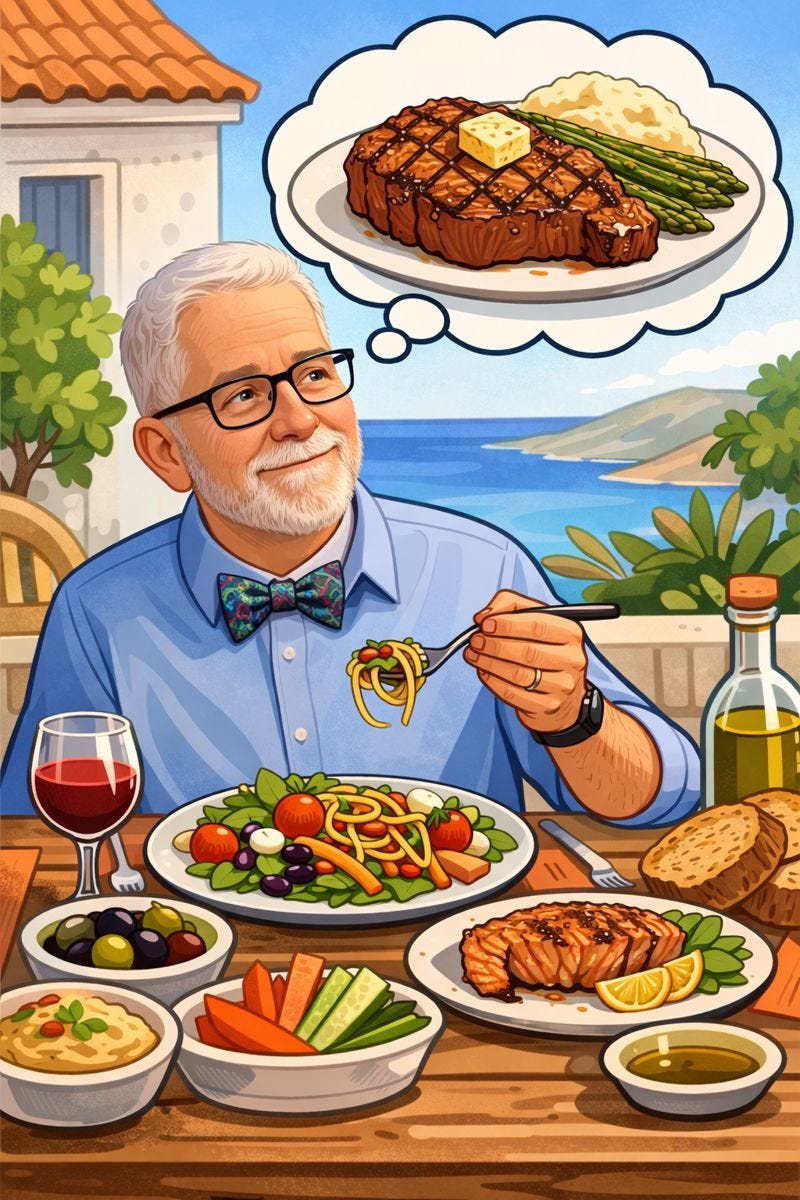
People who adhere more to the Mediterranean diet (see terrysimpson.com for a description of this) live longer and have less cognitive decline. More fruits, more vegetables, fish, olive oil, whole grains, and allow about 4 ounces of meat a day (that would fit into this study).
DASH Diet (Dietary Approaches to Stop Hypertension)
Originally for blood pressure
Also associated with better cognitive outcomes
We also call this the American version of the Mediterranean diet.
MIND Diet (Mediterranean + DASH hybrid)
Specifically designed for brain health
Associated with slower cognitive decline equivalent to ~7.5 years of aging delay in some cohorts
These are not fringe findings.
They come from:
large prospective cohorts
repeated analyses - two different studies one from Chicago and one from New York (Columbia) showed delay in cognitive decline. So, put off losing your keys for seven years.
consistent directional results
What Do These Diets Have in Common?
They don’t rely on a single food.
They emphasize:
vegetables
fruits
whole grains
legumes
nuts
fish
olive oil
And they consistently limit:
ultra-processed foods
refined carbohydrates
excessive saturated fat
Notice what’s missing?
There is no:
“eat more steak to prevent dementia” - but they still can eat the amount listed on here and make it.
The Gene Question
The APOE4 allele increases risk through complex pathways:
lipid transport
amyloid metabolism
inflammation
Diet may influence these.
But the idea that:
one food cancels genetic risk
…would require randomized trials showing exactly that.
We don’t have those. And having the gene does not DETERMINE destiny, it increases risk.
Common Questions
“Should APOE4 carriers eat more meat?”
We don’t know.
One observational signal is not enough to guide clinical advice. They should eat a Mediterranean/DASH/MIND diet.
“Does avoiding meat increase dementia risk?”
No credible evidence supports that claim.
That’s an inference—not a finding. In fact, plenty of studies show increasing saturated fat increases dementia and colon cancer might give one pause.
Vascular dementia is clearly related to higher levels of saturated fat.
“Does this overturn everything we know?”
No.
It adds a small, interesting piece to a much larger body of evidence.
“Were we wrong about red meat?”
Sometimes, yes—nutrition messaging has oversimplified.
But correcting that mistake by declaring:
“red meat protects your brain”
…isn’t science.
It’s a pendulum swing. But the details are important - it isn’t a heavy meat diet, and it is eating better. Honestly we have better diets for the brain.
The Bigger Issue
This isn’t really about meat.
It’s about how we handle uncertainty in nutrition science.
Weak signals get turned into strong claims.
Subgroups become universal truths.
Headlines outrun the data.
And patients are left trying to make sense of it.
What You Should Actually Do
If you care about brain health:
Focus on dietary patterns, not single foods
Follow evidence-based approaches like Mediterranean or MIND
Exercise
Sleep
Manage vascular risk factors
Because dementia is not caused—or prevented—by one ingredient.
Final Word
This study is interesting. It may lead to better research on gene–diet interactions.
But it is not a breakthrough.
And it is certainly not a reason to tell patients:
“Eat more red meat to prevent Alzheimer’s.”
One Line, Because It Bears Repeating
This isn’t a cure—it’s a correlation, dressed up as certainty by people who were already convinced of the answer.
🔒 Paid Member Section: What the MIND Diet Actually Is—and Why It Still Matters
Let’s slow this down a bit and talk like adults for a moment.
Because while everyone is arguing about whether red meat is secretly a brain-saving superfood, we already have something far more useful sitting in plain sight: dietary patterns that have been studied over and over again, in large groups of people, for years.
Not perfect studies. Not randomized in the way we’d like. But consistent.
And the most “brain-specific” version of that work is the MIND diet.
