


The Odd Carnivore
The first time I realized something odd was happening in nutrition was not in a medical journal. It was on social media, where a man was explaining with complete certainty that every human disease could be solved with beef.
Just beef.
Not a pattern of eating. Not a cuisine. Not even a diet in the traditional sense. Simply beef, eaten daily and heroically, preferably from a cow that had lived a morally upright life on a grassy hillside.
Vegetables, he explained, were toxic. Fiber was unnecessary. Fruit was suspicious. And legumes — well, legumes were practically chemical warfare.
This was delivered with the sort of confidence that once belonged to televangelists and late-night gold dealers.
And as I listened, I realized something familiar was happening. Nutrition had once again stopped behaving like a science and started behaving like a religion.
Yes, there are real scientists studying nutrition. But out on the fringes — where the supplements are sold — a different strategy emerged. They found a religion to deliver the message. There were prophets. There were commandments. And there were heretics. The newest sacrament, it turns out, is beef.
The Prophets: The Case of the Liver King
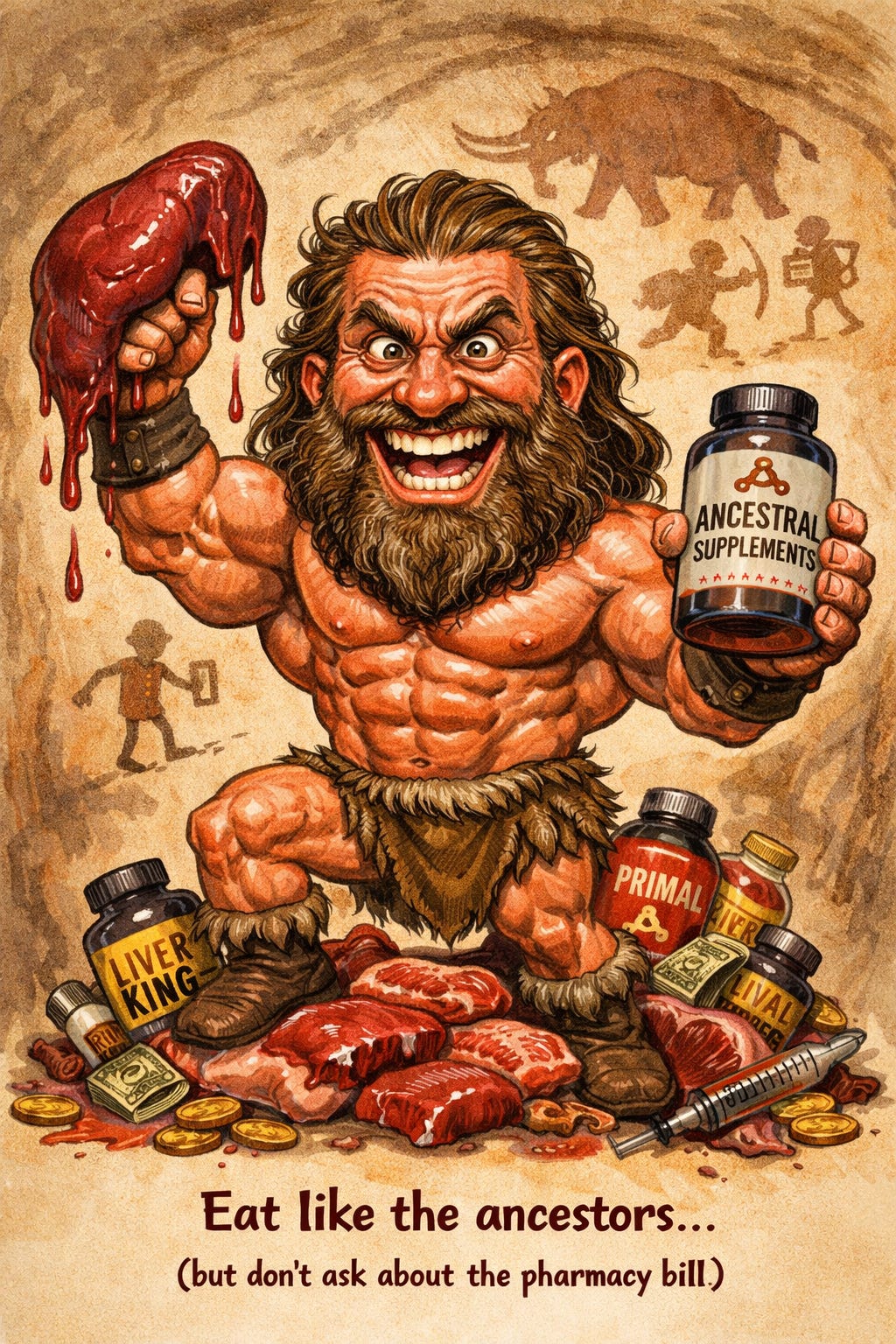
Every movement needs prophets.
The carnivore world found one in a man who called himself Liver King.
If you missed this particular chapter of internet nutrition, Liver King was a bearded, shirtless evangelist for what he called “ancestral living.” He appeared on podcasts and social media surrounded by raw organs, axes, and the occasional animal carcass, proclaiming that modern men had become weak because they had abandoned the ways of their prehistoric ancestors.
The solution, he said, was simple.
Eat organs.
Eat raw liver.
Train like a caveman.
Reject modern foods.
And, conveniently, purchase the supplements he was selling to help you live this ancestral lifestyle.
The image was powerful. A muscular man with the physique of a comic-book barbarian, declaring that everything modern medicine had learned about nutrition was wrong and that the answer lay in returning to primal habits.
There was only one problem. He wasn’t telling the truth. Does this sound like some modern “prophets” in other religions?
In 2022, leaked emails revealed that the Liver King spent over $10,000 per month on performance-enhancing drugs, including anabolic steroids and human growth hormone. Shortly afterward, he released a video admitting what most physicians and exercise physiologists already suspected.
His physique was not built on raw liver. It was built with pharmacology. Yes he did a lot of working out, but it was enhanced or “jacked.” It was not made with liver.
None of this stopped the business. By the time the truth surfaced, the Liver King had already built a supplement empire reportedly generating tens of millions of dollars per year.
And that is the real lesson. The carnivore movement often presents itself as a rebellion against modern industry and pharmaceutical influence. But many of its loudest voices are not rebels against the system.
They are simply running a different version of the same business model.
Sell certainty. Sell identity. Sell supplements. And if that fails, sell a coaching program. The beauty of the movement is that as you bring more people in, more can grift. Then they become the defenders of the steak, because now they have their finances invested in it.
The prophets of dietary purity rarely live the lifestyle they preach. But they are good at selling it.
The Other High Priest: Paul Saladino
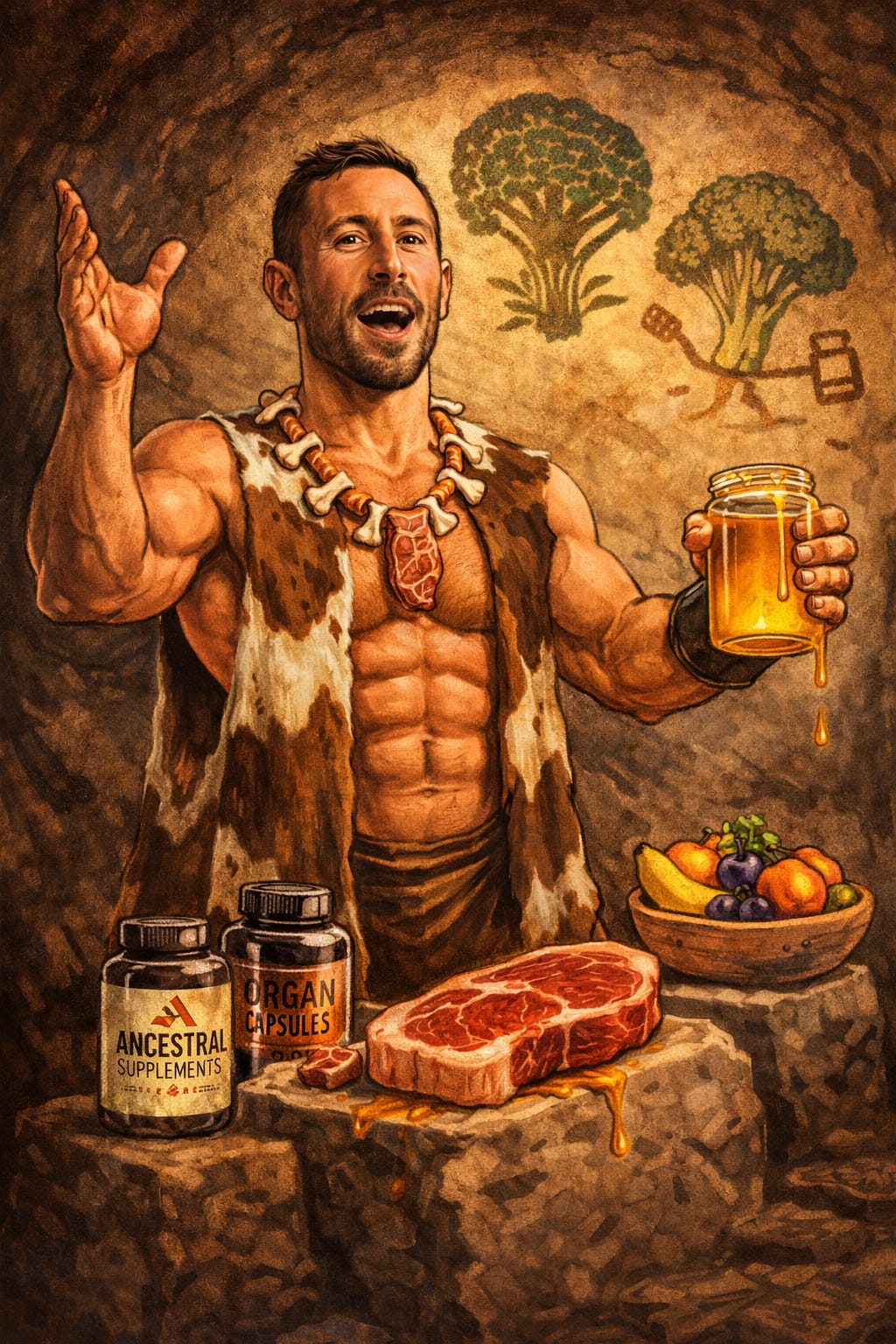
Every movement needs its theologians. If the Liver King was the circus barker of the carnivore movement — shirtless, roaring, waving a slab of liver like a medieval relic — then the movement’s more intellectual voice has been Paul Saladino.
Saladino is technically a physician. He trained as a psychiatrist, which means he spent a good deal of time learning about the mind, human behavior, and why people believe things strongly even when the evidence is less enthusiastic. Somewhere along the way, he pivoted away from psychiatry and toward nutrition evangelism, rebranding himself as Carnivore MD, a title that has the advantage of sounding both medical and vaguely medieval simultaneously.
For several years, his message was uncompromising. Plants, he argued, were full of toxins. Vegetables were chemical warfare. The safest diet for humans was meat, organs, animal fat, and little else. His book The Carnivore Code became something of a manifesto for the movement — a long argument that most human civilization had misunderstood food until the rediscovery of steak.
The difficulty with these sorts of absolute claims is that eventually the human body gets a vote.
After about two years of eating a strict carnivore diet, Saladino began describing many symptoms that were, shall we say, inconvenient for the theory. His sleep deteriorated. His heart would race unexpectedly. He developed muscle cramps. Testosterone levels reportedly fell. The body was sending a message that perhaps an all-meat diet was not the evolutionary triumph it had been advertised to be.
And so something interesting happened. Fruit appeared. Honey appeared. Raw dairy appeared.
The diet that had once condemned plants as toxins quietly evolved into what he now calls an “animal-based diet,” which in practice looks suspiciously like meat plus carbohydrates from fruit and honey. One might say the diet rediscovered sugar, but with better branding.
This sort of evolution is not uncommon in nutrition movements. The early phase is absolute — purity, certainty, doctrine. The later phase becomes more flexible once biology has made its objections clear.
From Psychiatry to Supplements
The other piece of the story is economic.
Saladino did not merely write books about carnivore diets. He also co-founded a supplement company that sells capsules made from freeze-dried animal organs and other “ancestral” ingredients. The marketing language is very clever. Modern food, we are told, is inadequate. The way to restore ancestral health is to consume carefully prepared capsules containing the concentrated essence of organs that our ancestors supposedly prized.
Oh, and his business partner? The Liver King.
You can see how the narrative works. The diet is incomplete. The supplements complete it. And conveniently, the supplements are available for purchase.
It is difficult to know exactly what Saladino earns from this business, but one suspects that selling organ capsules to hundreds of thousands of followers is financially more rewarding than practicing psychiatry in a quiet clinic somewhere. There are many ways to treat anxiety in modern America, but selling supplements to anxious people may be among the most profitable.
Here is the thing - Paul sounds like he is giving nutrition advice.
Don’t eat microplastics, watch out for farm-raised salmon, take in light in the morning. Lots of advice, and by giving advice and making nutrition simple, you are now creating a community for which you will have sales of your supplements for a long time.
Politics Enters the Kitchen
The story becomes more interesting when it leaves the internet and wanders into politics.
Recently Saladino appeared alongside Robert F. Kennedy Jr., now Secretary of Health and Human Services, in a video in which the two men shared raw milk and honey together. It was one of those moments that makes you wonder how the American conversation about nutrition arrived here.
The Mediterranean diet — vegetables, legumes, olive oil, fish, moderate meat — has been studied for decades. Large trials. Cohort studies. Epidemiology. Mountains of evidence.
But olive oil and lentils do not go viral.
Raw milk and steak do.
And so we arrive at the curious moment in which the loudest voices influencing nutrition discussions in Washington may not be epidemiologists or public health researchers, but a collection of internet diet prophets whose primary qualification is that they have microphones and large followings.
The Pattern
Once you see the pattern, it becomes difficult to miss.
First comes the dramatic claim: everything you have been told about food is wrong.
Then comes the simple solution: eat like this.
Then comes the supplement line.
Then comes the podcast tour.
And eventually, if the movement is lucky, the political connections.
None of this means meat is unhealthy. Far from it. Beef is nutritious, and a good steak remains one of life’s small reliable pleasures.
But when a diet becomes a brand, and the brand becomes a business, and the business begins to influence public health conversations, it is worth remembering something very simple.
Nutrition is a science.
Theology is something else.
And the difference between the two is usually evidence.
The Cave Painting Argument
One of the more charming arguments offered by carnivore advocates goes something like this: if humans ate vegetables, why don’t we see vegetables in cave paintings?
Apparently, the absence of broccoli in Paleolithic art is now considered nutritional evidence.
Let’s pause and think about that for a moment.
Cave paintings show dramatic things. Mammoths. Bison. Horses. Deer. They show hunts, danger, and survival. They show the moments that mattered to people living in a world where dinner occasionally tried to kill you first.
No one runs across the tundra chasing a woolly mammoth, and then returns to the cave and says, “Quick — someone grab the charcoal. We must commemorate this turnip.”
Cave art was storytelling. It was not a grocery receipt. If root vegetables had kept you alive all winter, you didn’t paint the turnip. You painted the mammoth.
If cave paintings determined diet, we would also conclude that early humans never ate fish. Except cave paintings show fish, but most of the carnivores are too lazy to look at anthropological sites. In addition, archaeological sites around the world are filled with fishing hooks, nets, and traps dating back tens of thousands of years. Humans clearly ate fish long before the invention of Instagram nutrition.
And then there is the broccoli problem.
Broccoli did not exist during the Paleolithic. It was cultivated from wild brassica plants by Mediterranean farmers — likely the Etruscans — centuries before the Roman Empire.
So the reason you do not see broccoli in cave paintings is the same reason you do not see tomatoes, potatoes, sourdough bread, or espresso machines.
They had not been invented yet.
Using cave paintings to prove humans were carnivores is like using medieval paintings to prove humans never drank coffee.
Humans Were Never Carnivores
Anthropology tells a much less dramatic and far more interesting story.
Humans are omnivores, and always have been. When scientists examine ancient bones, analyze plant residues on tools, or study preserved human feces — an activity politely referred to as coprolite analysis — they find evidence of remarkably varied diets.
Roots and tubers. Seeds and grains. Fruits. Fish. Meat when available.
The proportions varied enormously depending on geography. Arctic populations relied heavily on animal foods. Equatorial populations consumed far more plant foods.
But nowhere in human history do we find a civilization living entirely on beef — or on any single food.
Flexibility, not purity, was the great evolutionary advantage of our species.
The Forgotten History of Meat-Only Diets
The carnivore diet is often presented as revolutionary.
It is not.
In the nineteenth century, a physician named James Salisbury promoted what became known as the Salisbury diet. His prescription was simple: eat ground beef patties several times a day, drink hot water, and avoid vegetables.
Yes, the original carnivore diet was essentially a hamburger diet.
Like many restrictive diets, some people lost weight. They also developed other problems, including nutrient deficiencies and constipation severe enough that one suspects the hot water was doing heroic work.
The diet eventually faded away.
But like many ideas in nutrition, it seems to have been waiting patiently for the invention of the podcast.
When Diet Becomes Identity
The modern carnivore movement is not about food.
It is about certainty. With certainty, you become a prophet, and with that you can sell people anything.
“Eat a variety of whole foods” is sensible advice, but it does not build a brand.
“Plants are poison” is far easier to market. Or “Kale is b.s.”
Extreme diets attract attention, followers, and eventually revenue streams. Supplements, coaching programs, laboratory panels, and subscription beef boxes all follow naturally once a food ideology has been established.
Nuance rarely sells well on social media.
Absolutes do.
The Scurvy Reminder
History occasionally reminds us why dietary diversity matters.
Recently, the musician James Blunt revealed that he once developed scurvy.
Yes — scurvy, the disease that plagued sailors during the age of wooden ships.
Scurvy occurs when humans fail to consume enough vitamin C, something that tends to happen when fruits and vegetables disappear entirely from the diet.
Centuries ago the British navy solved this problem by issuing sailors citrus fruit. It worked so well that British sailors eventually acquired the nickname “limeys.”
It is slightly astonishing that a lesson learned in the eighteenth century occasionally needs to be rediscovered in the twenty-first.
The carnivores often state that this isn’t an issue, and point to men who were in the Arctic - ignoring that arctic mammals make their own vitamin C and by consuming those, will avoid scurvy. Eating only cows or pork will not do that.
And One More Problem With Carnivore
It is boring.
Human cuisine is one of the great cultural achievements of our species. Every culture has created extraordinary food traditions built on combinations of plants, grains, spices, and animal foods.
Reducing all that to an endless procession of ribeyes is not just nutritionally questionable.
It is culinarily tragic. I grew up on a little island in Alaska, and beef was rare and expensive. So for me, beef is wonderful. But eating only beef every day is not a cuisine. It is a punishment. Ask anyone who has been on the low carbohydrate diet for a time.
