


Those lovely abdominal muscles you see on Greek and Roman statues were not built with whey, they were built with beans. The original diet of those ancient Mediterranean societies was a diet where the primary protein source was puls (legumes as we call them today, some call them pulses), and whole gains.

In my recent FORK U podcast, I discussed the family known as legumes or The Leguminosae. Or, as botanists now call them, the Fabaceae.
It wasn’t ribeyes, protein powder, or soy that built the bodies that came to define the word gymnasium, and today we seem to forget. The typical diet of the Roman or Grecian was fruits, vegetables, puls, and sometimes a bit of fish if they were near the coast.
Sometimes people have said beans are the “poor man’s meat.” I would suggest it is the other way around: for most of human history, meat was the rich man’s bean.
Daniel and the Meat Vs Bean Argument
You may remember the story of Daniel, captive of King Nebuchanezzar. You probably remember the “Daniel and the lion’s den” story, but I prefer the other one. Daniel was told to eat the food from the king’s table, the King’s meat and wine. But Daniel asked to be excused. He asked if he and his companions could eat their simple diet of beans - and probably for that region it was a pea (same family). After ten days, they were to be judged, and indeed, the “fairest” were those who ate the simpler diet.
This was not the first controlled nutritional experiment, this was just scripture and a story. But that metaphor was asking the universal question - what diet leads to better health.
Every Civilization had their Legume
When we look to the Romans and the Greeks, they had puls, but every civilization had some form of legume that became the important source of protein.
Legumes are easy to grow, in fact they are good for the soil, putting nitrogen back into the soil. Legumes are easy to store, they are inexpensive compared to meat, and they are a good source of protein and fiber.
In America, the Native American peoples discovered the three sisters: beans, corn and squash.
Vegetarians Rise in America
Vegetarians used to be a rare in America. Growing up in Ketchikan, Alaska, every Fourth of July, the local Seventh-day Adventists had a booth where they sold what they proudly called “Shamburgers.” They were bean burgers.
Let’s just say...they weren’t exactly culinary masterpieces. Fortunately, vegetarian cooking has come a long way.
There are now some outstanding bean burgers. My personal favorite comes from the Hillstone Restaurant Group, perhaps Houston’s in some parts of the country.
Years ago, though, eating vegetarian at most restaurants was an exercise in compromise. Your choices were usually a salad, a baked potato, steamed broccoli, or some unfortunate combination of the three. Vegetarianism may have been growing, but restaurant menus hadn’t quite caught up.
Today, that’s changed dramatically. Entire restaurants celebrate plant-based cooking, and chefs have discovered what much of the world has known for centuries: vegetables and legumes don’t have to imitate meat to be delicious.
In fact, once a month, Chef Ray joins me on Instagram and TikTok—together we’re the Elder Brothers—and we cook a plant-forward meal.
Long before “plant-based” became fashionable, beans were already doing the heavy lifting. They were the original protein for people who chose not to eat meat. And after thousands of years, they’re still one of the healthiest, most economical, and most delicious sources of protein you can put on your table.
Bread, Olive oil, Beans
Bread supplied the calories that fueled civilization. Bread allowed cities to be built, armies to march, and people to invent trade routes.
Olive oil not only gave us a delicious way to roast fish, vegetables, and legumes, but also provided light for homes, temples, and cities.
But beans, peas, and their family provided a source of protein low in saturated fat, high in fiber, rich in protein, and provided not only great food, but also satiety.
Between the bread, olive oil, and legumes, you have the foundation for the Mediterranean diet. Simple, rustic, and delicious.
Twenty Thousand Plants
The bean family (Fabaceae or Leguminosae) contains about 20,000 species (older texts often say 18,000 or 19,000; modern taxonomy is just over 20,000). Most of these are not edible.
Some of the most obvious of this family you are familiar with: Chickpeas, lentils, peas, soybeans, fava (broad) beans, lima beans, mung beans, black-eyed peas (which are actually beans), adzuki beans, and lupins. Nature liked the bean so much she invented it over twenty thousand different types. We only eat about a hundred of them—and most of us rotate through six.
If you think the bean family begins with kidney beans and ends with chickpeas, think again. Peanuts aren't nuts, black-eyed peas aren't peas, green beans are immature bean pods, and snow peas and snap peas are all legumes. Jicama, licorice, mesquite, tamarind, carob, fenugreek, and even alfalfa all belong to the same botanical family. I think that's a pretty good endorsement.
Surprised? One of the defining characteristics of the bean family is that they package their seeds inside a pod. Nature is remarkably practical. Instead of scattering seeds across the ground, legumes wrap them in a protective case until they're mature (no, kangaroos are not a legume, but I see why you think that). We call those seeds beans, peas, lentils, or chickpeas, depending on the species.
Sometimes, like green beans and snap peas, we get impatient and eat the whole pod before the seeds are fully mature. Sometimes we wait for the pod to dry, shell out the seeds, and that's what ends up in our soup or chili. Sometimes we throw the pod on the floor and call it a western restaurant. I remember one restaurant in Chicago, long since gone, where you toss your peanut shell on the floor and it was considered OK. Years later, I encountered another such place in Arizona (now closed). Well, better than a spittoon, and what a way to celebrate a legume.
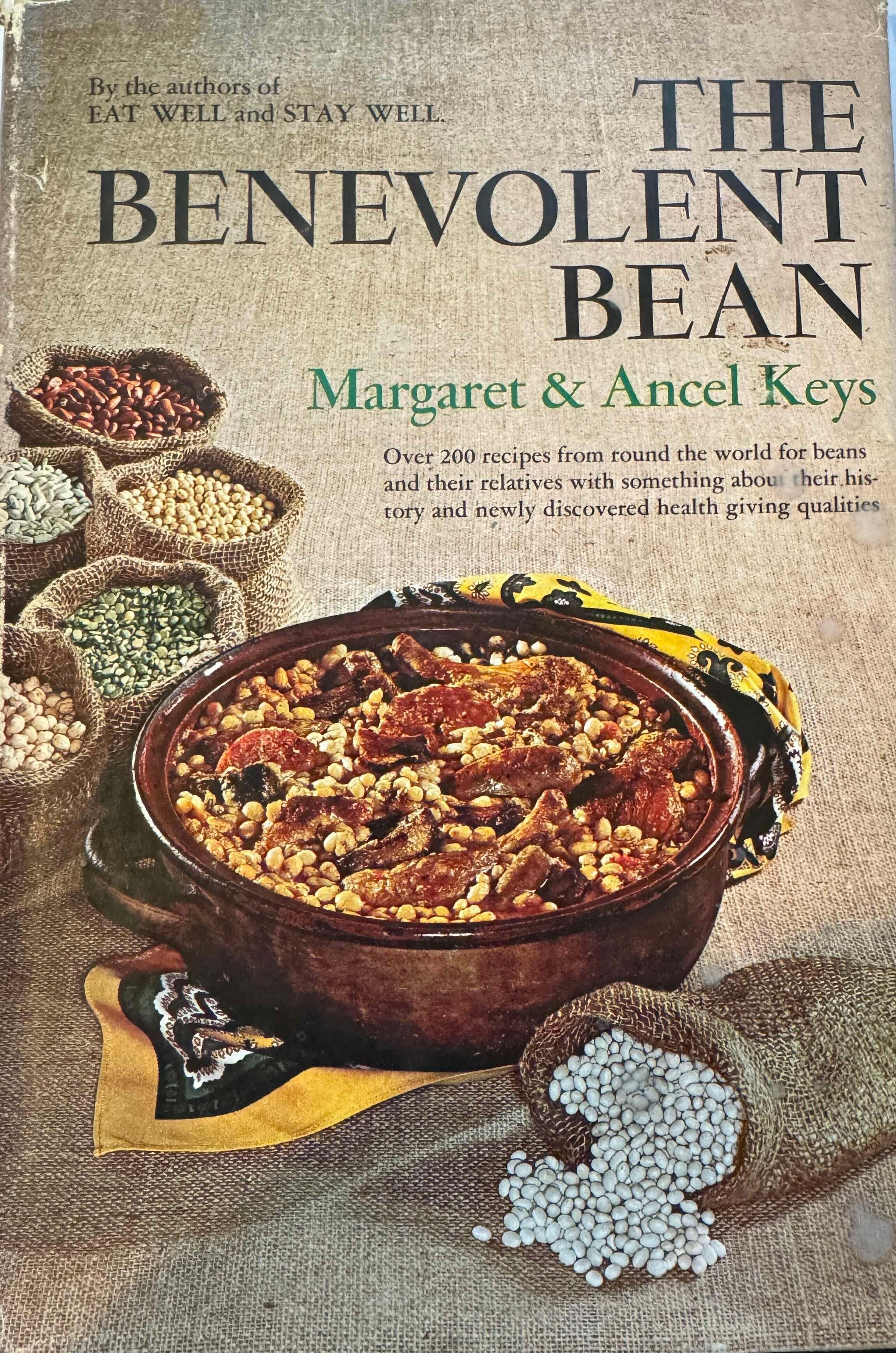
In 1967, Margaret and Ancel Keys (yes that one) wrote one of my favorite books about the bean.
Today, when we are looking for better and healthier ways to eat, I submit, you don’t need protein powder, you don’t need ribeyes. Consider the bean, and like heirloom tomatoes, there are even people bringing back some great beans.
