

The Em Dash Panic—And Why It’s Silly
Somewhere along the way, the em dash went from a mark of confident writing to a supposed tell of artificial intelligence. That’s backwards. The em dash didn’t come from AI—AI rediscovered what good writers have been doing for centuries.
And now, oddly, some writers are afraid to use it.
That’s a mistake.
I like to write, and am currently writing a book about GLP-1 from the perspective not only of a doctor — but a patient. And if anyone follows my Twitter (X) account, they will see me dismantle pseudoscience with abandon. But then someone decides to check grok to see if I am using AI? What does grok do- it looks for the em dash.
The Three Dashes (They Are Not the Same)
Let’s get the basics out of the way—because most people lump these together, and they shouldn’t.
Hyphen (-)
This is the workhorse. It connects words.
evidence-based
well-known
GLP-1
It’s glue. Nothing fancy.
En dash (–)
Slightly longer. Quietly useful.
1990–2025
dose–response relationship
New York–London flight
It means “to” or “between.” Most people ignore it—good writers don’t.
I love the en dash because it is in the en dash that we have life. Life is not the day you were born, or the day you die, life is the en dash.
Em dash (—)
Longer. Stronger. This is where voice lives.
The argument—confidently stated—falls apart under scrutiny.
GLP-1 drugs don’t just reduce appetite—they change physiology.
It interrupts, pivots, emphasizes. It lets you think on the page.
Why Writers Have Always Used It
The em dash isn’t new. It’s not trendy. It’s not algorithmic.
It shows up everywhere once you know to look:
Emily Dickinson used it as breath itself
Herman Melville used it to layer ideas mid-sentence
Virginia Woolf used it to mirror thought
James Joyce used it to fracture and flow at the same time
Mark Twain used it for timing—especially comedic timing
The common thread isn’t style. It’s control.
The em dash lets you move faster than a comma and more flexibly than a period. It captures interruption—the way people actually think.
What AI Actually Did
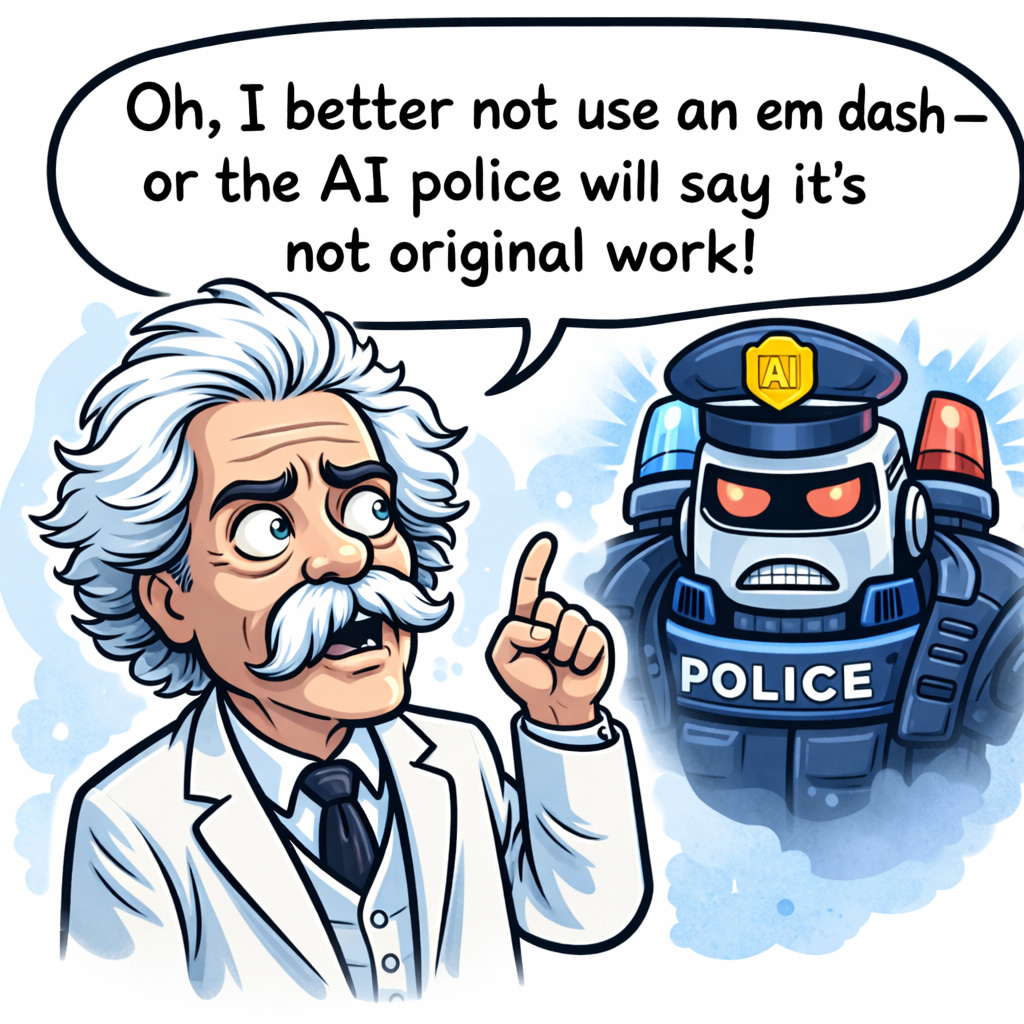
AI didn’t invent the em dash. It just uses it a lot.
Why?
Because it’s trained on good writing—and good writing uses em dashes.
So now we have this odd moment where:
People notice em dashes more
They associate them with AI
And they start avoiding them
That’s like avoiding verbs because AI uses verbs.
The Real Problem
The problem isn’t the em dash.
It’s bad writing using the em dash badly.
You’ve seen it:
Overused—every sentence fractured
Forced—where a comma would do
Decorative—rather than functional
That’s not a punctuation problem. That’s a thinking problem.
Where to Find It (So You Actually Use It)
On iPhone / iPad
Press and hold the hyphen (-) key
Slide to:
– (en dash)
— (em dash)
Or type two hyphens (--) → autocorrect often converts to an em dash.
On Mac
Em dash: Option + Shift + -
En dash: Option + -
On Windows
Em dash: Alt + 0151 (numeric keypad)
En dash: Alt + 0150
Or in Word:
Type -- → autoformats to em dash (if enabled)
In Google Docs / Word
Type -- → usually converts automatically
Or go to: Insert → Special Characters → search “dash”
Should You Use It?
Yes—with intent.
Use it when:
You want to interrupt a thought
You want to add emphasis without starting a new sentence
You want your writing to sound like a person thinking—not a report being filed
Don’t use it:
Because it “looks smart”
Because you saw it on Twitter
Because you’re trying to imitate a style you don’t understand
The Bottom Line
The em dash isn’t an AI tell. It’s a writer’s tool.
Good writers have always used it—confidently, deliberately, and sparingly.
If anything, AI has just reminded people it exists.
And now, instead of fearing it, you should do what good writers have always done:
Use it when it makes the sentence better—and don’t apologize for it.
And if someone says that you used AI, and you didn’t — do this, put a bit of Mark Twain’s writing in and show that his was all AI.
Oh, here is what I found about AI writing— it just isn’t that great. When someone says AI will replace people, I don’t see it. Let me give you an example:
AI vs Me
After gastric bypass, GLP-1 levels surge dramatically. Ghrelin falls after sleeve gastrectomy. Insulin sensitivity improves long before meaningful weight loss occurs. The metabolic machinery begins shifting almost immediately.
We thought we were carpenters rearranging plumbing.
We were endocrine surgeons with staplers.
Eventually the field acknowledged what the data had been quietly telling us. Bariatric surgery became bariatric and metabolic surgery. The name changed because the science demanded it.
Here is when I asked AI to redo it:
After gastric bypass, GLP-1 levels surge. Ghrelin falls after sleeve gastrectomy. Insulin sensitivity improves well before meaningful weight loss appears—the metabolic machinery begins shifting almost immediately.
We thought we were carpenters, rearranging plumbing.
We were something else entirely—endocrine surgeons with staplers.
In time, the field caught up to what the data had been saying all along. Bariatric surgery became bariatric and metabolic surgery, not by preference but by necessity. The name changed because the science refused to be ignored.
— Anyway, I prefer me. AI can write for you, but you have a unique voice. Use it. And learn to use the em dash