


Do you want your healthcare provider to be up to date with their COVID vaccination?
Earlier this week, I asked a broad substack audience if they wanted to know if their primary care doctor was not up to date with COVID. 87% said they wanted to know, 13% said no. Yes, we want to know if our doctor might be a vector for COVID infection.
Some hospitals and clinics are asking whether healthcare workers who have direct contact with patients should continue receiving the annual updated COVID vaccine. It is a fair question.
Unlike the early days of the pandemic, we now have six years of experience and data. We know that COVID vaccines are not perfect, but do they reduce risk enough to justify requiring them for healthcare workers who care for vulnerable patients?
Wastewater surveillance is currently showing increasing circulation of SARS-CoV-2 in many communities. Emergency departments around the country are seeing an uptick in patients with COVID infections. The virus continues to circulate and evolve.
COVID and Influenza
That the last COVID surges have been relatively mild does not mean the next surge will be. That being said, COVID is three times more likely to cause death than influenza, especially among the many vulnerable patients we care for, from the elderly to those whose health is compromised. If we believe annual influenza vaccination is worthwhile for those caring for vulnerable patients, it is reasonable to ask whether we should apply that same standard to a virus that continues to cause substantially more severe disease.
Like influenza, COVID has settled into a seasonal pattern, and some years COVID will have far more hospitalizations and deaths. We cannot predict whether the next variant will be milder or more severe, only that the virus will continue to mutate.
Semmelweis to Lister Reducing Risk
Nearly two hundred years ago, Ignaz Semmelweis noticed that mothers delivering babies in the physicians’ maternity ward died at rates approaching 10 to 18 percent. In the neighboring ward staffed by midwives, mortality was only 2 to 3 percent. “Why?” he wondered.
It came down to hand washing, especially when the physician went from the autopsy room to the delivery room. Semmelweis had data, not only from his hospital, but also from two other colleagues. Despite the data, Semmelweis’s interventions were dismissed. Semmelweis was ultimately proved correct, but sadly years after he died.
Joseph Lister studied the use of antiseptics in the operating theater to reduce surgical wound infections. The spray of carbolic acid in the operating theater was a bit noxious to the staff. In spite of good and careful data, there were many who pushed back on his data.
Early risk reductions were dramatic. Lister showing a reduction of death after amputations from 50% down to 15%. But as further changes occur, the reductions in morbidity and mortality would show some diminishing return.
Incremental Changes
When you look at drawings of Lister operating, I have to smile. He was wearing his suit and tie, no gloves, no mask. You can still see the machine used to spray carbolic acid into the operating theater. The operating room bears little resemblance to what we know today. Yet beside him sits the one piece of equipment that changed surgery forever: the carbolic acid spray apparatus.
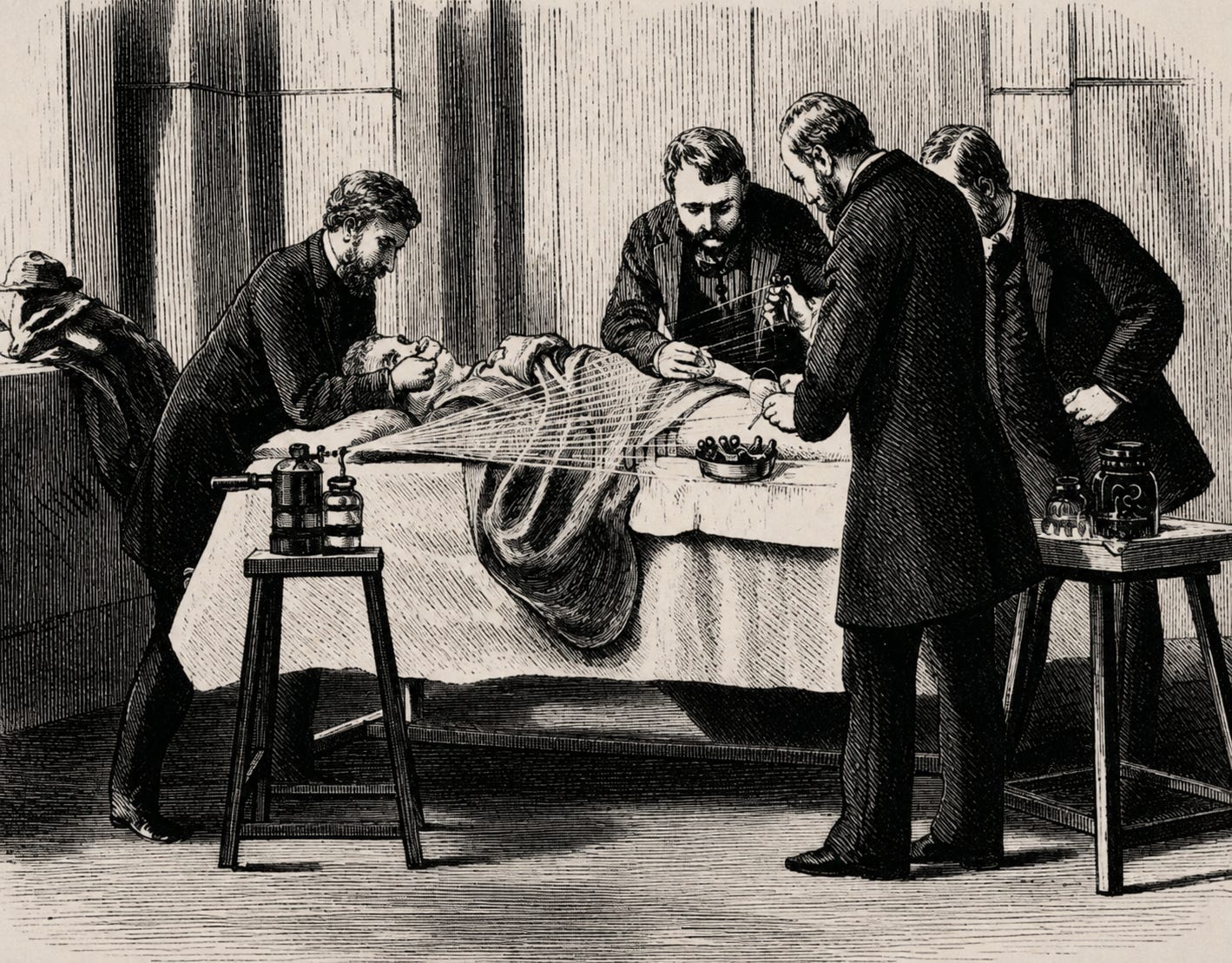
It was far from perfect.
The spray irritated everyone’s eyes and lungs. It was messy. Many surgeons thought it was unnecessary. But as the evidence accumulated, Lister’s methods spread throughout Britain, Europe, and eventually the world. The spray apparatus became so iconic that it can still be found in surgical museums from Edinburgh to Ohio.
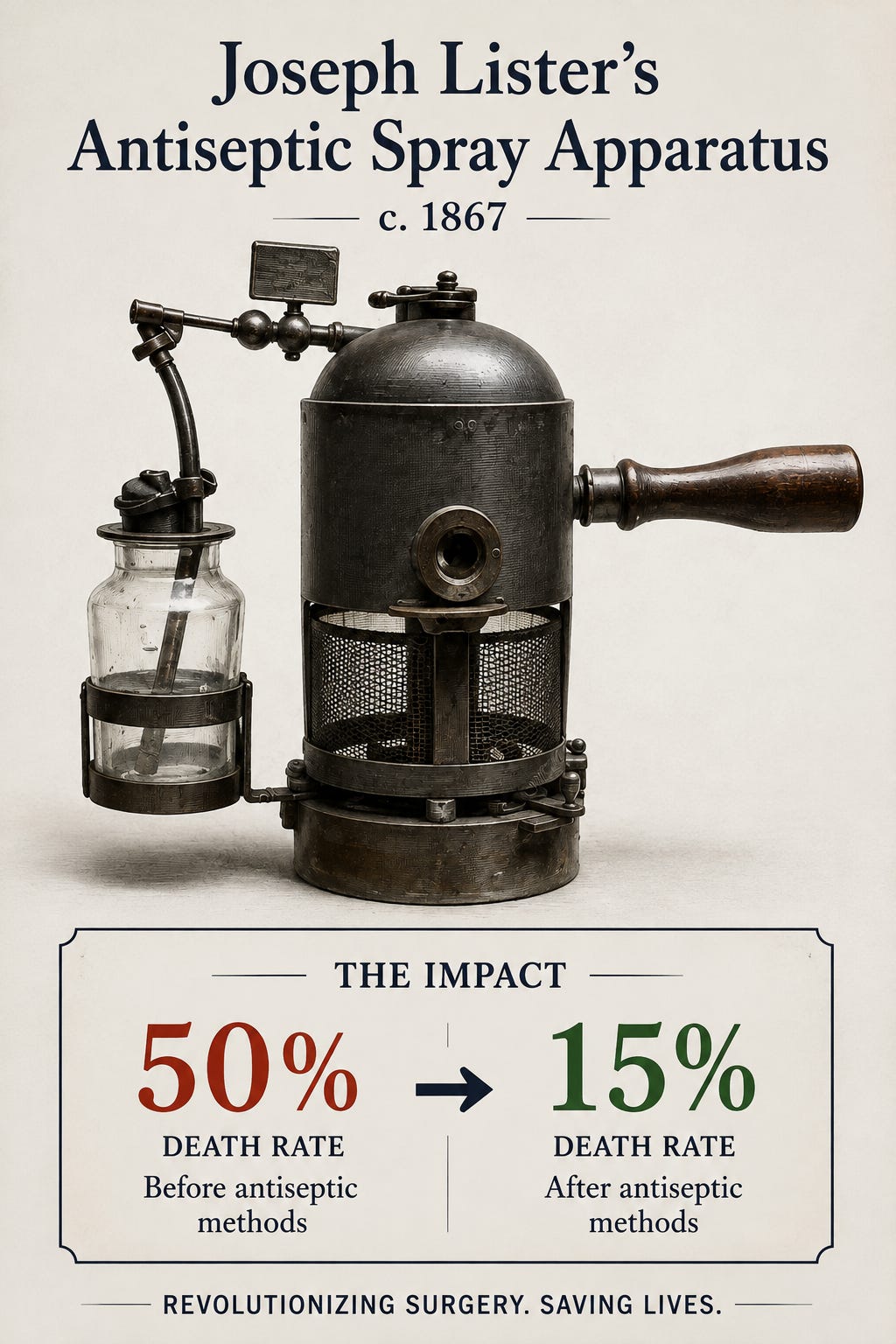
One of Lister’s greatest students was William Macewen. Macewen realized that instead of killing bacteria after they entered the wound, perhaps they should never enter the operating room. He shifted surgery from antisepsis, killing bacteria with carbolic acid, to asepsis, keeping bacteria out to begin with.
Instruments were first sterilized by boiling, but Macewen soon introduced steam sterilization. Surgeons had boiled instruments in the Roman Republic, and this fact was lost from Rome’s fall until Macewen’s reintroduction.
He championed one-piece steel instruments, replacing the wooden-handled instruments that harbored bacteria in tiny cracks and crevices. Not long ago, we discovered a few wooden-handled surgical instruments tucked away in a hospital storage room. They hadn’t been used in generations, but they were a reminder of how far surgery had come.
The operating room itself was changing. Surgeons began wearing dedicated operating room clothing, replacing the business suit with the first version of scrubs, and they were all white. For years, surgeons referred to them simply as “the whites.” FIGS eventually arrived and proved that operating room attire could have some style without bringing back the bacteria.
Macewen also championed the ritual every surgeon knows well: the surgical scrub. Long before alcohol hand rubs and modern antiseptic solutions, surgeons spent ten minutes meticulously cleaning their hands before every operation.
The operating room was becoming cleaner by design, rather than by rescue. As aseptic technique matured, the famous carbolic acid spray apparatus disappeared from operating rooms, replaced by a philosophy that prevented contamination, rather than trying to disinfect it after the fact.
In America, William Halstead introduced gloves to the operating room, not to decrease infection. He did it to protect his chief nurse, who ultimately became his wife (surgeons and nurses - a long story), as her hands were suffered from skin damage from harsh antiseptic soaps.
Each step in the operating room presented changes, the first ones like Semmelweis and Lister were dramatic, and with every incremental step increased the costs.
If you have ever peeked into an operating room while an orthopedic surgeon replaces a hip or knee, you probably wondered why everyone appears to wear space suits. Those helmet systems are more than costumes. They are body exhaust suits with filtered air designed to reduce contamination of the surgical field.
Hospitals invest millions in laminar airflow operating rooms, surgical helmet systems, and disposable body exhaust suits, all to reduce the risk of infection after joint replacement by less than one percent. Why? Because when an artificial joint becomes infected, the consequences are devastating. Patients often require multiple operations, months of antibiotics, prolonged disability, and sometimes never regain normal function.
No hospital administrator walks into an orthopedic operating room and says, “The benefit is less than one percent. We can’t justify the expense.” Okay, I am sure some hospital administrators have tried that.
We accept those costs, because every infection prevented matters. Technology has changed. The principle has not. Our responsibility is still the same: reduce the chance that we become the source of a patient's infection.
Now Back to COVID
As surgeons, we don't accept preventable infections simply because they cannot all be eliminated. We work relentlessly to reduce risk. The same principle applies to COVID-19. We want to reduce the likelihood that an infected healthcare worker brings the virus to a vulnerable patient, because that transmission may lead to hospitalization, prolonged illness, or death.
A 2026 JAMA Network Open study found that individuals who had received a COVID vaccine within the previous six months were 43% less likely to transmit SARS-CoV-2 to close contacts than those whose vaccination was more remote. Like immunity against infection itself, that protection declined over time. Rather than being an argument against boosters, it is the rationale for timing them before the winter respiratory virus season, when COVID transmission predictably increases and our patients are at greatest risk.
If we introduced a new device that reduced hospital-acquired infections by 43 percent during the months it was most effective, no hospital would hesitate to adopt it. Infection prevention committees would recommend it. Hospital administrators would find the funding. Physicians would ask why it wasn’t already available.
One of the silly arguments I heard is that since the vaccine wears off, we shouldn’t require it. You know hand washing wears off, but we require that between every patient's room. The effect of wearing gloves wears off after two hours, and we recommend surgeons change gloves if their case lasts more than two hours, we don’t recommend they forego wearing gloves.
Why should we view a vaccine differently?
No intervention in medicine is perfect. The protection from a COVID booster wanes over time. That is true. But COVID is also seasonal. The largest waves predictably occur during the late fall and winter, after holiday travel, family gatherings, and people spending more time indoors. If a yearly booster provides its greatest reduction in transmission during precisely the months when our patients are at greatest risk, then that is exactly when we should want our healthcare workforce to have that protection.
Medicine has never advanced, because we found one perfect intervention. It has advanced because we stacked one evidence-based improvement upon another. Semmelweis gave us hand washing. Lister introduced antiseptic surgery. Macewen brought aseptic technique. Halstead introduced surgical gloves. Every generation accepted another layer of protection, because each layer reduced risk for the patient.
COVID vaccination for healthcare workers belongs in that same tradition.
We also do it for our workforce
Protecting patients is the primary reason to keep healthcare workers up to date with COVID vaccination. But it isn’t the only reason.
Healthcare workers are among the most likely to be exposed to SARS-CoV-2. During every seasonal surge, they care for infected patients day after day. When they become infected, they are required to stay home, precisely when hospitals and clinics need them the most.
A large multicenter study found that healthcare workers who remained up to date with COVID vaccination missed, on average, about two fewer days of work for each COVID illness than those whose immunity had waned. Two days may not sound like much for one person. Across an entire hospital system, however, those days translate into hundreds of thousands of dollars in staffing costs, overtime, temporary personnel, and reduced clinical capacity. More importantly, fewer absences mean more experienced nurses, physicians, therapists, and support staff are available to care for patients during the very weeks when demand is highest.
This is one reason virtually every major infectious disease and infection prevention organization continues to recommend that healthcare personnel remain up to date with COVID vaccination. The Society for Healthcare Epidemiology of America (SHEA), the Infectious Diseases Society of America (IDSA), the Association for Professionals in Infection Control and Epidemiology (APIC), the Pediatric Infectious Diseases Society (PIDS), the HIV Medicine Association (HIVMA), the Society of Infectious Diseases Pharmacists (SIDP), and the Society for Post-Acute and Long-Term Care Medicine (AMDA) issued a joint consensus statement concluding that COVID vaccination should be a condition of employment for healthcare personnel in U.S. healthcare facilities.
In contrast, an updated COVID booster is inexpensive. It reduces transmission, reduces healthcare worker absenteeism, and helps protect the patients entrusted to our care.
Healthcare workers have long accepted requirements designed to protect patients. Most hospitals require immunity to diseases such as measles, mumps, rubella, varicella, and hepatitis B, and many require annual influenza vaccination. COVID should not be viewed differently, simply because it has become politically controversial. The same standard should judge it we apply to every infection prevention measure: does it meaningfully reduce risk? The answer is unambiguous, not perfect, but none of our interventions are.
Surgeons Live With the Consequences
As surgeons, we accept dozens of mandatory infection control measures without complaint, because they protect the patient. We don't "educate" people about sterile instruments, and then let them choose whether they want to use them. We require them because the patient has entrusted us with their life.
Our operating rooms are held to the highest standards of sterility, because our patients expect nothing less. If the circulating nurse tells me the sterilization indicator on an instrument tray failed to change color, we do not start the operation. I will inwardly curse, because that is twenty minutes of my day, but no surgeon would suggest we proceed anyway. That autoclave is the direct descendant of William Macewen’s steam sterilizer. It represents more than a century of learning that meticulous attention to seemingly small details prevents devastating infections.
Before every operation, I scrub my hands. I am assisted to properly put on the sterile gown and gloves. The patient’s skin is prepped with an antiseptic solution, and every member of the operating team follows this, almost as if it was ritual. While each individual step is imperfect, and reduces risk by an infinitesimally small amount, together they have created one of the safest environments in medicine because our patients have placed their trust in us.
As a surgeon, I go through the journey with the patient when there is a wound infection. The hospital administrator doesn’t. So when I hear someone suggest we “educate” healthcare workers about COVID boosters, rather than require them to do this as part of direct patient care, I wonder why we make that distinction. We don’t educate surgeons about instrument sterilization, and then allow them to decide whether they feel like using an autoclave today. We don’t educate nurses about hand washing and leave it as a matter of preference. We establish standards because the consequences of failure are borne not by the administrators, not by a governing board, but by the patient - the customer-owner, as we say in Alaska.
Education is essential, but education alone has never been the standard for infection prevention. We educate healthcare workers, and then we establish standards that protect patients.
Those of us who cared for patients during the pandemic have not forgotten what it looked like when someone could no longer breathe on their own. None of us wants to stand at another bedside wondering whether a preventable transmission occurred because someone in the healthcare system chose not to take advantage of a safe, inexpensive intervention. We cannot eliminate every infection. But we have a professional obligation to reduce the ones we reasonably can.
Every major healthcare organization involved in infectious diseases, hospital epidemiology, and infection prevention continues to recommend that healthcare personnel remain up to date with COVID vaccination. COVID remains a major cause of morbidity and mortality among our patients. If we have an opportunity to reduce the chance that the infection comes from us, we should take it. That has been the philosophy of medicine since Semmelweis asked a simple question, “Why?” It remains the philosophy that should guide us today.
I’m supportive of vaccines and understand their importance, particularly for healthcare workers. My question is about those of us who developed significant, persistent post-viral-type symptoms following COVID vaccination and who now experience similar problems with other vaccines, including the flu vaccine.
If mandatory vaccination for healthcare workers is going to be reconsidered, how can we plan for people in this situation? What research is being done to understand why some individuals appear to have prolonged immune or inflammatory reactions, how to identify who may be at greater risk, and—most importantly—how to make future vaccination safer for us?
I want to be able to receive the protection vaccines provide. What I would like to understand is what medicine is doing to help people who have experienced these reactions safely get there.