


The Scientists Who Built the Modern Snack
A few years ago, researchers at the National Institutes of Health performed one of the most expensive nutrition studies imaginable. Rather than asking people what they ate—which is a remarkably unreliable way to learn what people eat—they brought volunteers into a metabolic ward where every meal was prepared, every serving was weighed, and every leftover morsel was measured. There would be no guessing, no food diaries, and no wishful thinking. If someone ate a cookie, the researchers knew it. If they left half a sandwich on the plate, the researchers knew that too.
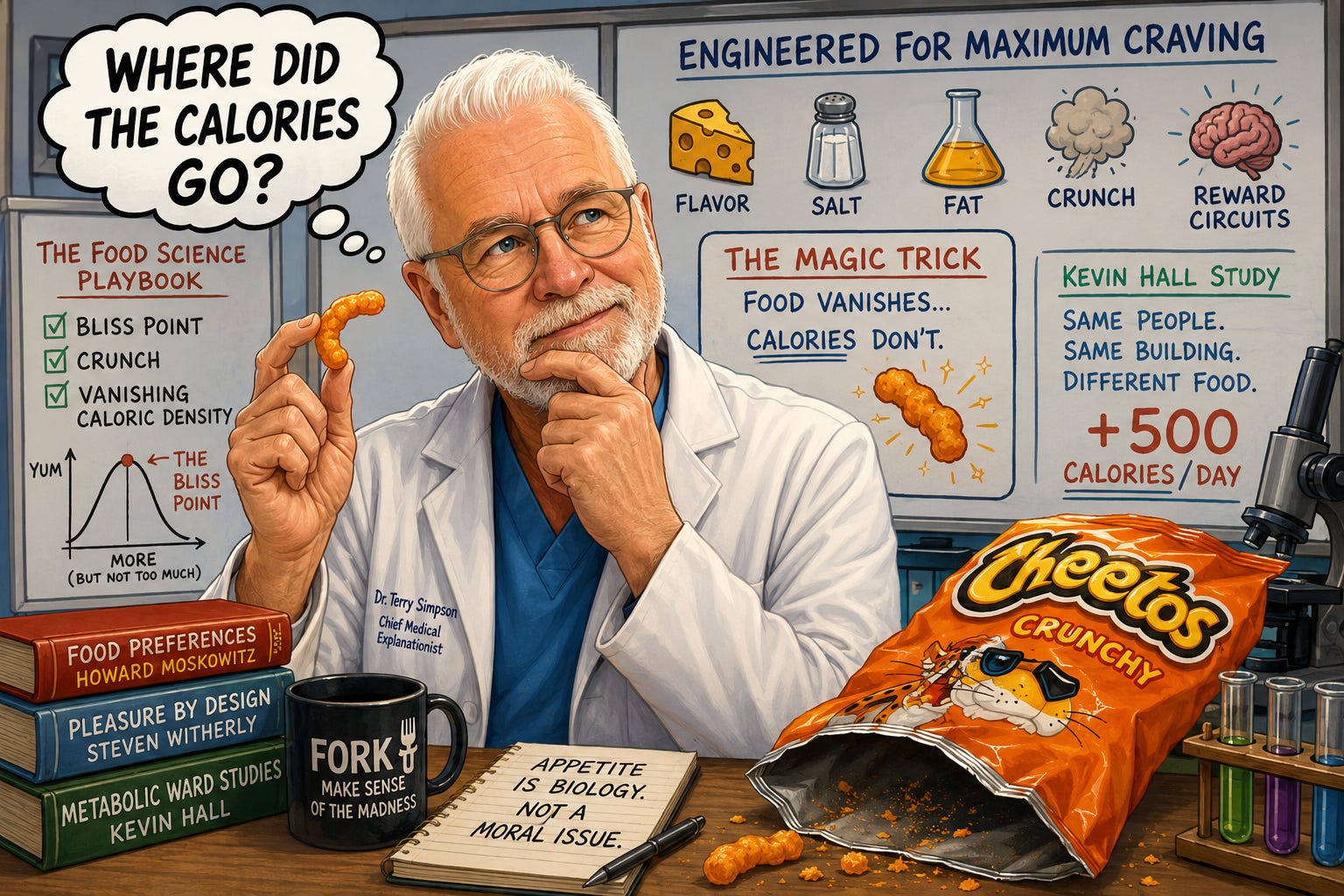
The study itself was deceptively simple. Participants were given two diets. One consisted largely of ultra-processed foods, while the other was built around minimally processed foods. The volunteers could eat as much as they wanted, and nobody instructed them to count calories or lose weight. Nevertheless, something fascinating happened. When eating the ultra-processed diet, participants consumed roughly 500 more calories each day than when they ate the minimally processed diet.
Five hundred calories.
Not because they were forced to eat more. Not because they lacked discipline. Not because they suddenly forgot everything they knew about nutrition. Instead, the food itself appeared to change their behavior.
Most people hear that finding and immediately ask why obesity occurs. However, the question that has always interested me is slightly different. If foods can influence calorie intake that dramatically, why doesn’t everyone become obese?
For those who listen to my podcast FORK U, we covered this partially in that podcast. Here are the details. If not, FORK U can be found where you subscribe to most podcasts. It typically comes out on Thursdays.
The Grocery Store Didn’t Happen by Accident
To understand how we arrived here, it helps to step back a few decades and visit a place that rarely appears in discussions about nutrition. While most of us imagine food evolving in kitchens, restaurants, farms, and family traditions, another form of evolution was taking place inside corporate research laboratories.
One of the most influential figures in that story was Howard Moskowitz, a statistician hired to help food companies create products that consumers would love. At the time, the prevailing assumption was that there must be a perfect spaghetti sauce, a perfect soda, or a perfect level of sweetness waiting to be discovered. Moskowitz, however, found something far more valuable. There was no perfect spaghetti sauce. There were many perfect spaghetti sauces.

Some consumers preferred smooth sauce. Others wanted chunks of tomato. Some liked sweeter flavors, while others preferred something more savory. Consequently, the goal shifted from creating one product for everyone to creating multiple products for different groups of consumers. Once food companies learned that lesson, grocery stores began to change. Suddenly there wasn’t one barbecue sauce, there were twelve. There wasn’t one yogurt, there were thirty. Entire aisles became exercises in consumer segmentation.
Today, when you stand in front of a shelf and wonder why there are twenty versions of the same product, you are looking at Howard Moskowitz’s legacy.
Then Came the Food Scientists
Knowing what people like is only half the battle. Once a company understands your preferences, the next question becomes how to maximize the pleasure associated with those preferences. This is where food scientists such as Steven Witherly enter the story.
The sensory experience fascinated Witherly. Flavor mattered, of course, but so did crunch, aroma, texture, temperature, and even the sound food makes when it breaks between your teeth. Long before social media influencers recorded themselves eating for millions of viewers, food scientists studied why certain foods seemed so rewarding.
One of Witherly’s most memorable observations involved what he called vanishing caloric density. Certain foods, particularly puffed and extruded snacks, dissolve so quickly in the mouth that they create the sensation of disappearing. The crunch arrives, the flavor explodes, and then the food is gone. Unfortunately, the calories remain very much present, but the sensory experience is so brief that the brain receives surprisingly little resistance during the process.
A carrot, by contrast, insists on being chewed. An apple demands attention. A piece of fish requires time and effort. A cheese puff, on the other hand, performs a magic trick. It appears substantial when it enters the mouth and then vanishes almost immediately afterward.
That difference may sound trivial until you remember Kevin Hall’s study. Suddenly, the extra 500 calories begin to make a little more sense.
Extrusion, Engineering, and Eating Faster
In previous articles, I discussed extrusion, the manufacturing process responsible for many breakfast cereals, puffed snacks, chips, and countless other packaged foods. At first glance, extrusion appears to be a discussion about machinery. Ingredients are ground, heated, pressurized, and forced through specially designed openings to create a desired shape.
Yet the more I think about Hall’s study, the more I suspect that extrusion is not merely a manufacturing technique. It is also a behavioral technique.
Structure influences texture. Texture influences chewing. Chewing influences eating speed. Eating speed influences satiety. Consequently, when we alter the structure of food, we may also alter how much of it people consume before fullness has the opportunity to catch up.
That idea does not mean ultra-processed foods are poison, nor does it mean every packaged food is part of a conspiracy. It simply means that modern food manufacturers employ scientists, engineers, statisticians, and sensory researchers, whose job is to understand how people interact with food. When enough bright people spend enough years studying the same problem, they tend to become good at solving it.
The Question I Can’t Stop Asking
I am the youngest in my family. My brothers grew up only a few years before I did, and although those years were not enough to alter our genetics, they were enough to place us in somewhat different food environments. They experienced more meals prepared at home, fewer convenience foods, and less of the fast-food culture rapidly expanding across America.
I became the one who struggled with weight.
Now, before anyone rushes to draw conclusions, let me save you the trouble. This proves absolutely nothing. Anecdotes make poor evidence, and medicine is littered with bad ideas that began with a convincing story. Nevertheless, anecdotes often generate useful questions, and this one has remained with me for years.
If much of our DNA is shared, why did our experiences diverge? Why do some people seem naturally protected from a food environment that others find extraordinarily difficult to navigate?
Every family has its version of this puzzle. One sibling struggles. Another does not. One parent gains weight. Another remains lean. A single factor rarely explains the differences, because biology seldom provides simple answers.
What GLP-1 Medications Revealed
One of the most fascinating developments of the past few years has been listening to patients describe their experiences with GLP-1 medications. Interestingly, many do not talk about hunger first. Instead, they talk about silence.
Foods that once demanded attention become easier to ignore. Cravings become less urgent. The constant background conversation about food begins to quiet down. As a result, many patients ask a question that obesity researchers have been circling for decades.
“Is this how other people think about food?”
That question may be more important than it appears. Before taking tirzepatide, I assumed hunger was the primary story. After taking tirzepatide, I became increasingly convinced that food noise often deserves equal billing. The food itself remains unchanged. The grocery store remains unchanged. The restaurant remains unchanged. What changes is the conversation occurring inside the brain.
Perhaps that is the most important lesson hidden inside Kevin Hall’s experiment. The difference between two people is not always knowledge. It is not always discipline. It is not always character. More often than we care to admit, biology interacts with an environment that has become extraordinarily sophisticated at capturing our attention.
Howard Moskowitz helped companies discover what we like. Steven Witherly helped explain why we like it. Kevin Hall showed what happens when real people are exposed to those foods under controlled conditions. Yet despite everything we have learned, the most fascinating question remains unanswered.
Why are some people protected?
Because if we can understand that, we may finally learn more about obesity than ever, by blaming the people who develop it.
