


Corn, beans and squash, the three sisters were the Native American’s crop, providing a stable source of calories, protein, and farming from Canada through South America. They allowed civilization to go from a hunting people to those who built cities that rivaled Europe and pyramids equal to the marvels seen in Egypt. The rise of civilizations has a pattern, grow a stable crop that allows people to survive, and go from nomads to develop complex societies.
In our series of foods that built civilizations, we turn to the Americas before Europeans arrived.
Long before Europeans arrived, civilizations in the Americas had developed writing, calendars, monumental architecture, cities, trade networks, irrigation systems, pottery and sophisticated agriculture. Corn, or maize, fed the Maya, Inca, and Aztec worlds.
In what is now the American Southwest, Pueblo peoples built multi-story communities in the desert, while Mississippian societies built towns and enormous earthworks along the great river valleys.
It began with Corn, or Maze
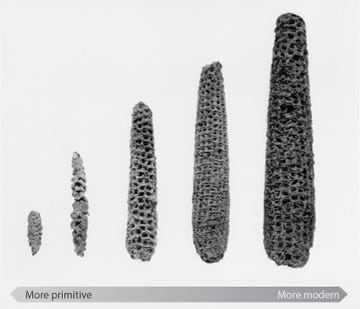
It all began with a grass called Teosinte (pronounced “tA-O-‘sin-tE”). Teosinte does not look like corn today, but the DNA shows they are alike, and it was this grass that Native Americans 10,000 years ago began to engineer. In fact it wasn’t until a few years, 2005, ago that modern molecular geneticists discovered that this grass, Teosinte, was the father of corn. For years, people who study plants, botanists, assumed the evolutionary predecessor had long since become extinct. And while Teosinte is widely spread throughout Central America, it was not even considered in the same family as corn.
The original ear of Teosinte is 2-3 inches long with 5-12 kernels. The kernels were hard, and most human teeth would break trying to eat them. Teosinte is inedible for many people. Contrast Teosinte with modern corn with a cob. A cob is 12 inches long, with over 500 kernels. The coating on the kernel was selectively bred from the rock-hard protecting seed to, now, where corn has an easily chewable, paper thin, but still indigestible membrane. This was breeding at its finest.

Ten thousand years ago, there was no plant that anyone would recognize as corn. In fact, there was no corn. By 4500 years ago, corn was throughout all the Americas, with carbon dating of kernels in Arizona from over 3000 years ago, Canada 700 years ago. Corn allowed the Mayan people to go from a people who foraged, to a people who could stay and cultivate.
You can see from the photos how as time went on corn changed: both Teosinte and corn have the same number of chromosomes, they have the same genes that code for the same proteins. Teosinte and corn can be bred, because they are so close genetically. The difference between the grass, Teosinte, and modern corn is about a few genes. Corn didn’t “evolve” early Native Americans bred corn. Generation of corn after generation, they bred the crop that tasted better, chewed easier, and survived well.
In what is now El Salvador, some have said the Mayans discovered corn in the mountains of Chalatenango. Recently, a damn revealed a village in the area, which was one of the original four Lake Island villages of the Mayans. On this land, one can see the range of corn from the grass to the modern corn. If you hike there, you can see places where the Mayans would grow special crops, where they would harvest the Teosinte with the kernels they could eat, and over time they would breed it and cross breed it until they had an agricultural system based on this plant.
So sacred was corn, that they called it the “grain of the gods.” To this day, the people in Santa Ana, in western El Salvador, still plant little plots of primitive corn that they called something like “ulupiche”. This is not to eat, but simply to please the ancestors. It is from these Mayans that corn was selectively bred, or genetically engineered for better taste, different colors, and ability to withstand pests.
Corn moved quickly, finding its way to Mexico 7000 years ago, South America 6800 years ago, and to North America nearly 4000 years ago. Once Europeans arrived, corn spread even more rapidly through the rest of the world.
The First Tupperware Party
Edible Tupperware, that would bring new life into a product that seems to have gone the way of Department Stores and home parties hosted by your neighbor to get you to buy something.

The first squash probably used to carry water, food, grain. Vessels such as these were radioactive-dated nearly 11,000 years ago in Hondorus. These gourds were hard, the inside was bitter, but they were efficient to carry water, perhaps cook food, and store nick knacks (the first junk drawer was a squash). But get hungry enough, and even bitter food can be tasty (not Brussels sprouts).
The squash family (Cucurbitaceae) was domesticated about the same time. Those squash were related to zucchini, yellow summer squash, acorn squash, delicata, many pumpkins, pattypan, and crookneck squash. And as much as zucchini feels Italian, these squash were grown and consumed in Mexico thousands of years before Rome existed.
Multiple types of edible squash were cultivated in different geographic regions, and ultimately traded.
The Bean
The last of the sisters was the bean. Indigenous peoples domesticated several species of beans in the Americas. The most familiar is Phaseolus vulgaris, the ancestor to black beans, kidney beans, pinto beans and navy beans. But there wasn’t just one ancestor to all the beans.
Indigenous farmers domesticated at least five species of Phaseolus. Today, we know their descendants. Besides the black and pinto beans. There was a different region that grew lima beans, and yet others were the scarlet runners and tepary beans.
Europeans had been eating beans for thousands of years before Columbus. Original old world beans included fava beans, peas, lentils and chickpeas. From America, Europe obtained kidney beans, black beans, pinto beans., and cannellini beans. Yup, those favorite beans I put on Paella originally were groomed in America.
The Three Sisters
When the first European settlers arrived, they noted the agricultural habits of Iroquois with the three sisters. The corn provided the pole, the beans fixed nitrogen into the soil, and the squash provided a ground cover that kept away pests.
The works not only from the perspective of good land use, but also provides a complete protein. You do not have to eat corn and beans in the same bite to create a “complete protein.” But across a diet, their amino-acid profiles complement each other beautifully. Corn gives abundant energy and some protein. Beans add protein, particularly lysine. And, squash adds micronutrients through the seeds, fat and additional protein.
The agricultural system worked, and because it worked, it was copied throughout the Americas. The nutrition also worked, without a Registered Dietician telling them.
Civilizations
We have historic records of what happened to some civilizations, which gave us written languages, weights, measures, amazing architecture, Mayan calendars. The tragedy of the indigenous peoples of what is now North and South America has been well documented. We have no idea what we have lost.
Yet what remains is the food. What always seems to remain is the food, and now when you eat your tomato on the pizza, or have cannelloni beans on Paella, you are eating history from the major continents that all had their own civilizations whose contribution was great pizza, paella, and food.
Every one of the ancient civilizations has disappeared. Their food remains. We read about the Greeks eating whole grains and pulses. We tour Machu Picchu. We marvel at the Code of Hammurabi. We look at the terracotta soldiers guarding the tomb near Xi’an. All while enjoying the food that allowed them to settle and make a civilization.
Some monuments survived, but the food is still here. I still don’t know why we kept Brussels sprouts.