


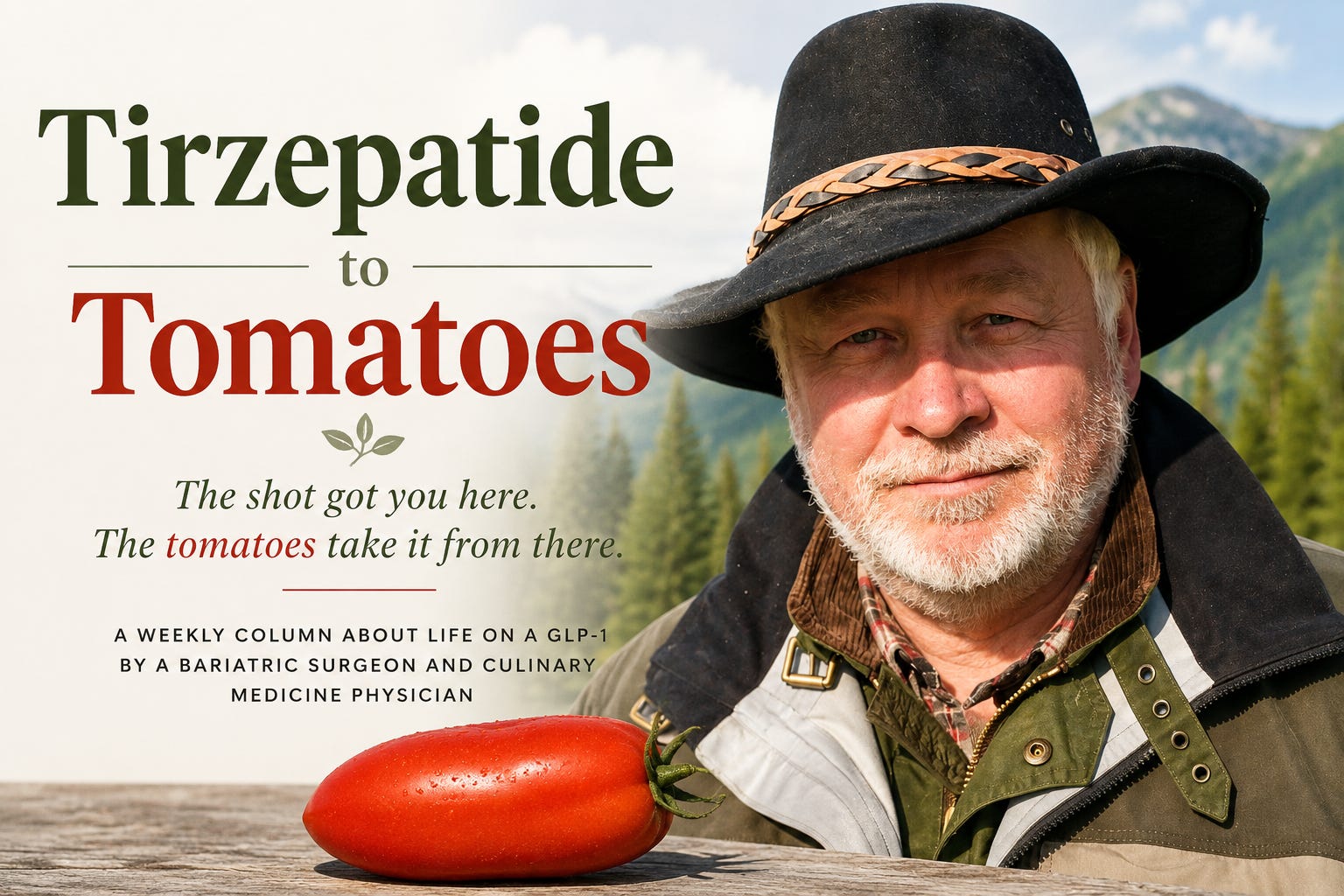
Welcome to Tirzepatide to Tomatoes. I suppose I could have called it Ozempic to Okra, but Mediterranean Marazono tomatoes won. This column is about what happens after the prescription is filled. Weight loss is wonderful, but eventually we all face the same question: now what? As a bariatric surgeon, culinary medicine physician, and fellow traveler on Zepbound, I'll share what I've learned about building health after the food noise quiets down.
I was going to launch this on Tuesday, so I could call it Tuesday Tirzepatide to Tomatoes, but that level of alliteration is best left to professionals. I'm a surgeon. We remove things; we don't name them.
You Have a Baby Stomach. Now What?
For years, when I performed bariatric surgery, I would tell patients they had a baby stomach.
The surgery was over. The anatomy was different. Now came the learning phase.
A baby's stomach doesn’t know what it likes yet. It doesn’t know which foods settle comfortably and which foods cause trouble. It doesn’t know that one bite too many can mean an hour of regret. Like a parent introducing food to an infant, patients had to pay attention. They had to learn. They had to discover what worked and what didn’t. This is what happened after surgery and what happens with a GLP-1.
Today, I find myself having the same conversation with people taking GLP-1 medications.
No, the medication doesn’t physically shrink the stomach the way surgery does. But many people discover that eating feels different. Portions that once looked normal now seem enormous. Rich foods may sit heavily. Eating too quickly can be uncomfortable. Fullness arrives sooner than expected.
GLP-1 give you a chance to start again - like a baby’s stomach
When we talked about baby stomachs after bariatric surgery, we also talked about protein shakes. Patients often misunderstood their role. They thought the protein shake was the diet. It wasn’t.
Protein shakes were formula. Like infant formula, the kind I would run to Walmart and get at 11 pm because I realized we were out and JJ was crying. Thank goodness they were open late.
Protein shakes were useful. They helped patients meet protein goals while learning how to eat again. But nobody wants a healthy two-year-old living exclusively on formula. Formula is a bridge. It is not the destination.
The same thing is true with GLP-1 medications. A protein shake can be a wonderful tool. It can help preserve muscle while weight is coming off. It can make a busy morning easier. But eventually, the goal is to learn how to eat real food. The goal is not to survive on shakes forever. The goal is to build a way of eating that you can enjoy for years.
That is where many people become stuck.
The weight starts coming off. Food noise becomes quieter. The old cravings lose some of their power. Then comes the inevitable question:
“What should I eat now?”
Unfortunately, diet culture answers that question. Somebody tells you to avoid bread. Another will tell you to count points. And there is always somebody who tells you to count macros.
The low carb evangelist tells you that fruit contains too much sugar. The new carnivore insists that humans should consume roughly half a heifer every week. Then the vegan will tell you that taking honey from bees is immoral.
Then the most common one I hear - “just eat less than before and better.” I don’t even know what that means.
God help them all.
The irony is that many people finally escape the biology that was fighting them, only to become trapped by nutrition rules that have confused them for decades.
The Counters
As a scientist, I understand the appeal of rules. When we conduct nutrition research, we measure everything. We calculate servings. We weigh foods. We count grams. We determine how closely somebody follows a Mediterranean dietary pattern.
That is how research works. But that is not how people live. You will not bring a digital scale to dinner. You will not calculate your Mediterranean Diet adherence score while standing in your kitchen wondering what to make on a Wednesday night.
The Mediterranean Diet score is a research tool. Researchers love counting things. If there are twelve almonds on the plate, they want to know if there were thirteen yesterday. Give a researcher a bowl of beans, and they'll find a way to create a spreadsheet.
It helps scientists compare populations. It was never intended to become a lifestyle religion. When I was seeing how well patients did after bariatric surgery, I used that scale to calculate scores for the patients. But it is a tool to measure adherence, because that is what we have to do. It is not what we want you to do. Yes, someone probably has built some app to do that, but do you want an app telling you that you need two more ounces of legumes today?
I used those scores in research. They are useful. They tell us who is following a Mediterranean pattern and who isn't. But they are measuring tools, not living tools. A thermometer tells you the temperature. It does not tell you what to wear.
What matters is direction. Are you eating more fruit? How many vegetables are you consuming today? Yes, use the Brussels sprouts for the slingshot, that is why God made them round.
But what is your consumption of beans this week? Was fish, be it tuna or shrimp or salmon, in two meals this last week?
Are you cooking with olive oil?
If the answer is yes, you’re probably moving toward better health.
The baby's stomach gives you the opportunity to make those changes. Better yet, having lost that big reward signal for the ultra processed food, whole foods can take on more interest.
Breakfast of champions
One of my favorite examples is breakfast. I’d rather have you learn three breakfasts that you can prepare repeatedly, than hand you a complicated meal plan you’ll abandon in ten days.
My first choice is a smoothie.
I spend a lot of time commuting. A smoothie travels well. I can sip it while driving to Santa Maria before dawn. Most mornings, it contains at least a cup and a half of fruit. Berries, bananas, yogurt, protein, oats—nothing exotic, nothing expensive, nothing that requires a nutrition degree. It is simple, portable, and starts the day with fruit already on board.
Another favorite is overnight oats. The beauty of overnight oats is that tomorrow’s breakfast is prepared tonight. Oats, yogurt, milk, fruit, and a few extras sit in the refrigerator while you sleep. In the morning, breakfast is waiting. There is no decision to make, because the decision was already made yesterday.
The third breakfast is eggs with beans and ranchero sauce. It tastes like real food, because it is real food. Eggs provide protein. Beans provide fiber. Ranchero sauce provides flavor. Nobody has to pretend it is dessert, a supplement, or a miracle food. It is simply breakfast.
The Grapes or Klondike of Wrap
That brings me to grapes.
Every afternoon, my Apple Watch reminds me to eat some. Yes, grapes.
I know that sounds odd, but I think of them the same way I think of medicine. They are washed, prepared, and waiting in the refrigerator. Around 2:30 in the afternoon, I grab a handful.
Now, I should confess something. There is also a Klondike bar in the freezer.
If it is day six before my next Zepbound injection and that freezer drawer opens, I suddenly become much more interested in that Klondike bar than I was a few days earlier. Fortunately, the grapes are ready and waiting. But it sure is easy to unwrap the Klondike bar, and I can have it consumed by the time I make the turn from the refrigerator to where I deposit the foil wrapper in the trash can. If I have not washed the grapes, well, that seems way more effort than unwrapping the Klondike. Human beings are remarkably efficient. We will travel across town to save twenty cents on gasoline and avoid washing grapes, because it seems like too much work.
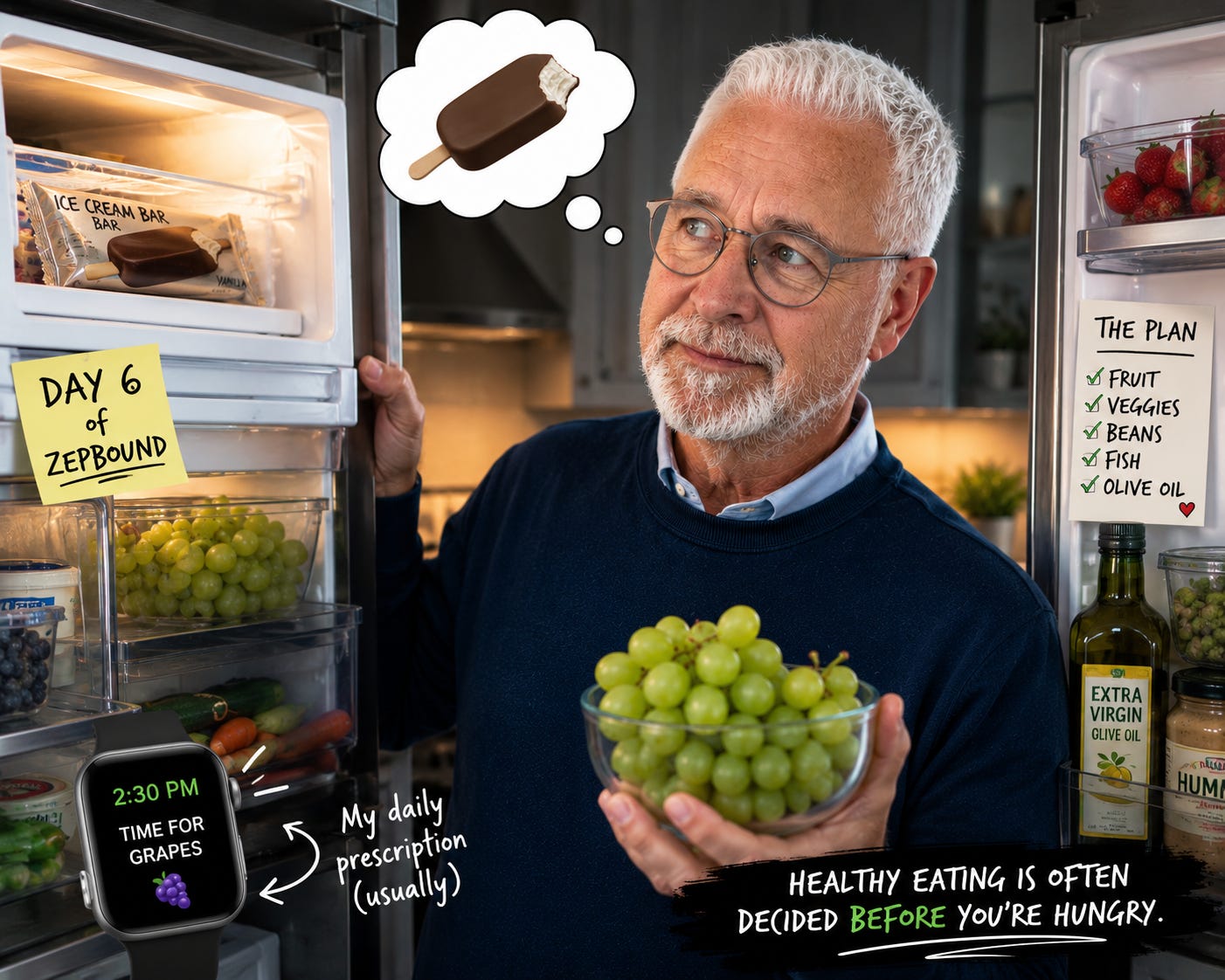
One of the surprising things I noticed on Zepbound is that fruit became more interesting. Not exciting. Not magical. Just interesting. Before, a bowl of grapes was competing, with a thousand food engineers working overtime to make a snack irresistible. Now the grapes get a fair fight.
Most days, the grapes win. Most days.
I was disappointed to learn that the sprinkles on a doughnut do not count as fruit. Apparently nutrition scientists are strict about these things.
Prepare for the day
The point isn’t that grapes are magical. The point is that healthy habits become easier when they are prepared in advance. If fruit is washed and ready, you’ll eat more fruit. If vegetables are prepared, you’ll eat more vegetables. If healthy food is convenient, healthy eating becomes convenient.
That is how adults learn to feed a baby's stomach. Not through willpower, guilt or perfection. But through preparation.
Eventually, the weight will come off. The clothes fit differently. People start complimenting you. You step on the scale and realize you’ve reached a number you haven’t seen in years.
That is wonderful.
But it is not the end of the story.
For years, I have joked that losing weight makes it easier for your friends to carry your casket. While that may be true, it misses the point entirely.
The goal is not to become a lighter corpse. Yes, that is nice if your pallbearers can say - “sure glad they were on a GLP-1. It makes this easier to carry”. The goal is to avoid becoming a corpse before your time.
You now have the tool to make yourself healthier, stronger and sleek.
Let’s make it easier to travel, play with grandchildren (JJ is 15 years old so hopefully this will be another 20 years away), walk farther, remain independent, and enjoy the life you’ve built.
Weight loss is wonderful. Health is better.
GLP-1 medications have given many people something they haven’t experienced in years: enough quiet to make choices, rather than simply react to cravings. That opportunity is precious.
Use it.
So I want to make this simple, and the answer is that we humans are very simple. Consider breakfast. Most of us eat the same thing, or at most we have three types that we like. In my case, two for the week when I am busy and then my weekend eats. There are more. But start by learning three breakfasts.
Next is lunch and the afternoon snacks. It is not hard to learn three lunches. I used to eat out for lunch, and most days the choice I made before GLP-1 was between a fried chicken sandwich and a burger.
But for dinner, we expand it a little. So I say, Learn five dinners. And in the paid section, I will go through mine and show you how I cook them.
.
The greatest gift of a GLP-1 isn’t the weight you lose.
It’s the opportunity to decide what kind of life you’re building after the weight is gone.
In the paid section: three lunches, five dinners I use to keep healthy eating simple—even on the weeks when life gets busy.
