


The guidance about what to eat while taking a GLP-1 ranges from “just eat less,” to “eat better” to someone trying to sell you their favorite diet. And eat better doesn’t come with a guide. Yes, more vegetables, bla bla.
It reminds me of the noise my weight-loss surgery patients faced.
That is one reason I became certified in Culinary Medicine. After years of operating on people for obesity, I realized that telling someone to “eat less and eat better” wasn’t particularly useful. Better how?
For years, I gave patients the same general advice many of my colleagues did. Others had their own answer: low-carb forever. Arg.
I wanted something more useful than that. I wanted to know what pattern of eating had evidence not simply for losing weight, but for living longer and healthier.
The Mediterranean Diet
Simply put, the Mediterranean Diet has some of the best long-term health data of any dietary pattern.
The Mediterranean Diet is not “eat whatever people living around the Mediterranean eat.” Pizza in Naples does not automatically become health food, because Naples is on the Mediterranean. McDonald’s in Rome isn’t better than the one in LA. Although, I like Rome.
Plus, people in that region today are eating more ultra processed foods than before.
Here is the technical definition. The Mediterranean Diet is a pattern, named after traditional eating patterns from parts of the Mediterranean region. It is scored based on how much or little of different food groups. OK, that sounds way too complicated. And rather than make this complicated, I like to reduce it to nine points.
Think of it as a scorecard, not a religion. The more points you get, the better health outcomes you have.
1. Vegetables
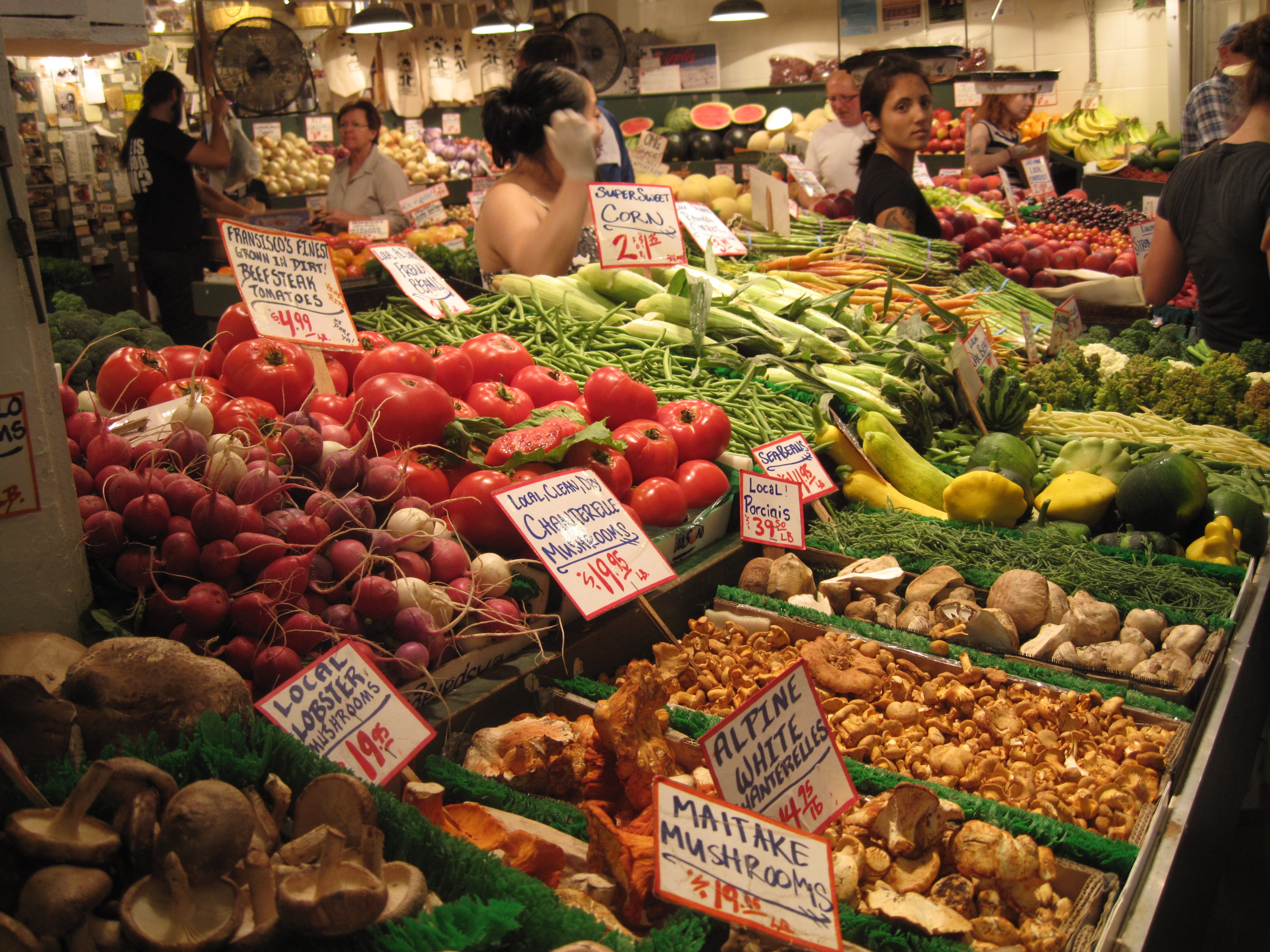
To score one point for vegetables, you must eat at least 250 grams (about 9 ounces) of vegetables per day. We count based on the raw food. So two medium carrots are about 6 ounces or 170 grams. Have a salad filled with chopped vegetables, and you’ve made the nine ounces.
Not just lettuce. Tomatoes, peppers, carrots, broccoli, greens, eggplant, onions, squash — whatever vegetables you actually enjoy enough to eat repeatedly.
2. Legumes
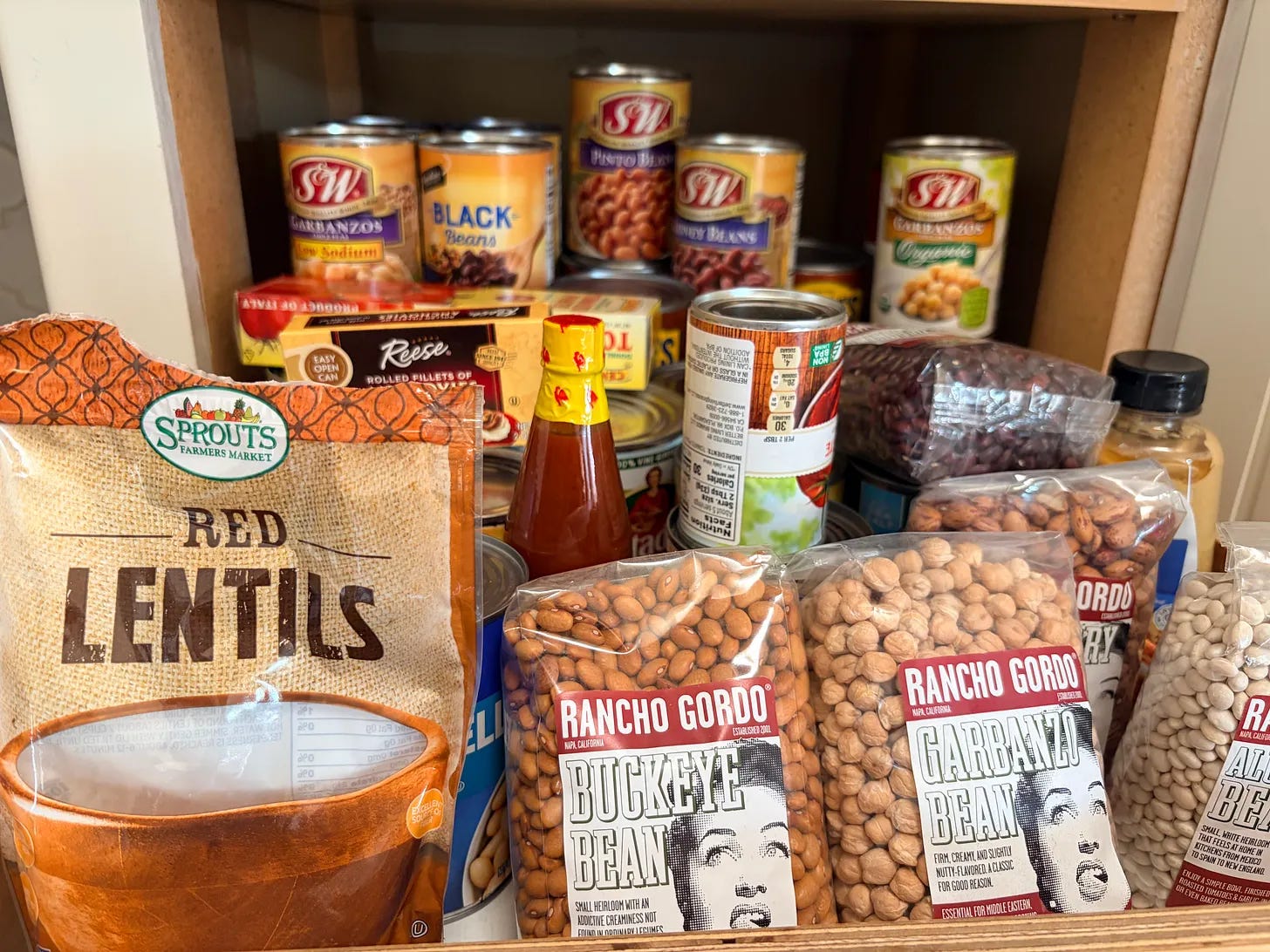
I have fallen in love with beans lately. Simple bean dishes are so easy to make from canned beans (recipe below). Adding beans or making them the center provides protein with fiber and low saturated fat. Some of my favorite beans come from Rancho Gordo.
To get a point, you need two ounces of legumes a day. By the way, peanuts are a legume, so a serving of peanut butter might count. No, Reese’s might not be the best source, but hey.
Beans, lentils, chickpeas and peas.
They bring fiber, protein, minerals and remarkable versatility. And no, they don’t have to come from Greece. Dal fits beautifully. So do black beans.
3. Fruit and Nuts
Fruit is food, not candy. Yes the low carb people think fruit is horrific, even though the data shows the opposite.
This is another 9 ounces (250 grams) to make a point. Not difficult to do. An apple is about 5 ounces. Twenty grapes is about 100 grams. And I love having frozen grapes for dessert.
Add nuts and you get another source of fiber, unsaturated fats and protein. You don’t need exotic berries harvested under a full moon.
4. Whole Grains and Cereals
To get one point, you need nine ounces, but how do you get that?
What is a serving of whole grains? It seems confusing, especially since some products are a mix of both whole and refined grains. In the Mediterranean Diet, you might notice 9 ounces, but is that grain when it is dry or wet or both? So it turns out there is a whole grain council that has done the work for you, and they tell you right on the package. See the symbol below.
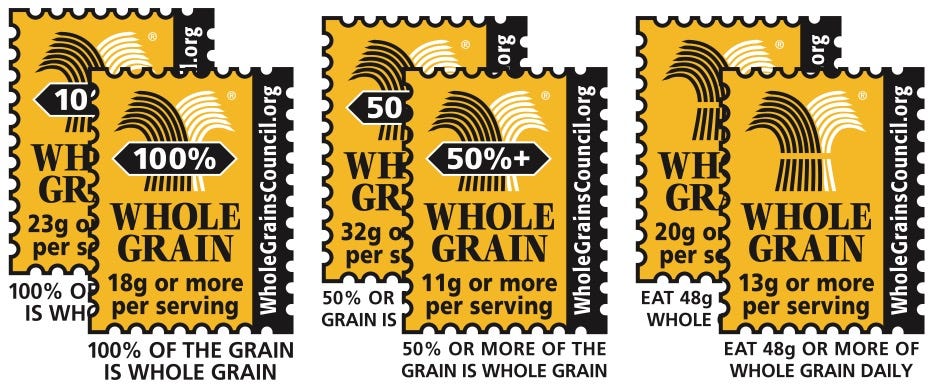
This makes your math simple. You either need three stickers of the 100% whole grain or six of the other stickers.
Ways to incorporate whole grains. Use whole grain pasta, whole grain breads, popcorn is a whole grain, and overnight oats in the morning is a great way to start the day (on my commuter mornings, I sometimes take overnight oats to drink in the car). Whole grain rice works, although it takes a bit longer to cook.
5. Fish and Seafood
Think Sushi! OK, I want sushi
Two servings of fish per week. That might be a tuna fish sandwich one day, and salmon another day. It might also be shellfish, like crab, or maybe a serving of clam chowder.
Allergic to fish and seafood? Well, it is one point you won’t make, but that is just one.
Fish appears regularly in this pattern, particularly in place of some red and processed meat.
6. Dairy
The Mediterranean diet emphasizes fermented dairy products, yogurt and cheese. . To get a point for dairy on the Mediterranean Diet Score, and limit sugar, I like plain Greek yogurt and add fruit (blueberries, strawberries).
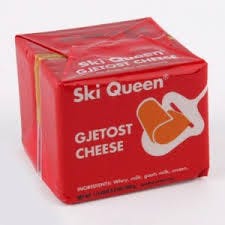
Other fermented products include cheese. My favorite cheese is still the Norwegian goat cheese that I grew up with as a child.
The key with dairy is that there is an upper limit. In this case about 1 cup per day. This allows some modest cheese and yogurt.
I’ve discovered Kefir lately (which I tend to pronounce like my son’s childhood friend but and told I should pronounce it Kah Fear. I am lactose intoleratant and on a GLP-1 this is an easy drink, fermented, and gives me high quality protein on those days when solids don’t go down well.
Dairy is a point on the Mediterranean Diet Score, and more points are not a bad thing. The studies were clear that yogurt and low fat milk had a reduced risk of metabolic syndrome (Babio N, et al. Consumption of Yogurt, Low-Fat Milk, and Other Low-Fat Dairy Products Is Associated with Lower Risk of Metabolic Syndrome Incidence in an Elderly. Mediterranean Population.J Nutr. 2015 Oct;145(10):2308-16. for link click here.)
7. Meat
The Mediterranean diet limits one to about 4 ounces of red meat a day. If you don’t eat red meat, you get a point. Have beans instead of meat, you get a point. Four ounces isn’t that much, but here are two facts for you. Your body will only absorb as much iron as is in 3 ounces of red meat. More will not increase iron absorption (unless you have hemochromatosis). People with hemochromatosis must limit red meat intake. Four ounces is anywhere from 20-35 grams of protein, but probably not your only protein source for the meal.
Red meat has some health disadvantages in large quantities over time. So having other sources of protein seem to work out better.
8. Fats and Oils
One point if most (sixty percent) of your fats come from olive oil. This isn’t difficult, and it is delicious. I like California Olive oils because they have some of the highest purity standards for extra virgin olive oil in the world. You can argue with the taste (I love olive oil from Liguria) but you cannot argue chemistry.
9. Alcohol
If you drink 5 ounces a day of wine, or one beer, or one drink, you get a point. Less you get a point. No alcohol, you get a point. More, you lose the point. No, you cannot store your points for the weekend.
As much as alcohol has had a disappointing result for health, I still have the occasional glass of wine - and I enjoy it.
GLP-1 greatly reduced my desire for alcohol. I used to drink wine with dinner most nights, now I have it on the occasional weekend. It has also made me appreciate some wines more than others.
Some of my Favorite Dishes and Examples of Mediterranean Points
Sometimes you just want examples of how you can get these points. There isn’t an app, but it isn’t that difficult. But incorporating this eating plan into your life has health benefits.
One study showed that higher adherences (five points out of nine per day consistently) led to a 9 percent increase in longevity. Another study of over 1.5 million people showed a 22 percent reduction in cardiovascular disease. Another study showed decreased incidence of cancer.
Hence, health is cusine. Weight loss is chemistry.
Weight loss is the GLP-1 (Ozempic, Zepbound, Retatrutide, etc). We found that. No more dieting. But we want long-term health.
This is where the Mediterranean Diet comes in. You can eat a fish taco and get Med points?
Whole grain taco - 1/4 of a point
Fish - 1 point
Cabbage for crush 1/4 point
Salsa - real good salsa, not the canned red stuff - 1/4-1/2 point
Add beans - 1 point
In one meal you have 2 - 2.5 points .
None of that is traditional Mediterranean, but all of it is great, and that is the point to getting points.
Ok, here are some of my favorites:
