


Why do the first few minutes of a cardiac emergency matter more than anything that happens afterward?
Senator Mitch McConnell reportedly needed CPR.
Since then, everyone seems to have become a neurologist, a cardiologist, or both.
Is he alive, brain dead, on a ventilator, being kept alive by machines? Is he going to recover? Why won’t anyone tell us what’s going on?
Fair questions. They’re questions I’ve been asked all week. They’re questions Katie Couric has asked. They’re questions millions of people are asking online.
Let's talk about them. I'm a physician, and while I don't know exactly what happened to Senator McConnell, I know how physicians think about these situations.
Every episode of my podcast, Fork U, ends the same way. After I’ve finished talking, there’s a brief pause. Then comes the little “Hey Evo” exchange that regular listeners have come to expect.
Then you hear three heartbeats.
Three steady beats.
Then they stop.
A second later comes the long, unmistakable tone...
Beeeeeeeeeeep.
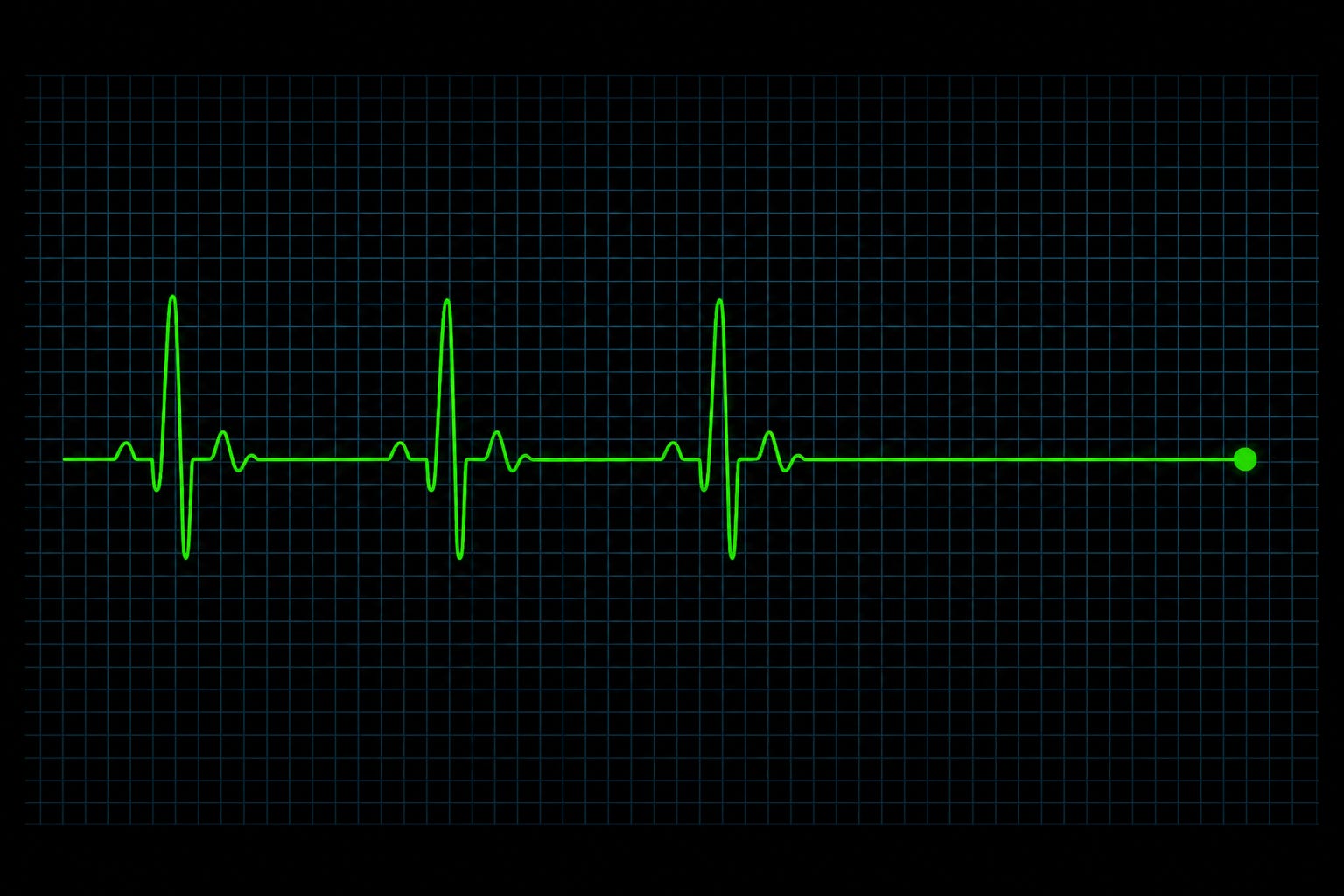
Until this week, it was simply the way we ended the show.
This week it sounded different.
Twenty-five years ago, my brother Jimmy developed crushing chest pain and did exactly what we hope every patient will do. He called 911.
During the ambulance ride to the hospital, his heart went into a lethal rhythm three different times. Three different times, the paramedics shocked him back into a rhythm capable of sustaining life.
I wasn’t in that ambulance.
Years later, I stood beside his hospital bed when I watched the monitor trace his final three heartbeats before the line became perfectly still.
That sound at the end of Fork U isn’t there because it sounds dramatic.
It’s there because I’ve heard it before.
Can Someone Be Brain Dead and Still Be in the Hospital Weeks Later?
One of the first questions I was asked was whether Senator McConnell could be “alive but brain dead.”
The short answer is no.
Brain death is one of the most misunderstood terms in medicine. It isn’t a coma. It isn’t a vegetative state. It isn’t someone who is “mostly gone.” Brain death is the complete and irreversible loss of function of the entire brain, including the brainstem. Under the law and in medicine, brain death is death.
People often become confused because they see a ventilator moving the chest, a heart monitor showing a heartbeat, or warm skin, and assume the person is still alive. Those are understandable observations, but they don’t change the diagnosis. Machines temporarily move air into the lungs or support circulation, but they cannot restore a brain that has permanently ceased functioning.
If Senator McConnell had been declared brain dead shortly after his hospitalization, we would not be discussing his recovery several weeks later. Brain death is not a prolonged medical condition. It is a legal declaration of death.
That means we can move that possibility off the table.
The next question is much more realistic—and much more difficult to answer.
Could he be in a coma? Could he be in a vegetative state? Could he be awake but recovering from brain injury?
Those are very different conditions with very different prognoses, and they deserve their own discussion.
The First Thing We Can Tell You
There is one thing we can tell you, even without knowing exactly what happened to Senator McConnell. If he required CPR, the odds were against him from the moment his heart stopped.
In the United States, only about 10% of people who suffer an out-of-hospital cardiac arrest survive to leave the hospital. If the arrest occurs inside the hospital, where physicians, nurses, monitors, medications, and defibrillators are only seconds away, survival improves to about 24%—better, but still sobering. Among those who survive, roughly one in five is left with a significant neurologic disability, ranging from problems with memory and executive function to weakness, impaired speech, vision loss, or other permanent deficits. Cardiac arrest remains one of the most lethal emergencies in medicine.
But those numbers tell only the beginning of the story. Survival after cardiac arrest isn’t a single event—it is a series of milestones. Someone begins CPR. The heart starts beating again. The patient survives the trip to the hospital, then the first day, then the intensive care unit, then wakes up, and eventually goes home. Each milestone changes the prognosis. Those statistics describe patients at the moment their heart stops—not patients who have already survived the next several hours, days, or weeks. That’s why physicians become more optimistic with each passing day, even though we may still not know the final outcome.
My brother taught me that lesson. During the ambulance ride to the hospital, his heart went into a lethal rhythm three separate times. Three separate times, the paramedics shocked him back. He underwent emergency heart surgery, recovered completely, and never suffered any permanent neurologic injury.
Five years later, metastatic lung cancer took his life. That seems sad, but it isn’t. Those five years mattered. I would not have had them with my brother had he been riding in the front seat of a family car instead of the back of an ambulance.
Cardiac arrest doesn’t just happen to senators. It happens every day, roughly once every few seconds in the United States, to people at home, at work, at church, on golf courses, and in grocery stores. Understanding why some survive—and, more importantly, what you can do to improve those odds—is far more valuable than trying to guess the medical details of Senator McConnell.
If Not Brain Dead, Then What?
That brings us to the next question I see over and over online.
If he isn’t brain dead, then what is he?
The honest answer is that we don’t know. I see people confidently claiming they’ve spoken with Senator McConnell. Others confidently say those reports aren’t true. Some insist he’s recovering. Others insist he’s in a coma. None of us outside his family and medical team knows enough to say.
Could he be in a coma? Yes.
Could he be in a vegetative state or another disorder of consciousness? Yes.
Could he be awake, talking with family, beginning rehabilitation, and simply choosing to keep the details private? That’s also possible.
Those possibilities have different prognoses, but without knowing what happened in those first minutes after CPR, how long his brain was deprived of oxygen, and how he has progressed since then, they’re simply possibilities.
There is also a legitimate tension between a public official’s right to medical privacy and the public’s interest in knowing whether that official can carry out the duties of office. Reasonable people can disagree about where that line should be drawn. Since Senator McConnell has already announced his retirement, and there are no immediate constitutional questions before the Senate, I’ll resist the temptation to join the political speculation.
A few journalists have called to ask what I think is happening. I’ve told them that eventually, one of a few things will become clear. We may learn more because his condition changes or his office decides to release details. We may learn that he recovered, but only after enough time has passed that the political question has largely resolved itself. Or we may hear of his death when that day comes, whether it is related to this hospitalization or not. None of those possibilities allows me to diagnose him today.
That may not produce a satisfying headline, but it is the honest answer. In the meantime, I have something more useful to offer: what cardiac arrest means, why the odds change every day a patient survives, and what you can do to improve those odds for yourself and your family.
What interests me far more is the question that applies to every one of us. Not whether one senior senator will recover. But whether you or someone you love will survive if a heart suddenly stops tomorrow.
Because unlike Senator McConnell, this is about you.
This Is About You
The numbers are staggering. I’d be willing to wager that you know someone who died from sudden cardiac arrest. A family member. A friend. A coworker. Maybe the parent of one of your children’s friends.
Some had no warning at all. Others ignored symptoms they hoped would go away. Some tried to drive themselves to the hospital. And there are people who would have died even if they had collapsed in front of a board-certified cardiologist outside a cardiac operating room. Medicine doesn’t save everyone. But it can dramatically improve the odds.
My brother’s decision to dial 911 saved his life and gave him five more years. It put him in the back of an ambulance, instead of the front seat of a car. When his heart went into a lethal rhythm three separate times, the paramedics were there with a monitor, a defibrillator, medications, and the training to use them. Those first few minutes changed the rest of his life—and mine.
There is a reason you find automated external defibrillators in airports, sports arenas, schools, casinos, shopping malls, and many office buildings. Every minute without CPR and defibrillation reduces the chance of survival. Those devices aren’t decorations. They’re there because someone else’s worst day may become yours.
A few months ago, during a TikTok Live, someone commented she had chest pain. I told her to get off TikTok, call 911, and let me know how she was later. Six weeks afterward, she came back to tell me what happened. She’d been having a heart attack. The ambulance took her directly to the hospital, where she went straight to the cardiac catheterization laboratory and received a stent. She thanked me for saving her life. I didn’t save her life. She did. She listened, picked up the phone, and gave herself a chance instead of becoming another statistic.
So what can you do? Learn CPR. Know where the nearest AED is at work, at your gym, and where you worship. If you’re older or have heart disease, talk with your physician about whether a wearable device, such as an Apple Watch or a Withings watch, might be appropriate. They aren’t a substitute for common sense or emergency medical care, but they may detect certain rhythm abnormalities, recognize a serious fall, or prompt you to seek care sooner. Most importantly, if you think you’re having a heart attack, don’t drive yourself to the hospital. Call 911. Give yourself the same chance my brother gave himself.
But More Important - All Roads Lead to JJ
My brother’s decision to dial 911 saved his life and gave him five more years. Five years may not sound like much until you begin to fill them.
Those were five more birthdays. Five more Christmases. Five more phone calls. Five more chances to laugh at bad jokes and argue about things brothers argue about.
Four years after Jimmy died, I met someone. A little later, despite being at an age when many of my friends became grandparents, we decided to have a child. Long before we knew whether we were having a boy or a girl, the baby already had a name. We didn't know if it was a boy or a girl, but the fetus already had a name: JJ. It stood for Jimmy Junior.
His birth certificate says James George Terry Simpson. We still call him JJ. Except for a brief period in grade school when he wanted to be called James, everyone knows him as JJ—and I mean everyone. (He's a ham, unlike his father.)
Without those paramedics in the back of that ambulance...without CPR...without three shocks...without my brother making one smart decision and dialing 911...
...my son would never have been JJ.
Medicine doesn’t always give us forever. Sometimes it gives us enough time to change generations. And when I look at JJ’s smile, sometimes I see my brother—and I wipe my eyes.
