


The Plateau
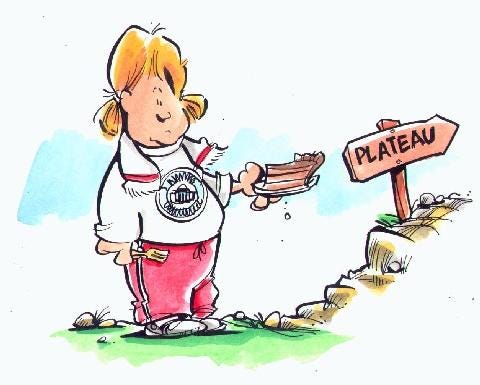
There is a moment that almost every person trying to lose weight encounters. It happens after the excitement of the first few weeks or sometimes months. The scale has been moving steadily down, clothes fit differently, knees hurt less, people start commenting on your appearance, and then one morning you step on the scale and nothing happened.
Or worse, it went up two pounds.
That is the moment panic enters. Patients who were feeling successful suddenly feel as if they failed. They start searching online for metabolic damage, starvation mode, insulin spikes, cortisol surges, hidden carbohydrates, lectins, seed oils, toxic fruit, or whatever the newest nutrition cult is selling this week.
I’ve watched this happen for years as a bariatric surgeon. I watched it after sleeve gastrectomy, after gastric bypass, after lap bands, after medically supervised diets, and now I see it with GLP-1 medications like Zepbound and Wegovy.
And now, being on a GLP-1 myself, I understand the psychology of it even better.
The plateau feels personal. It feels like betrayal. But biologically, plateaus are normal. In fact, they are expected.
Weight loss is not a slide. It is a staircase.
You lose weight, then pause. Lose again, then pause. Those pauses become the landings on the staircase, and the farther down you go, the longer the landings tend to become. Early weight loss often includes glycogen depletion and water loss, especially when appetite changes dramatically. Later, some glycogen and water return. One salty dinner, alcohol, poor sleep, travel, constipation, or simply eating later than usual can move the scale several pounds overnight.
Glycogen is a way to store energy in your muscles that is more readily available than fat. If you look at glycogen, it is simply one molecule of glucose strung to another. Your body can break this down quickly to get the fast energy it needs for almost anything. You store this in your liver, your muscles, and your heart. When you first lose weight and your body needs energy, it breaks down glycogen. With gram of glycogen, you break down, and you also lose slightly more of that in water, as the glycogen is stored in water. This is why you get fast weight loss on low-carb diets. It isn’t fat, it is breaking down glycogen.
That is not fat.
The human body is not gaining three pounds of fat because you had sushi on Saturday. But if you had a lot of soy sauce with the sushi, that extra salt doesn’t just urinate away overnight.
I wish more people understood this, because modern diet culture has convinced people that every fluctuation is either virtue or failure. It isn’t. It is physiology.
This is why I like regular weigh-ins. Daily or weekly is fine if you understand what you are looking at. I personally use a Withings scale, because I like watching trends in fat mass and lean mass, rather than obsessing over a single number. If body weight stays stable, but muscle mass improves while fat mass decreases, that is a victory. If you are walking farther, climbing stairs easier, sleeping better, or fitting into smaller clothes, those count too.
The scale is a tool. It is not a morality test.
What I have learned over the years is that the biggest issue during a plateau is usually not what people are eating.
It is how they are eating.
One of the clearest signs a GLP-1 dose may need adjustment is speed. How fast are you eating? I do not mean compared to a competitive eater. I mean compared to a normal human sitting at a table. Patients often tell me their medication stopped working, and then I watch them finish an entire meal in under ten minutes.
That is not medication failure. That is outrunning your biology.
GLP-1 medications help slow gastric emptying and amplify satiety signals, but those signals are not instantaneous. If you eat rapidly, you can overshoot fullness before your brain catches up. You can overwhelm the system.
And this is where I have learned something important both from patients and myself: if the medication tells you to stop, people stop. But if the medicine isn’t having an effect on people tend to stop when the plate is empty, rather than hearing that simple signal in the brain.
People often say, “I felt full, but I kept eating.”
That sentence contains the entire problem.
The best part of food is the first or second bite. You get the flavor, the texture, the little reward of a new bite. But after that you are either eating to feel “full” or until it runs out.
With GLP-1, after that first bite, the food becomes less interesting, less rewarding, so stopping sooner is pretty easy. But if that food tastes great you can eat past where a GLP-1 medicine tells you to “slow down and walk away.” If food is becoming less interesting, if the urge to continue fades, if you feel pressure, fullness, or simply loss of desire for the next bite, then the medication is working. The mistake is treating fullness as a suggestion instead of an endpoint.
You do not have to finish the plate, because the restaurant gave you too much food. You do not have to “get your money’s worth.” You do not have to clean your plate because of some childhood guilt left over from another generation.
First Box it Up. Then Eat less. Walk away. Box it up.
You can always return later.
Most of the time, you won’t.
One of the biggest mistakes people make during plateaus is falling back into all-or-none thinking. One high-calorie meal becomes “I blew it.” One weekend away becomes “I’m off the wagon.” Then suddenly a temporary fluctuation becomes a month-long spiral because shame entered the equation.
I try to teach patients to stop moralizing food. Dessert is not evil. Rice is not poison. Bread is not a biochemical assassination attempt.
Asians eat rice.
Italians eat pasta.
Mediterranean cultures eat bread with olive oil, and still historically had far lower obesity rates than modern America.
Meanwhile, I watch people order giant steaks dripping in butter, while fearing a side of risotto because someone on social media told them carbohydrates are the problem.
Calories still matter. Portions still matter. Hyperpalatable foods still matter.
And perhaps most importantly, food environments matter.
The average restaurant meal today is essentially three meals, pretending to be one. Soft textures, endless chips, sugary drinks, giant portions, engineered foods that barely trigger satiety — we created an environment that disconnects people from fullness. GLP-1 medications help restore the volume on satiety signals, but they do not magically change the environment around you.
Contrary to some myths, GLP-1 will not force you to stop, if it does, you’ve really eaten too much. But it will give you a soft signal. But setting yourself up for success means, when you go out, box up a bit of food before you start.
I can eat the 600 calorie burger, it is delicious. But if I eat half, then I am just as satisfied and if not, I can eat more. This is an old “diet” trick, but in this case it is more. Because if you keep thinking about that burger, or really feel the urge to eat the rest - you need to up the dose of your GLP-1. Remember you can feel “full” on a GLP-1 and still eat more. The GLP-1 is not your mom telling you to stop eating (and that never worked either).
Grazing: The Quiet Way Calories Sneak Back In
One of the reasons people plateau on GLP-1s is not giant meals.
It is grazing. Mindless eating. Unconscious bites. A handful here. A few chips there. Finishing the kids’ fries. Walking through the kitchen and grabbing something because it is there.
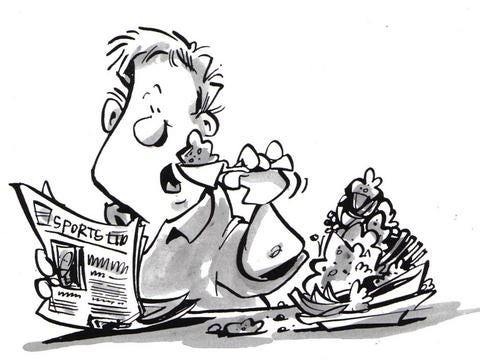
The problem with grazing is that it often bypasses awareness. You never feel like you “ate a lot,” because there was never a formal meal attached. There was no plate, no pause, no decision point. Just continuous low-level eating throughout the day.
Bariatric surgeons learned this years ago. Patients could sometimes eat around surgery by constantly grazing soft foods. Tiny amounts at a time still add up if there is never a stopping point.
GLP-1s help with this, but they do not completely eliminate it.
And this is where mindfulness actually matters. Not mindfulness as some wellness cliché. Mindfulness as paying attention.
The medication gives many people something they have not had in years: enough quiet around food to actually notice what they are doing.Use that.
If you sit in front of the television with snacks and scroll your phone while half-reading emails, you can still eat far beyond what you intended, because your brain never fully registered the experience.
Eating becomes background noise.
So one of the most powerful things you can do is surprisingly simple:
When you eat, just eat. Put the phone away - a rule in the Simpson house. My 15 year old son would love to keep his phone on and text his buddies. But instead phones are not allowed. Not at the table. Family time to catch up.
Turn off the endless scrolling. Stop reading. Pay attention to the conversation if you are with people.
Pay attention to the taste if you are alone. Notice the bites. Even if it isn’t a Michelin Star restaurant, you can and should strive to enjoy food.
Notice when the excitement of the first few bites fades. That is important, because most pleasure from food occurs early. After that, many people are simply eating out of momentum.
Slow down enough to notice when satisfaction appears before fullness.
That distinction matters.
One of the hidden gifts of GLP-1 medications is that they can help people rediscover the experience of eating instead of consuming food mechanically. Taste becomes more important than volume. A few good bites become more satisfying than endless quantity.
That is why many patients naturally drift toward foods with stronger flavor, texture, freshness, and balance. They stop chasing sheer volume and start appreciating quality.
And honestly, that may be one of the healthiest psychological shifts these medications create.
You still have to participate.
Now, after years of doing this, people often ask me what diet I recommend. The funny thing is that I usually end up moving people toward a Mediterranean style of eating, without ever calling it Mediterranean.
I do not hand people a laminated Mediterranean Diet pyramid and tell them to memorize it.
Instead, I say simpler things.
Eat something green every day.
That’s it. Something green. A salad, broccoli, asparagus, green beans, spinach, zucchini, Brussels sprouts, herbs, avocado, whatever works for you. Green foods tend to slow you down, fill space in the stomach, provide fiber, micronutrients, texture, and satiety. They also crowd out some of the ultra-processed foods that dominate modern eating.
Yes, everyone online screams “more protein” and “more fiber,” and they are not entirely wrong. Protein matters. Fiber matters. But people often hear those messages as supplements, powders, bars, or strange engineered foods.
I would rather people start by learning to eat actual meals again.
Meals with vegetables. And yes, sometimes I have to hide them from myself.
Meals with beans. Once you start cooking with beans and chickpeas and lentils you find a great source of satisfying meals that have a lot of fiber.
Meals with fish occasionally.
Meals where olive oil appears more often than industrial sauces.
Meals where dessert is enjoyed but not worshipped.
The goal is not perfection.
The goal is normal.
Food Noise or Head Hunger is Real and Persistent Nagging
And perhaps the most important thing I have learned from being on a GLP-1 myself is understanding food noise. Before these medications, many people lived with constant mental chatter about food and assumed that was normal. Thinking about the next meal while eating the current one. Opening the refrigerator repeatedly. Negotiating with yourself about snacks. Seeing dessert menus before the entrée arrives. Watching television while mentally inventorying the pantry.
Then the medication works, and suddenly patients say something fascinating:
“The noise got quiet.”
That may be one of the most profound effects of these medications.
This is why I do not love obsessive food tracking during plateaus. Tracking every calorie often becomes old diet behavior. It shifts people back into punishment instead of awareness.
What I care about more is whether the noise is returning.
Are you thinking about food all day again?
Are desserts becoming mentally louder?
Are grocery cravings returning?
Are you opening delivery apps at night?
Are you bargaining with yourself constantly?
For me personally, one clue is embarrassingly simple: when I start thinking about ice cream more often, and suddenly it appears on the grocery list again, I know the medication effect may be fading. Last time I skipped a dose of Zepbound, and in my freezer there were a selection of Dove bars and Ice Cream sandwiches. No idea where they came from, they magically appear when my Zepbound wears off. What is odd is that as magically as they appear, my brain knows they are there, and in a day I can have three of them just because they are there. With my dose of Zepbound, I know they are there, but they don’t call to me.
That is useful information.
Not failure.
Not weakness.
Information.
To Up the Dose or Not?
And sometimes the answer is not necessarily a huge dose increase. Some people simply metabolize these medications differently and notice the medication wearing off before the next injection. By day six, food becomes louder, hunger increases, and grazing returns.
In some patients, taking the medication every six days instead of every seven may smooth out those fluctuations — under the guidance of their physician.
But even then, the medication remains a tool, not a replacement for awareness.
That has been true in bariatric surgery for decades. Surgery works well, but patients can still eat past restriction. They can graze around the operation. They can override fullness. The patients who do best long-term are rarely the most obsessive or rigid. They are usually the ones who learn to recognize the moment they have had enough and consistently stop there.
The same is true with GLP-1s.
The greatest skill in weight loss is not calorie counting. It is not avoiding carbohydrates. It is not buying expensive supplements from influencers with suspiciously perfect lighting and absolutely no endocrinology training.
The real skill is learning to stop when your body says:
“That’s enough.”
GLP-1 medications help people hear that signal.
Weight loss surgery amplifies it.
But neither can force you to respect it.
That part still belongs to you.
And honestly, after years of treating obesity, performing surgery, studying nutrition, and now living with these medications myself, I think that is where long-term success actually lives — not in perfection, not in punishment, and certainly not in fear of food, but in finally learning how to hear your body without all the noise drowning it out.
Those who say this is about willpower have never had that constant brain loop. And once that noise is quieter, or quieter, it is easy to make some better choices.
